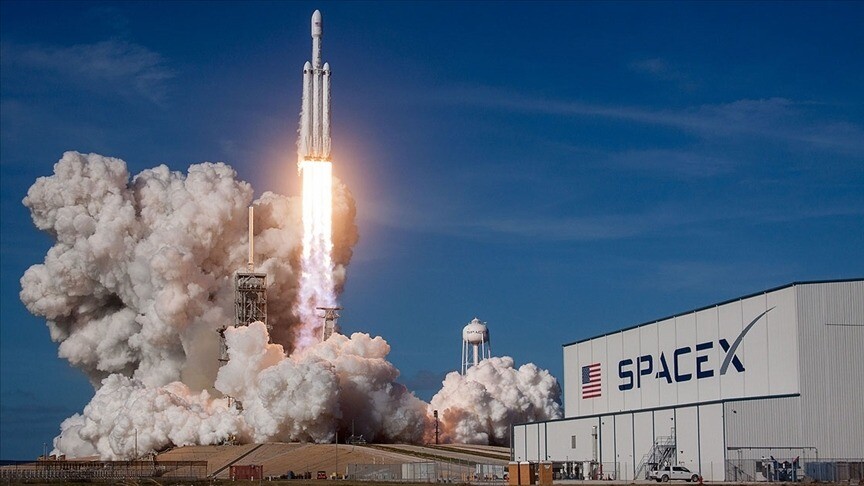
- Investors are betting on satellite internet, artificial intelligence, future space infrastructure despite ongoing losses
- Analysts remain divided on whether the company's nearly $1.8T valuation can be justified
SpaceX is preparing for what is expected to become the largest initial public offering (IPO) in history, seeking to raise $75 billion at a valuation of nearly $1.8 trillion.
The offering would instantly place Elon Musk's company among the world's most valuable firms, despite annual revenues of less than $20 billion and continued heavy losses as it pours money into artificial intelligence, satellite infrastructure and next-generation space technology.
The planned listing would surpass the current IPO record of $29.4 billion raised by Saudi Aramco in 2019 and has sparked debate among analysts over what exactly investors are buying and whether the valuation can be justified.
Supporters point to SpaceX's dominant position in rocket launches, the rapid growth of its Starlink satellite internet business and the company's expanding ambitions in artificial intelligence.
Critics argue the valuation relies heavily on future projects that remain years from commercialization.
More than a rocket company
Founded by Musk in 2002 with the goal of making humanity a multiplanetary species, SpaceX has evolved far beyond its origins as a launch provider.
Today, its business spans rocket launches, satellite communications, national security contracts and broadband internet through Starlink, which has become one of the company's fastest-growing operations.
Earlier this year, SpaceX absorbed Musk's artificial intelligence company xAI, which owns the social media platform X and has invested billions of dollars in developing the Grok large language model.
Rather than valuing the company solely as an aerospace firm, many investors now see it as a technology company operating at the intersection of artificial intelligence, communications and space infrastructure.
The company has also outlined plans involving future AI infrastructure in orbit, including putting data centers in space, launched aboard its next-generation Starship rockets.
According to its IPO filing, SpaceX estimates its total addressable market at $28.5 trillion – a figure that includes launch services, satellite communications, artificial intelligence infrastructure and other future businesses.
The estimate exceeds the current size of the entire US economy.
IPO structure breaks with convention
The offering itself has attracted attention for departing from several traditional Wall Street practices.
SpaceX has reportedly considered reserving up to 30% of its IPO shares for retail investors, potentially allowing them to buy more than $20 billion worth of stock before the company’s Nasdaq debut. Such allocations are uncommon in IPOs of this scale, which are typically dominated by institutional investors.
The move reflects Musk's longstanding popularity among retail investors, many of whom helped fuel Tesla’s rise on Wall Street.
SpaceX also broke with convention by setting a fixed IPO price of $135 per share, rather than offering investors a pricing range that could be adjusted after its roadshow.
Traditionally, companies use investor feedback gathered during roadshows to determine a final IPO price. By announcing a fixed target from the outset, SpaceX has effectively turned the process into a test of whether demand is strong enough to support its valuation.
Analysts say those decisions reflect confidence that investor demand will remain strong despite the company's lofty valuation.
The offering also aims to capitalize on a new Nasdaq rule that could allow SpaceX to be added to the Nasdaq-100 index after 15 days of trading, rather than the previous requirement of several months, potentially creating additional demand from funds that track the benchmark.
Investors betting on future growth
Jay R. Ritter, director of the IPO Initiative at the Warrington College of Business at the University of Florida, said investors are valuing SpaceX primarily on future opportunities rather than current earnings.
"With SpaceX, Anthropic, and OpenAI, the valuations are based on the future, not the past," Ritter told Anadolu, referring to other upcoming IPOs in the AI space.
"These companies are spending massive amounts now because there are massive economies of scale and very large potential markets."
Ritter argued that SpaceX's technological complexity creates barriers that could limit future competition.
"The Starship rocket is complicated, which is why there will be no competition," he said.
He said lower launch costs could allow the company to dramatically expand Starlink's global reach while supporting entirely new businesses that do not yet exist today.
Ritter also dismissed concerns that the IPO would absorb significant liquidity from financial markets.
The $75 billion offering represents only a small fraction of total US stock market capitalization, while daily trading volumes and corporate cash distributions remain far larger, he said.
"There is very little money that focuses on aerospace alone, so the funds to buy SpaceX stock will come from other sources," Ritter added.
Skeptics question valuation
Not all analysts are convinced the company's target valuation is realistic.
Investment research firm Morningstar recently estimated SpaceX's fair value at roughly $63 per share, less than half the planned IPO price of $135.
Analysts there argued that even optimistic assumptions require investors to believe SpaceX can solve engineering challenges that remain unresolved, including the development of rapidly reusable Starship rockets and the successful commercialization of orbital data centers. Morningstar assigned only a 7% probability to that scenario.
Its base-case scenario assumes SpaceX successfully develops viable orbital computing capabilities but on a more limited scale, producing a valuation significantly below the planned offering price.
Morningstar said it expects Starlink to remain the company's primary revenue driver, but noted that SpaceX's registration statement identifies a combined $1.6 trillion total addressable market for its mobile and broadband services – roughly equivalent to current global spending on those services outside Russia and China.
The firm was more cautious about the company's AI ambitions, warning that the newly acquired xAI business "poses a material threat of value destruction to the company."
Morningstar argued that many of the assumptions underpinning SpaceX's AI strategy remain unproven, including the commercial viability of orbital data centers. It also noted that Grok has yet to demonstrate a significant advantage over rival AI models and that X's revenue has declined by around 50% since Musk's takeover.
“The company faces substantial risks related to strategic execution, technological evolution, market dynamics, regulations, AI buildout and key-person dependency,” Morningstar said.
Despite acknowledging strong investor enthusiasm for AI-related companies, Morningstar said long-term investors "eager to participate in SpaceX's future endeavors and potential success will have opportunities to do so with more margin of safety than the initial offering is likely to provide."
Musk, however, pushed back against some of the skepticism surrounding the company's plans for orbital data centers during a video discussion released by SpaceX on Monday.
"Part of what we want to convey here is that there is not some magic that is necessary," he said.
"A lot of this is technology we've already made for the Starlink V3 satellites. We don't think this is a super hard problem compared to the things we already do."
* Writing and contributions by Alyssa McMurty
news_share_descriptionsubscription_contact