Beyza Binnur Donmez
31 July 2026•Update: 31 July 2026
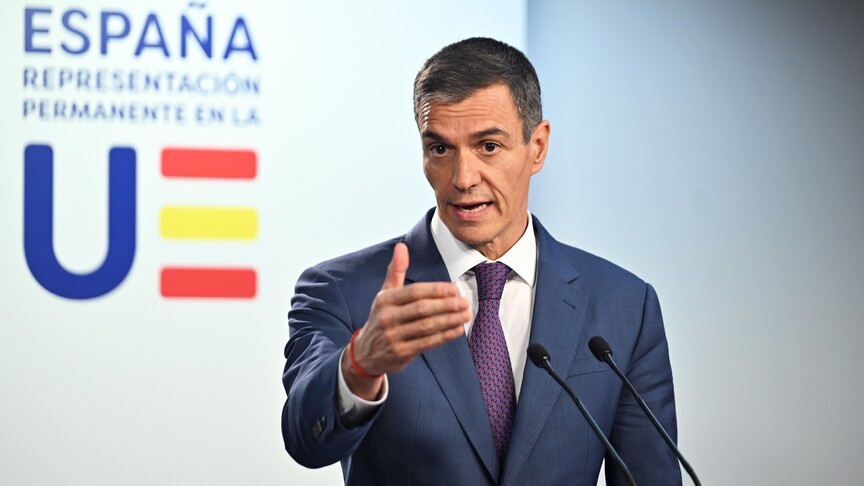
Spanish Prime Minister Pedro Sanchez on Friday described the mass influx of migrants into the Spanish enclave of Ceuta as "an attack" and "a violation of Spain's territorial integrity," while pledging to restore normality "as soon as possible."
Speaking in Ceuta, Sanchez said the government stands with residents following the migrant influx, calling the situation an unprecedented disruption to a broader trend of declining irregular migration.
"What happened yesterday deserves all our reproach, all our condemnation at the strongest possible level of rejection and condemnation of the violation and attack on the territorial integrity of a Spanish city such as Ceuta," he said.
Sanchez said Spain is expediting the processing of migrant files and repatriations for those who entered Ceuta irregularly, adding that "many of these migrants are already leaving."
He said the government's asylum commission had met on an urgent basis to facilitate expulsion procedures.
He also pledged to mobilize "all state resources" to restore normality in Ceuta "as soon as possible," saying defending security and coexistence in the city is an "urgent" matter.
According to Sanchez, the criminal smuggling networks exploited a recent Supreme Court ruling on border returns, spreading misleading interpretations through social media that triggered the mass movement toward Ceuta.
The ruling found that migrants intercepted at sea while attempting to reach Ceuta or Melilla, Spain's other North African enclave, cannot be immediately returned to Morocco.
He said the government plans to install floating buoys near the breakwater to create a visible physical barrier.
The prime minister also said the government would examine whether legislative changes are needed to make border returns more effective.
Sanchez also said Spain is coordinating closely with Morocco to accelerate repatriations and combat human trafficking networks, while expressing regret over deaths that occurred during the crisis.
Over 37,500 of migrants returned
Spain's Interior Ministry said, according to EFE, more than 37,500 of the roughly 50,000 migrants who entered Ceuta irregularly since Thursday had already returned to Morocco by 3.30 pm (1330 GMT) local time Friday, increasing the previous trajectory of 25.000.
The agency previously reported that the departures are likely to increase throughout the day, with departures continuing at a pace of about 150 people per minute.
According to EFE, many migrants began returning voluntarily after realizing they would not be able to regularize their status in Spain, although smaller groups continued attempting to reach Ceuta by sea and via the breakwater.
It also reported that Moroccan police were clashing with groups of youths near the border, while at least 43 people have died in the migration crisis, according to Spanish authorities.
EU pledges continued support to Spain amid 'unacceptable' situation
European Commissioner for Internal Affairs and Migration Magnus Brunner also said that the situation in Ceuta is "unacceptable," pledging continued EU support for Spain in managing the bloc's external border.
In a statement posted on X, Brunner said he remains in close contact with the Spanish authorities as the situation continues to evolve.
“I reiterate that there are no onward movements towards the European continent or other Member States. The Schengen Borders Code provides for special rules that apply to Ceuta and Melilla. Border checks on persons departing from Ceuta and Melilla remain in force,” he said.
He welcomed what he described as close cooperation between Spain and Morocco in managing the situation and ensuring the swift return of migrants.
Brunner said the European Commission will continue working with Spanish authorities to make effective use of the instruments available under the EU's new Migration and Asylum Pact and provide additional support through EU agencies.
He added that he is prepared to travel to affected areas if necessary, emphasizing that the EU's immediate priority is to support Spain in protecting and managing the bloc's external border in an effective and orderly manner.