Anadolu Ajansı © 2026


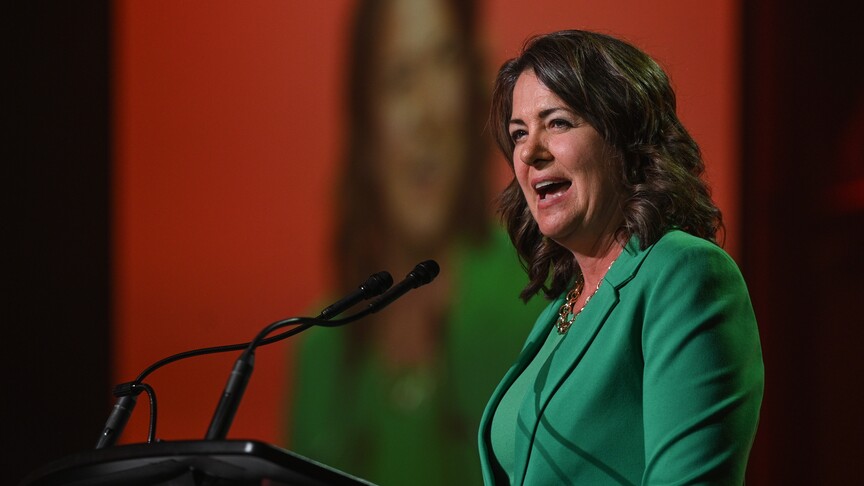
Canada is facing renewed debate over national unity after Alberta announced plans to hold a referendum in October on whether the province should begin a legal process that could eventually lead to a vote on separation from the country.
The proposal, put forward by conservative Alberta Premier Danielle Smith, has intensified long-standing tensions between the western province and Ottawa, while raising constitutional questions about whether any province can leave Canada under the country's legal framework.
The referendum question would not directly ask Albertans whether they want independence. Instead, voters would be asked whether the province should begin the constitutional process that could eventually lead to a future binding referendum on separation.
At a news conference last week, Prime Minister Mark Carney warned that separatist campaigns could become a “dangerous bluff,” saying he had seen firsthand in the UK how similar political processes escalated during Brexit.
“They’re still, 10 years later, trying to undo what people didn’t think they were voting for,” said Carney, who was the UK’s central bank governor during the 2016 Brexit campaign.
He also argued there remained “a very strong positive case … for a strong Alberta in a united Canada.”
Despite the renewed political attention, recent polling suggests most Albertans still oppose separation.
A survey by the Angus Reid Institute found that 60% of respondents would vote against beginning a separation process, while 35% supported it.
When asked more directly whether Alberta should remain in Canada or leave, support for remaining rose to 67%, compared to 30% in favor of independence.
Unlike Quebec separatism, which centered largely on language and identity, Alberta’s sovereignty movement has been driven primarily by disputes over energy policy, environmental regulation, and relations with Ottawa.
Alberta, a landlocked province with the US border to the south, holds the world’s fourth-largest proven oil reserves, and many residents argue that federal climate policies and environmental regulations have constrained the province’s economic potential.
Tensions between Alberta and Ottawa have intensified repeatedly over pipelines, carbon pricing, and energy development.
Separatist sentiment also gained momentum during the COVID-19 pandemic, when Alberta became a center for anti-government protests opposing lockdowns, masks, and vaccine mandates.
Analysts say the movement has increasingly drawn inspiration from US-style populist politics focused on energy nationalism, opposition to climate regulations, and distrust of federal institutions.
Support for a referendum is strongest among older male voters living outside Alberta’s major cities of Calgary and Edmonton, according to the Angus Reid survey.
Smith has insisted she personally supports Alberta remaining in Canada, but said her government could not ignore growing public pressure for a vote.
In a televised address, she said roughly 700,000 Albertans had signed petitions connected to the issue. The province’s population sits at just over 5 million.
She defended moving forward with the referendum despite legal controversy surrounding one separatist petition initiative that courts found unconstitutional because of inadequate consultation with Indigenous communities.
“I, as premier, will not have a legal mistake by a single judge silence the voices of hundreds of thousands of Albertans,” she said.
While the decision has been slammed by Alberta’s opposition parties, some separatist activists have also criticized Smith for not holding a direct referendum on independence itself.
Jeffrey Rath, a pro-separatist lawyer from Alberta, sharply criticized Smith's handling of the referendum process, accusing her of breaking a promise to voters by avoiding a direct independence vote.
In a post on the US social media platform X, he claimed Smith had agreed with Carney that there would be no vote on independence this year, allegedly as part of a deal to secure a pipeline project to Asia.
Nearly 65% of supporters of Smith’s United Conservative Party are in favor of the vote, whereas 90% of previous voters of the main opposition party, the left-wing New Democratic Party, are against beginning the process of a referendum, according to the Angus Reid poll.
Constitutional experts say Alberta cannot unilaterally leave Canada under existing law.
Emmett Macfarlane, a political science professor at the University of Waterloo, said the issue is governed largely by the Supreme Court of Canada’s 1998 Quebec Secession Reference.
The ruling, he said, determined that if a clear majority supported separation in response to a clear referendum question, the federal government and provinces would be obligated to negotiate.
“But even under those circumstances, such a negotiation would not necessarily result in secession," he told Anadolu.
Any separation process would also require constitutional amendments involving Canada's Parliament and provincial governments, he said, adding that Indigenous treaty rights would become central to any negotiations.
"No government at any level would be free to negotiate secession absent intensive consultations with affected Indigenous nations, and likely could not affect secession absent their consent," he said.
Indigenous leaders in Alberta have also strongly criticized the referendum push, arguing that treaty rights cannot be overridden by a provincial vote.
Grand Chief Trevor Mercredi of Treaty 8 First Nations of Alberta called renewed separatist rhetoric “dangerous, unconstitutional and deeply disrespectful to the Treaty relationship.”
Treaty 8, signed in 1899 before Alberta became a province, covers a vast region across northern Alberta and neighboring provinces and territories.
"Any discussion about Alberta's future must recognize that treaty nations are not stakeholders in this issue. We are treaty partners," Mercredi told Anadolu.
"Despite that, the current provincial government continues to give oxygen to separation politics instead of respecting the rule of law, the courts and the constitutional rights of First Nations," he said.
He stressed that the issue extends beyond Alberta's borders as a challenge to Canada’s constitutional order.
"Our concern is simple. Treaty rights cannot be voted away by the province of Alberta," he said.
Analysts say even if Albertans vote to begin a separation process, the referendum would not trigger independence itself but instead open a politically and legally complex period of negotiations.
Macfarlane described Alberta separation as “not a very realistic constitutional prospect.”
Even so, some businesses and economists say even just the proposal for a referendum has already prompted concern from investors.
“I’m always of the view that anything that introduces an element of uncertainty to business in the province is not what we need at any time, and especially not now,” Deborah Yedlin, CEO of the Calgary Chamber of Commerce, told the Calgary Herald.
The economic consequences of separation also remain highly uncertain.
Carney warned that leaving Canada could jeopardize Alberta’s access to Canadian and international trade arrangements.
“Being part of Canada brings many economic advantages,” Carney told reporters in Ottawa. “Being part of our large market, being part of free trade agreements with one and a half billion people around the world.”
The debate has nevertheless exposed widening political frustrations inside Alberta and growing polarization over Canada’s future direction.
While separatist sentiment remains a minority position, analysts say the referendum debate reflects deeper divisions over energy policy, federal authority and national identity that are unlikely to disappear soon.
The campaign ahead of the October 19 vote is expected to dominate political debate in Alberta, with separatist groups, federalist voices and Indigenous leaders all seeking to shape the province’s future.
“It is the battle of our lives,” said Alberta opposition leader Naheed Nenshi at a recent rally. “We will do everything we can, we will use every ounce of energy we have to say we are Canadian and we will always be Canadian.”
news_share_descriptionsubscription_contact

contact_the_ombudsman
is_there_an_error_in_this_story