
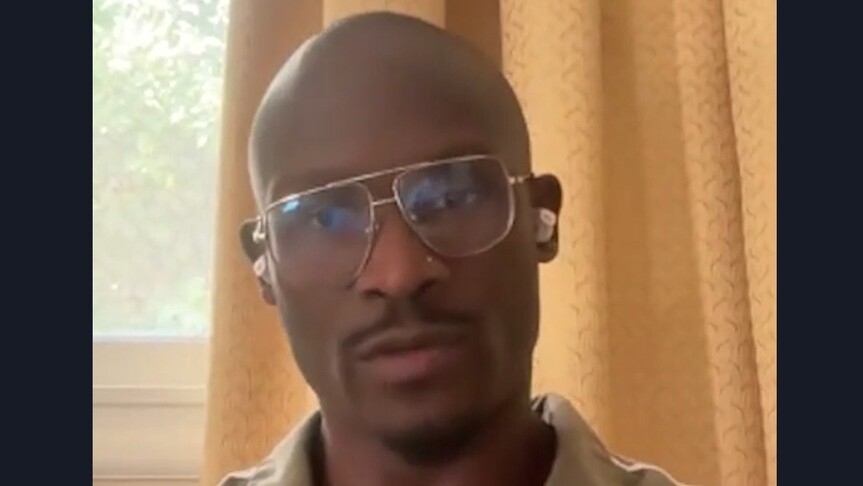
Cornell University has told two graduate students, who left the US over fears of immigration detention linked to pro-Palestinian activism, to return to teach or risk losing their funding, a move one described as "politically motivated."
The move has put the students in a difficult position: return to a country where they fear detention, or face the possible loss of financial support for their studies.
One of them, PhD candidate Amandla Thomas-Johnson, told Anadolu that Cornell knew he could not safely return when it offered him a teaching position.
Thomas-Johnson, who left the US in April 2025 amid concerns over Immigration and Customs Enforcement (ICE) scrutiny, said the university's offer was effectively an ultimatum designed to undermine its obligation to fund him and fellow graduate student Momodou Taal.
The university’s demand was first reported by The Intercept on Friday.
Thomas-Johnson is a dual British and Trinidad and Tobago citizen and previously worked as a reporter before becoming a PhD student.
Thomas-Johnson's dispute with Cornell began following a September 2024 student-led protest at a campus career fair featuring Boeing and L3Harris, companies protesters accused of supplying weapons to Israel amid its ongoing war on Gaza. Cornell suspended him in the weeks that followed.
He said the suspension was eventually lifted, but his concerns intensified after President Donald Trump returned to office in January 2025.
The Cornell student said he went into hiding for about four months after ICE officers arrived in Ithaca, NY, where Cornell is located.
He said he eventually left the US in April 2025 after “ICE was stationed" outside his house "at one point” on Cornell's campus, and one of his friends was detained at an airport and questioned about his whereabouts.
He subsequently crossed into Canada and later traveled to Switzerland, where he stayed for about three months. He has since lived in Ghana, Senegal, and Egypt, saying he moved between countries largely because of financial constraints and temporary opportunities.
Thomas-Johnson is currently in Cairo, where fellow Cornell graduate student and pro-Palestinian activist Momodou Taal, who was also suspended by Cornell and ordered to report to an ICE office last year, previously lived.
He said they sought safe and affordable places to live, while ruling out the UK over pressure on pro-Palestinian activists.
Thomas-Johnson had previously told Anadolu in March 2025 that he feared deportation or detention over his activism.
“I don't want to be deported or put in Guantanamo,” he said at the time. More than a year later, he said he still cannot safely return to the US.
“I can't come back,” he said, adding that the US government had effectively revoked his visa.
“I don't know if there's a detention order out for me in the US, for example,” he said, adding that for that reason, Cornell's request for him to return to the US to teach was not a realistic option.
Thomas-Johnson is now entering the sixth and final year of his PhD. He said Cornell is contractually obligated, under an agreement with the union representing graduate workers, to fund students for the duration of their doctoral programs.
Cornell University told Anadolu in a statement that “students outside the United States for personal, legal, or visa-related reasons may also receive fellowship support when such funding is available.” However, the university said it is “not permitted to extend assistantship appointments to students residing outside the United States.”
“Because of student privacy obligations, Cornell will not discuss the personal circumstances or educational records of individual students,” the university added.
Cornell also said it remains “deeply committed” to helping international students continue making academic progress when they face visa or travel-related challenges.
After he declined the position, he said, the university argued that he had been offered work but was unwilling to take it, potentially allowing it to stop funding him.
“They're basically trying to get around the obligation to fund myself and to fund Momodou,” he said, referring to fellow Cornell graduate student Momodou Taal.
“Let me be clear, I think that this is politically motivated,” he added.
Thomas-Johnson said he viewed the university's demand as an ultimatum because the choice it presented, return to the US to teach or risk losing his funding, was not, in his view, a genuine choice given his immigration status.
“They've given us an ultimatum, basically,” he said. “And it's an ultimatum that they know isn't really an ultimatum, it's manipulation.”
He said the dispute goes beyond his own case, arguing that other international students who are unable to return to the US because of visa restrictions or changing immigration rules could face similar problems.
“Our struggle is not just about us, it is about those students as well,” he said.
“This is a bigger struggle. It's about labour rights as much as it is about politics.”
Thomas-Johnson also discussed the disclosure of his personal data to US immigration authorities, an episode he detailed in an article published by the Electronic Frontier Foundation (EFF) in April this year.
He said that weeks after arriving in Geneva, Switzerland, he received what initially appeared to be a routine email from Google informing him that the company had already provided his account data to the Department of Homeland Security.
Thomas-Johnson said he initially expected to receive advance notice because fellow Cornell graduate student Momodou Taal had previously been notified by Google and Facebook when authorities sought his data. In Taal's case, law enforcement later withdrew the subpoenas before the companies disclosed the information, according to Thomas-Johnson.
But Google's notification to Thomas-Johnson came after the disclosure had already taken place, he said.
“Google has received and responded to legal process from a law enforcement authority compelling the release of information related to your Google Account,” he recalled the email as saying.
“There was no opportunity to contest it,” he noted.
He said Google's policy generally promises users notice before their data is disclosed in response to legal process, and that none of the stated exceptions applied in Thomas-Johnson's case.
Months later, Thomas-Johnson's lawyer at the EFF obtained the subpoena. According to Thomas-Johnson's account published by the EFF, the request sought subscriber information, including IP addresses, physical addresses, other identifiers, and session times and durations.
Thomas-Johnson said he believed the disclosure could have helped authorities locate him.
“Google gave my data illegally to ICE,” he told Anadolu, clarifying that he had not filed a legal case but was pursuing the issue.
“I feel like Cornell made an example out of me. Google have done so, and so has the US government,” he said.
“These are a few of the most powerful institutions in the world. One in big tech, one in the realm of knowledge and education, and the other, the most powerful government on Earth.”
Thomas-Johnson also pointed to Cornell's ties with Israeli institutions, particularly the Technion, which he described as reflecting “an ideological commitment, a material commitment to Zionism at Cornell.”
“We know that the university has very, very strong ties to Israeli institutions, including Technion,” he said, adding that the institute had “pioneered the use of technology, weapons, weapons of mass destruction on the Palestinian population,” and used that “information and that know-how to then export and sell abroad.”
“And Cornell has been part of that,” he said. “There are academics at Cornell that make weapons for Israel and do research on behalf of the Israeli state.”
Thomas-Johnson said he does not regret participating in pro-Palestinian activism despite the consequences he says he has faced.
“I paid a very little price comparatively to what people in Palestine have paid, and many have paid the ultimate price.”
He said the financial uncertainty may force him to take outside work, but vowed to complete his PhD and continue speaking out.
“I don't plan to give up. I plan to finish my PhD,” he said.
news_share_descriptionsubscription_contact

contact_the_ombudsman
is_there_an_error_in_this_story