Esra Tekin
17 May 2026•Update: 17 May 2026
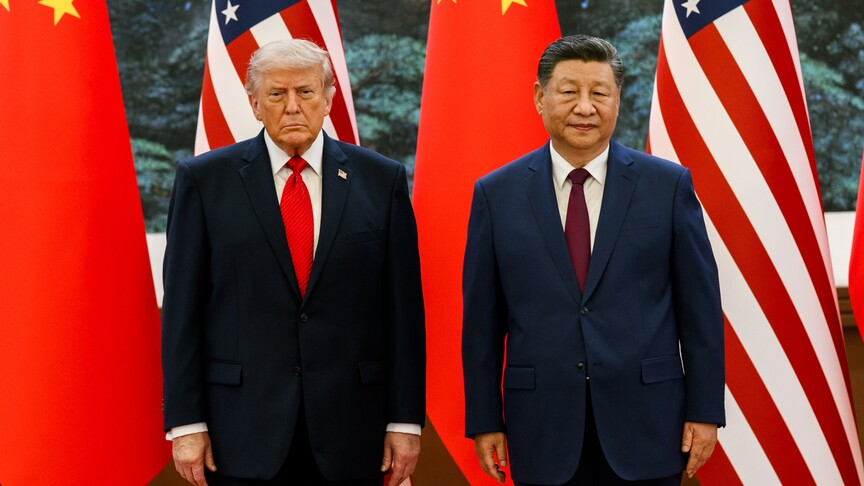
US President Donald Trump and Chinese President Xi Jinping reached a series of agreements this week aimed at stabilizing relations between Washington and Beijing during the first visit by a US president to the People’s Republic of China since 2017, said the White House in a statement.
The two leaders agreed that the US and China should pursue what they described as a constructive relationship based on strategic stability, fairness, and reciprocity, said the statement.
Trump is expected to welcome Xi to Washington this fall, while both governments said they would support each other as hosts of the G20 and APEC summits later this year.
The talks also covered major international security issues.
According to the statement, Trump and Xi agreed that Iran must not obtain a nuclear weapon and called for the reopening of the Strait of Hormuz, saying no country or organization should be allowed to impose tolls there.
The statement said that the two leaders also reaffirmed a shared goal of denuclearizing North Korea.
It added that the agreement established two new bilateral institutions: the US-China Board of Trade and the US-China Board of Investment.
The Board of Trade is intended to help both governments manage trade in non-sensitive goods, while the Board of Investment will serve as a government-to-government forum for investment-related issues.
The statement also outlined several economic commitments from China, including measures related to rare earths and other critical minerals such as yttrium, scandium, neodymium, and indium.
Beijing said it would address US concerns over supply chain shortages and restrictions on rare earth production and processing equipment.
China also approved an initial purchase of 200 Boeing aircraft for Chinese airlines, marking its first commitment to buy American-made Boeing planes since 2017.
The statement also said the agreement would benefit manufacturing jobs in the US.
In agriculture, China committed to purchasing at least $17 billion annually in US agricultural products in 2026, 2027, and 2028, in addition to soybean purchase commitments made in October 2025.
Beijing also restored market access for US beef by renewing expired listings for more than 400 American beef facilities and adding new ones.
China said it would work with US regulators to lift remaining suspensions on US beef facilities, the statement said.
It also resumed poultry imports from US states that the US Department of Agriculture has determined are free of highly pathogenic avian influenza.