
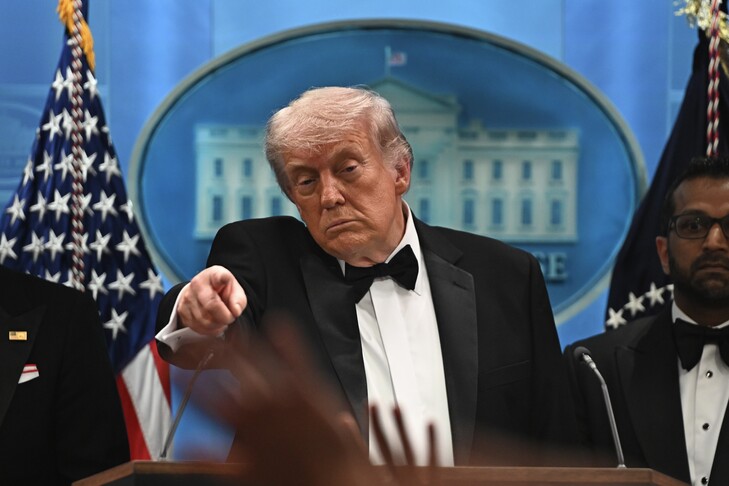
US President Donald Trump’s recent threats to withdraw American troops from Spain have intensified tensions between Washington and Madrid over defense spending, Iran policy and Europe’s role within NATO.
The dispute marks one of the sharpest public confrontations between the NATO allies in years and has fueled broader debate across Europe over whether the continent should reduce its reliance on Washington for defense and security.
Spain hosts some of the US military’s most strategically important facilities in Europe, including the Rota naval base and Moron air base, which support operations across the Mediterranean, North Africa and the Middle East.
But disagreements between the two allies have intensified since Trump returned to office and sharply increased pressure on European governments to raise military spending well beyond NATO’s traditional 2% target.
Spain accelerated defense expenditure to reach 2% of GDP in 2025 -- four years ahead of its original timetable -- but tensions with Washington persisted as NATO’s debate shifted toward significantly higher targets.
At the June 2025 NATO summit, alliance members agreed to move toward a new defense spending target of 5% of GDP by 2035.
Spain, however, publicly pushed back and secured flexibility from NATO after arguing it could meet alliance capability requirements while spending closer to 2.1% of GDP.
Prime Minister Pedro Sanchez argued European security should focus on “spending better” and “spending together” rather than simply spending more.
He also warned that a 5% target would threaten Spain’s welfare model.
Eduard Soler Lecha, associate professor at the Autonomous University of Barcelona, said that disagreements with Washington should not be interpreted as opposition to NATO itself.
“When an ally has needed Spanish support, it has found Spanish support,” he told Anadolu.
Soler Lecha said Madrid’s position reflects both domestic political realities and broader disagreements over alliance priorities.
“It has absolutely nothing to do with a lack of Spanish commitment to European or Atlantic defense, but rather with political disagreements,” he said.
Iran tensions deepen dispute
Tensions escalated further following Spain’s opposition to joint US-Israeli attacks on Iran.
According to reports, frustration grew within parts of the Pentagon after Spain denied the use of the Rota naval base and Moron air base for operations linked to the conflict, while also restricting overflight access tied to military activities in the region.
Trump later threatened Spain with economic consequences.
In remarks at the White House in March, he described Spain as “terrible” and warned Washington could reduce trade ties with Madrid.
“We don't want anything to do with Spain,” Trump told reporters.
Spain, however, maintained its outspoken opposition to involvement in the conflict, reflecting the country’s long-standing anti-war political tradition.
Madrid also largely brushed aside Trump’s threats over trade, noting that trade relations with the US are negotiated at the EU level and have remained largely unaffected despite the political tensions.
Waya Quiviger, a global governance expert at IE University’s Global Policy Center, said the tensions extend beyond disagreements over Iran or defense spending and “are simultaneously domestic, transatlantic and intra-European.”
She told Anadolu that the dispute also reflects a growing European debate over strategic priorities, dependence on the US and whether European governments should automatically align themselves with Washington’s security agenda.
Soler Lecha similarly argued that Madrid’s position reflects resistance to what many in Europe see as increasingly unpredictable US policymaking.
“What Spain is not willing to do is simply operate under a logic of obeying whatever Washington says,” he said.
Spanish Foreign Minister Jose Manuel Albares recently argued Europe must strengthen its own defense capabilities to avoid uncertainty surrounding future US policy decisions.
“We cannot be waking up every morning wondering what the US will do next,” Albares said.
Spain unlikely to be punished within NATO
The tensions have also fueled speculation over whether Spain could face punitive measures within NATO, including proposals floated by some US officials to reduce military cooperation or suspend Madrid from parts of the alliance’s structures.
Analysts, however, said such scenarios remain highly unrealistic.
Quiviger noted that NATO has no formal mechanism to suspend or expel a member state.
“What we are really seeing is political pressure around burden-sharing and strategic alignment,” she said.
She added that disagreements between allies are not unusual inside NATO and that the alliance has historically endured disputes over Iraq, Libya, Russia and defense spending.
Soler Lecha similarly dismissed speculation about suspending Spain from NATO as political rhetoric.
“That’s not how things work,” he said.
“A member country, no matter how powerful it is, doesn't have the power to expel another from the alliance. The alliance belongs to all its members.”
Europe debates greater defense independence
Spain is not the only European ally facing pressure from Trump.
The US president has repeatedly criticized European governments over defense spending, threatened tariffs against allies and questioned longstanding US security commitments across Europe.
Trump has also revived tensions with Denmark over Greenland, criticized German Chancellor Friedrich Merz and expressed frustration with Italy over its opposition to military escalation involving Iran.
The Pentagon recently confirmed plans to withdraw 5,000 US troops from Germany and halt a planned rotation of around 4,000 troops to Poland.
Quiviger said repeated tensions between Washington and European capitals could strengthen calls for Europe to develop stronger defense coordination and reduce excessive dependence on American leadership.
Still, she cautioned that Europe remains far from achieving genuine military autonomy.
“Europe still lacks the political cohesion, defense integration and industrial capacity required for true strategic independence,” she said.
“For the foreseeable future, European security still depends heavily on the alliance and, ultimately, on US military capabilities.”
Quiviger said the current tensions are “unlikely to be existential for NATO,” while stressing that Russia’s war in Ukraine continues to create “a strong structural incentive” for maintaining transatlantic unity despite the disagreements.
Soler Lecha argued that Trump’s return has accelerated debates that already existed inside Europe over sovereignty, defense policy and the future of transatlantic relations.
“The Trump factor is accelerating a discussion that already existed before,” he said.
Quiviger warned that NATO’s longer-term challenge is preserving political cohesion despite growing disagreements across the alliance.
“If debates over defense spending evolve into broader disputes over strategic priorities and political leadership inside the alliance, then trust between allies can gradually erode,” she said.
“NATO ultimately functions not only through military capabilities, but through political consensus.”
news_share_descriptionsubscription_contact