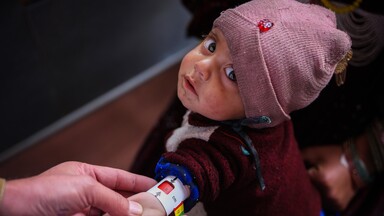
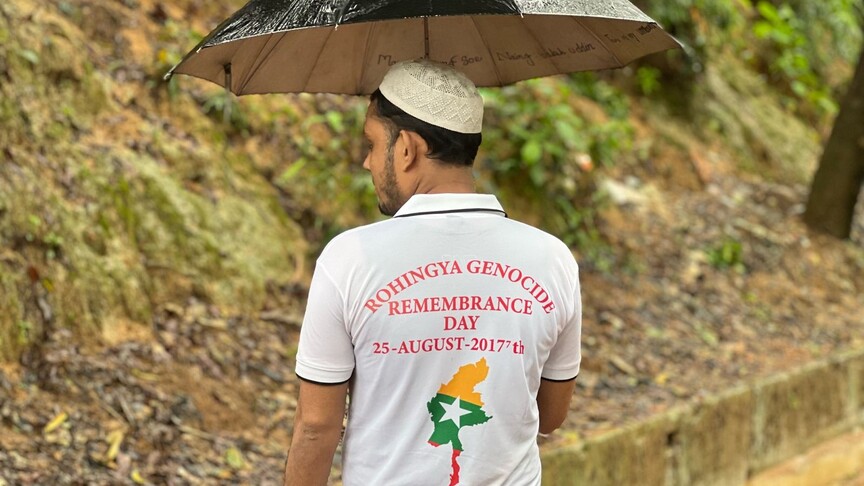
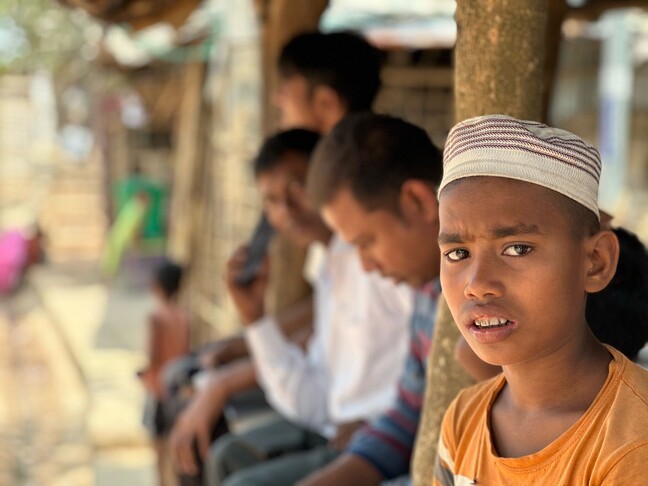
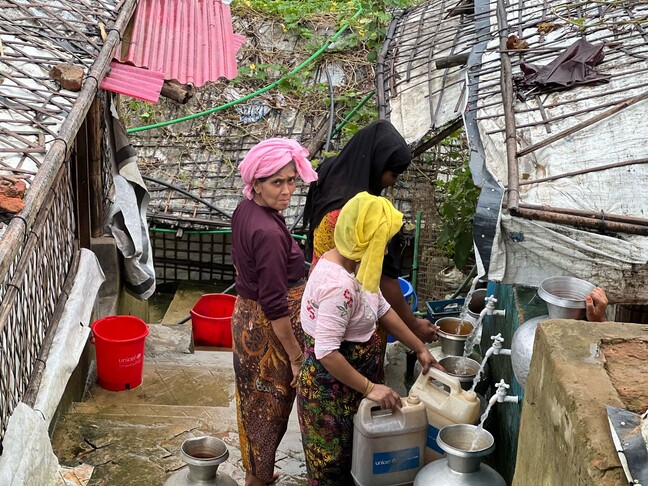
Under a low, overcast sky in the Kutupalong refugee camp, three vehicles pulled up outside a thatched structure as visitors arrived ahead of another anniversary of the Rohingya exodus from Myanmar.
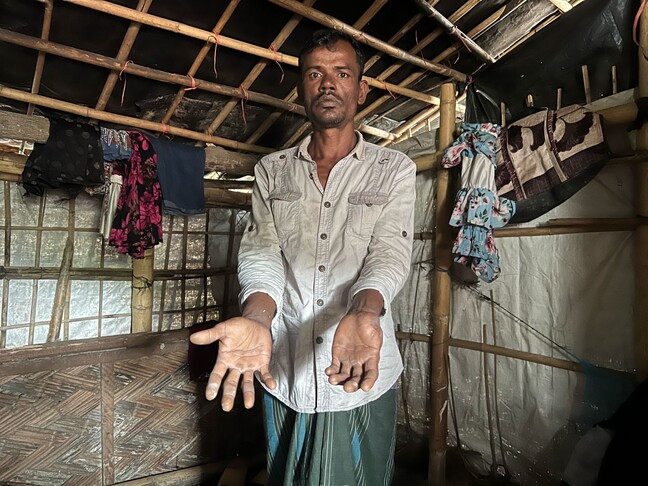
For Mohammad Ibrahim, who has spent the past nine years watching delegations try and fail to find a lasting solution for the Rohingya, there was little reason to take notice.
“Yes, they come and go,” the 34-year-old told Anadolu. “Our fates haven’t changed a bit.”
On Monday, a day before Rohingya marked nine years since the mass exodus that began on Aug. 25, 2017, the sprawling refugee camps around Cox’s Bazar in southeastern Bangladesh were busy with commemorations.
But nearly a decade after hundreds of thousands fled a brutal military crackdown in Myanmar's Rakhine State, which the UN described as a “textbook example of ethnic cleansing,” more than 1 million Rohingya remain in Bangladesh and no large-scale repatriation has begun.
Ibrahim was among those who arrived in 2017. His home was burned. His brother and his nephews were hacked to death. He crossed into Bangladesh with his wife and children.
“For nine years, it's been a life of uncertainty,” he said. “We live on aid money. How can we call this a life?”
After years of paralysis, Myanmar has offered what appears to be new momentum toward repatriation.
Bangladesh submitted the names of 828,824 Rohingya to Myanmar for verification as part of efforts toward eventual repatriation.
In response, Myanmar's Foreign Ministry said in July that it had so far verified 426,545 of those names, including 308,797 it identified as former residents of Rakhine State.
“Myanmar will receive the displaced persons who have been verified as former residents of Rakhine State when the security situation in Rakhine State becomes more stable,” the Myanmar junta government said.
While the acknowledgement is a step forward, there is still no timetable, and the qualification about security goes to the heart of the problem.
“The 300,000 figure is a slice of a larger process, not a new offer,” Shahab Enam Khan, a professor of international relations at Jahangirnagar University, told Anadolu, cautioning that the announcement did not mean their immediate return.
For now, Khan said, it amounts to “movement on paper rather than on the ground.”
The most immediate obstacle is control of Rakhine itself.
Much of the state is no longer controlled by Myanmar's military. The Arakan Army, an ethnic armed group fighting the military, has seized large areas, including territory near the border with Bangladesh.
That leaves Rohingya leaders questioning who could guarantee their safe return.
“They don’t even have control there in Rakhine,” Abdur Rahim, a leader of the Arakan Rohingya Society for Peace and Human Rights, told Anadolu. “How can they take us?”
Khan nevertheless sees signs of renewed diplomatic momentum.
Bangladesh has created a national committee under the country’s new prime minister, while China and the Association of Southeast Asian Nations increasingly view stability in Myanmar as important to regional security, he said.
“That opens bilateral space and a multiparty track at once,” he said, arguing that a durable solution may eventually require linking humanitarian concerns with trade, connectivity and economic reconstruction in Rakhine.
For Mohammad Arifullah, the question of returning begins with memories of how he left.
He fled Myanmar Aug. 25, 2017, with four family members, walking through rugged hills to escape the military before reaching Kutupalong.
“We came to this country after walking for eight days to save our lives from the military,” he told Anadolu. “I still feel like crying when I remember those days. But that is my country, my land. I want to return there.”
His story is ordinary here in its horror. Some crossed carrying children; others supported elderly parents through forests and mountains. Many arrived after relatives were killed.
More than 700,000 Rohingya fled Myanmar following the violence that began in August 2017, joining people displaced by earlier waves of persecution.
The influx transformed Kutupalong into the world's largest refugee settlement. Bangladesh now hosts more than 1.2 million Rohingya, according to UN and humanitarian estimates, with most living across 33 camps in Cox’s Bazar and more than 30,000 relocated to Bhasan Char, a remote island in the Bay of Bengal.
Nine years have also created a generation shaped by displacement. Children who fled Rakhine are now young adults. Thousands born in Bangladesh know the villages their families came from only through their parents' stories.
Rohingya representatives say any return must be safe, voluntary, dignified and sustainable.
Mohammad Furkan Mirza pointed to the United Council of Rohingya (UCR) as an attempt to organize those demands from within the refugee community.
Elections for representatives were held across 33 camps in 2025 with permission from Bangladesh's refugee authorities, involving religious leaders, students, teachers, women, doctors, businesspeople, young people and other community representatives.
“The UCR has demonstrated that Rohingya can organize themselves peacefully, transparently and responsibly,” Mirza said. “This organization has become a symbol of our unity, accountability and hope for a dignified future.”
Human rights advocates, however, say the conditions necessary for a safe return still do not exist.
“Repatriation at this time is dangerous,” John Quinley, director of Fortify Rights, told Anadolu. “The Arakan Army is continuing to abuse Rohingya refugees, committing widespread human rights violations.”
Quinley said Bangladesh should prepare for the possibility that refugees will remain for years, including by expanding access to formal education, livelihoods and legal status.
“Rohingya genocide survivors deserve more solutions and support than just a one-point repatriation policy on Rohingya,” he said, calling on Bangladesh's government to develop a broader policy in consultation with refugees and host communities.
Burmese human rights activist Maung Zarni was even more skeptical of Myanmar's announcement, arguing that authorities cannot credibly promise repatriation when they lack effective control over much of the border and the Rohingya homeland.
He also criticized Myanmar's continued use of “Bengali” to describe the Rohingya, a designation the community rejects because it portrays them as outsiders from Bangladesh rather than an ethnic group native to Myanmar.
Zarni argued that the timing may also be connected to the genocide case brought by The Gambia against Myanmar at the International Court of Justice, which he expects could produce a ruling before the end of 2026.
For Abu Morshed Chowdhury Khoka, president of Cox's Bazar Civil Society, the sheer scale of displacement makes announcements about verification far removed from the practical challenge of bringing people home.
“If more than 1.2 million people are to be repatriated in phases, it is easy to understand how long the process could take,” he said. “Repatriation does not mean simply sending people across the border. There must be guarantees that they can return with dignity.”
Back in Kutupalong, that distinction is everything.
The Rohingya who spoke to Anadolu did not describe Bangladesh as home. Again and again, they spoke of Rakhine that way.
“Who wants to live an undignified life in the refugee camps?” asked Rahim. “We still long for our homelands.”
What they questioned was whether the place they fled nine years ago had become safe enough to return to – and who, amid a continuing conflict and shifting territorial control, could guarantee that safety.
Myanmar has now verified hundreds of thousands of names. But there is still no date for their return, no settled mechanism for large-scale repatriation and no clear authority capable of guaranteeing their safety once they cross the border.
For Ibrahim, another anniversary has arrived much like the previous eight.
The cars come. Visitors step out. Meetings are held.
Then the doors close, the convoys leave and the camps remain.
news_share_descriptionsubscription_contact

contact_the_ombudsman
is_there_an_error_in_this_story