‘Question of justice and fairness’: Nepal seeks climate compensation after deadly floods
Foreign minister says support for climate-vulnerable Himalayan nation should not be viewed merely as charitable aid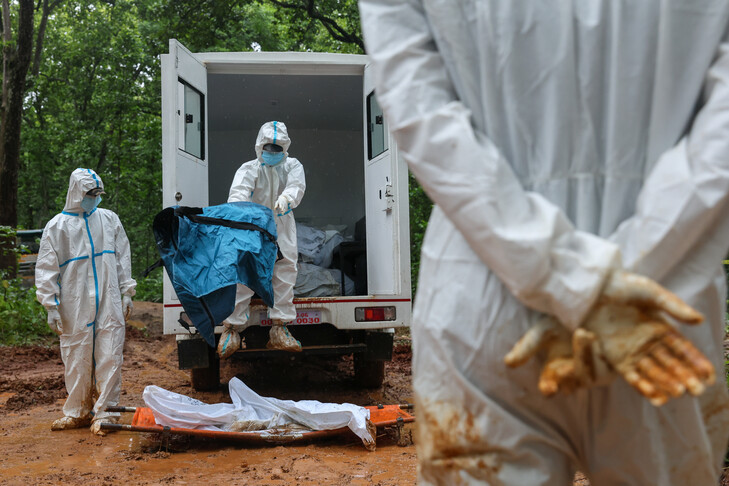
Nepal’s Foreign Minister Shisir Khanal has urged international support following deadly floods to be treated as climate compensation rather than charity, saying it is a “question of justice and fairness."
The death toll from the flash floods and mudslides that struck the Nepal-China border Aug. 26 has climbed to 1,225, while nearly 4,757 victims, including 541 in China, are missing.
Nepalese authorities have said 1,204 people were found dead, while China confirmed 21 fatalities by Wednesday.
Khanal said Nepal was suffering disproportionately from climate change despite accounting for a tiny fraction of global greenhouse gas emissions.
"If you look at data, even our overall carbon footprint, greenhouse emission is less than a 10th of a percentage," Khanal told CNN’s Anderson Cooper 360°.
"The glaciers are melting. The permafrost are thawing, and there is a risk of glacier flood," he said, adding that the latest disaster involved a glacier collapse.
"What we are telling to the world is, look, our contribution in this changing climate is almost negligent," said Khanal.
He stressed that protecting the Himalayas should not be Nepal’s responsibility alone.
"Saving Himalayas has to be part of a global effort because today it’s impacting Nepal but it also impacted China," he said.
Khanal noted that Himalayan rivers eventually flow into India and, in some cases, Bangladesh, providing fresh water for agriculture and drinking to more than 2 billion people.
"Global communities have to come together and this cannot be seen merely as a charitable giving, but has to be part of a compensation process as well," he said.
"You don’t want foreign governments to look at this as giving aid to Nepal. You want this to be compensation," asked Cooper.
"Exactly, this should be seen from the perspective of justice and fairness," Khanal replied. "How fair is it for Nepali people and people of Himalayas to bear the burden of the climate change, where we have had very little contribution to it?"
Asked whether he regarded the disaster as a direct result of climate change, Khanal replied, "Absolutely, you know, there is no question that there is evidence."