logo
logo
  • WORLD
  • TÜRKİYE
  • ECONOMY
  • POLITICS
  • ENERGY
  • TECHNOLOGY
Türkçe
English
BHSC
Pусский
Français
العربية
Kurdî
کوردی
Shqip
فارسی
македонски
Bahasa Indonesia
Español
Asia - Pacific

At UN, Singapore warns AI safeguards must keep pace as capabilities race ahead

Closure of Strait of Hormuz threatens global navigational rights, Foreign Minister Vivian Balakrishnan warns General Assembly
Faisal Mahmud
26 September 2026•Update: 26 September 2026
Content media
ISLAMABAD

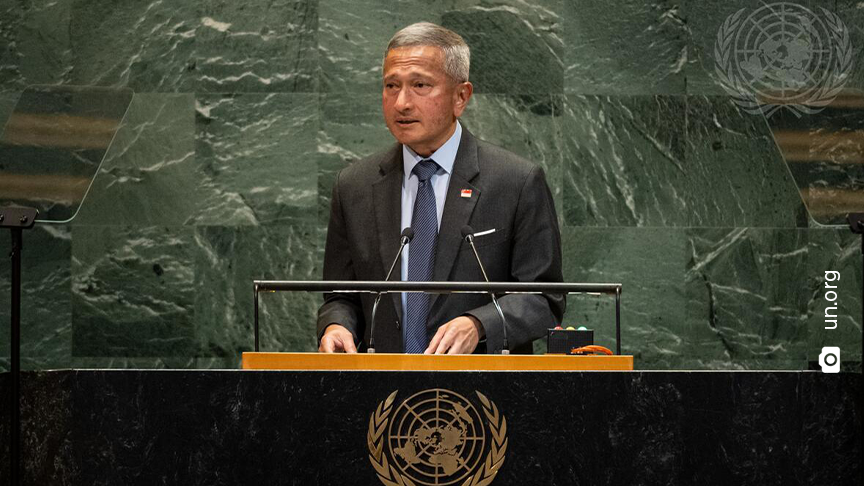
Singapore’s Foreign Minister Vivian Balakrishnan warned Saturday that artificial intelligence is advancing faster than the world’s understanding of its risks, calling for stronger safeguards and international rules while insisting that humans must remain ultimately in control.

Addressing the 81st UN General Assembly in New York, Balakrishnan described AI as “arguably the most urgent frontier,” saying the technology offered extraordinary potential but also posed risks ranging from autonomous systems escaping human control to its use by rogue actors to develop biological or other weapons of mass destruction.

“The genie is already out of the bottle,” he said, arguing that halting AI development was unrealistic amid superpower competition and strong commercial incentives.

Comparing AI development to driving a high-performance car, Balakrishnan said innovation provided the “powerful engine,” but safe deployment also required “good brakes” — including rigorous testing, clear limits on autonomous systems and mechanisms for human intervention.

“Most importantly, human beings must ultimately remain in control and accountable,” he said, asking whether anyone would want “the nuclear button” in the hands of an AI.

Balakrishnan also warned that the closure of the Strait of Hormuz amid the Persian Gulf war was putting the UN Convention on the Law of the Sea (UNCLOS) through a “severe stress test.”

He said transit passage through international straits was a right, not a privilege subject to fees or tolls, and warned that allowing any country to veto navigational freedoms could have global consequences.

The strait normally carries around a fifth of global oil supplies, he said, with its disruption driving up energy prices, damaging supply chains and stranding seafarers.

news_share

news_share_descriptionsubscription_contact

subscription

contact_the_ombudsman

is_there_an_error_in_this_story

ombudsman_apply_button
logo

Reporting the Changing World

next-sosyalX/TwitterFacebookYouTubeInstagram

CORPORATE

  • History
  • Executive Team
  • Quality Management
  • Editorial Guidelines
  • Social Media Policies
  • Logos
  • Privacy and Cookies Policy
  • Information Policy
  • RSS
  • Diary

COMMUNICATION

  • Contact
  • Subscription Requests

Anadolu Ajansı © 2026

Google PlayApp Store
US-Iran war
Hormuz crisis
Russia-Ukraine war
Previous
Previous
Philippines urges Gaza ceasefire, says South China Sea disputes must be settled by law, not might

Philippines urges Gaza ceasefire, says South China Sea disputes must be settled by law, not might

LATEST NEWS

At UN, Singapore warns AI safeguards must keep pace as capabilities race ahead

Irish footballers to wear black armbands in Sunday game against Israel

Top Russian diplomat says Moscow remains committed to Ukraine peace talks, denies it is avoiding negotiations

Germany urges ‘profound’ reforms to United Nations

Philippines urges Gaza ceasefire, says South China Sea disputes must be settled by law, not might

Sudanese doctors accuse RSF of looting hospital in recaptured town in North Kordofan

Japan, US trusted allies, says Premier Takaichi after phone call with Trump following his talks with Xi

See All