Saadet Gokce and Ilayda Cakirtekin
09 September 2026•Update: 09 September 2026
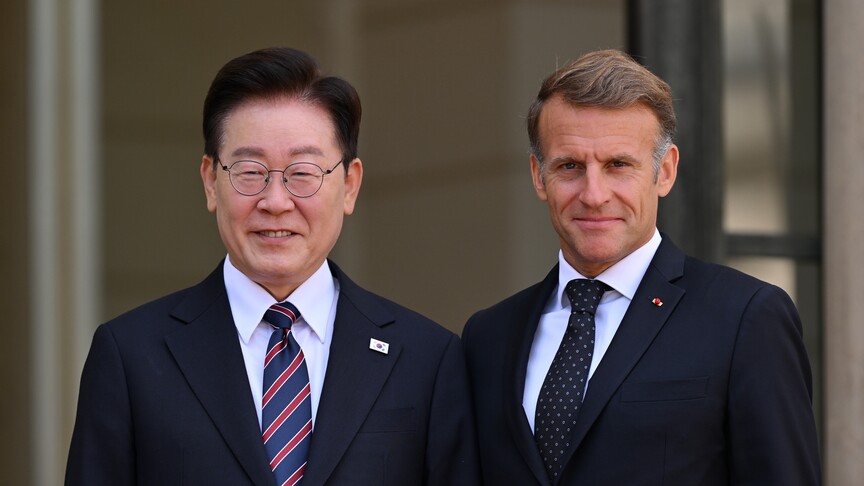
South Korea and France signed several agreements Tuesday to deepen bilateral cooperation in national defense, the defense industry, military information protection and other areas.
"In order to jointly respond to uncertainties facing the international order, (we) agreed to make tangible progress in cooperation on defense and security," South Korean President Lee Jae Myung said at a joint news conference with French President Emmanuel Macron in Paris following their summit, according to Yonhap News Agency.
Lee is on a two-day visit to Paris as South Korea and France mark the 140th anniversary of the establishment of diplomatic relations.
The two countries also signed a pact to upgrade a military secret information protection agreement reached during the two leaders' summit in Seoul in April to further improve information sharing between the two countries.
The two leaders also agreed to work toward an early signing of a separate agreement on mutual military logistics support to strengthen defense cooperation, Lee said.
Lee added that they agreed to pursue joint projects that combine France's technological expertise with South Korea's manufacturing capabilities.
France and South Korea will also seek to increase annual bilateral trade to $20 billion by 2030 by strengthening economic and industrial cooperation, he said.
"I will closely communicate with (Macron) to help companies from both countries operate in a more predictable environment and find more opportunities in each other's market," he added.
Lee said South Korea and France also agreed to expand cooperation in artificial intelligence (AI), quantum technology and nuclear energy into the industrial and market spheres, including joint research and development projects on AI, semiconductor and quantum technology.
Samsung Electronics Co. said earlier that it has partnered with French startup Mistral AI to enhance its semiconductor operations.
The two countries also agreed to cooperate on next-generation nuclear reactors, supply chain diversification and civil nuclear energy.
Macron also welcomed the signing of agreements in various areas, saying "2026 is a major year for Franco-Korean relations as we celebrate 140 years of friendship between our two countries."
He hailed their partnership founded on shared values and common interests.
“We also share a belief in democracy, human rights and the rule of law. We share a commitment to respecting international law and to free and fair trade,” he noted.
He reaffirmed that both nations agreed on the need for defending respective sovereignties and strategic autonomies “at a time of global realignment and upheaval.”
“Together, we have common actions to pursue for a peaceful Indo-Pacific,” he added.
Macron also underscored that their further common actions in defense, security, technology and energy areas prevent them “from becoming vassals of any major power.”
“The Republic of Korea can count on France’s consistent support for peace and stability on the Korean Peninsula,” he emphasized.
The leaders also discussed global security, including the Strait of Hormuz and the Russia-Ukraine war, said Macron.
Macron and Lee both stressed their common vision of defending freedom of navigation within a peaceful context and added that they will continue to join efforts to propose solutions for the reopening of the Strait of Hormuz.
“In any case, the prospect of a strictly peaceful multinational mission, once an agreement is reached, continues to be the subject of intensive work,” said Macron.