- The vote follows last year’s impeachment and removal of former President Yoon Suk Yeol after a failed martial law declaration
- Lee made AI development a centerpiece of his economic agenda, pledging investments of up to 100 trillion won ($72 billion)
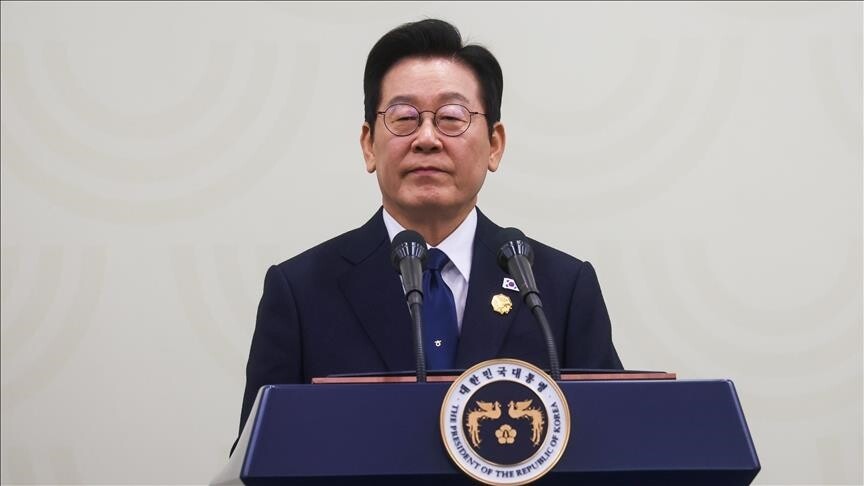
Millions of South Koreans will head to the polls on Wednesday in nationwide local elections, the first major political test of President Lee Jae Myung's government since he came to power a year ago.
The vote comes at a symbolic moment in South Korean politics. On the same date last year, Lee won an early presidential election triggered by the impeachment and removal of conservative President Yoon Suk Yeol following his failed martial law declaration.
The vote will serve as an early gauge of public support for Lee's administration and the opposition People Power Party (PPP).
More than 7,800 candidates are competing in elections for provincial governors, metropolitan mayors, municipal leaders and local council seats across the country.
Voters will choose 17 metropolitan mayors and provincial governors, 226 municipal mayors, and thousands of local councillors.
While local elections traditionally focus on municipal issues such as housing, transportation and regional development, this year’s contest has taken on national significance because it is widely viewed as a referendum on Lee’s administration and the political fallout from the turmoil that engulfed South Korea in 2024 and 2025.
The elections are being held alongside 14 parliamentary by-elections, an unusually large number that has intensified public and media attention. The vacant National Assembly seats emerged after lawmakers resigned to run for local office, accepted government appointments or lost their seats through court rulings.
One vacancy was created when Lee himself resigned his parliamentary seat after winning the presidency last year.
Although the by-elections will not dramatically alter the balance of power in parliament, where Lee’s Democratic Party already holds a majority, they are being treated as an important measure of public sentiment.
Strong performances by Democratic Party candidates would reinforce Lee’s political momentum, while gains by the conservatives could suggest that the opposition is beginning to recover after a year of internal turmoil.
Mechanics of voting
The mechanics of voting differ depending on the office being contested.
For mayors, governors and parliamentary by-elections, South Korea uses a first-past-the-post system in which the candidate with the most votes wins, even without an absolute majority.
Some local council seats, however, are allocated through proportional representation based on party-list votes, creating a mixed electoral structure that combines constituency races with proportional representation.
As in previous elections, South Korea has offered early voting to increase participation. Early voting opened on May 29 and allowed citizens to cast ballots at designated polling stations before election day.
The system, introduced nationally in 2014, has become a regular feature of South Korean elections and is particularly popular among younger voters and those unable to vote on election day.
Beyond electoral arithmetic, the campaign has highlighted the growing importance of artificial intelligence and advanced technology as political issues.
AI takes center stage
During last year’s presidential campaign, Lee made AI development a centerpiece of his economic agenda, pledging investments of up to 100 trillion won ($72 billion) to transform South Korea into one of the world’s leading AI powers.
He described AI as a “game changer” for economic growth and technological competitiveness.
Since taking office, Lee’s government has moved to translate those promises into policy.
Officials have announced plans to spend more than 16 trillion won on AI-related initiatives through 2030, including national AI computing centers, a new supercomputer, talent development programmes and support for domestic AI models.
Yet questions remain about how realistic some of the campaign pledges are, particularly in sectors such as autonomous mobility and AI-driven transportation.
Analysts have pointed to funding challenges, regulatory barriers and technological hurdles that could complicate implementation. Those concerns have featured prominently in local election debates, where candidates have competed to position their regions as future technology and innovation hubs.
The political stakes extend beyond the election results themselves.
Attention is also focused on Prime Minister Kim Min-seok, who has been mentioned by political observers as a possible contender to take a leading role within the ruling Democratic Party after the elections, potentially reshaping the party’s internal power structure as Lee enters the second year of his presidency.
For now, however, the central question is whether voters remain willing to give Lee and the Democratic Party a strong mandate.