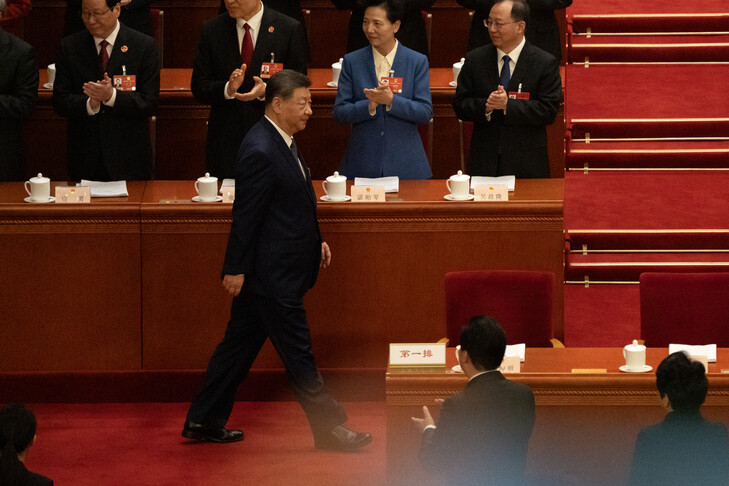
Chinese President Xi Jinping voiced confidence on Friday that Taiwan will "come together" with the mainland while hosting Taiwanese opposition leader Cheng Li-wun in Beijing and stressing cooperation.
"Compatriots on both sides are both Chinese, and we need peace, we need development, we need communication, and we need cooperation. This is a common wish," Xi said, according to the South China Morning Post.
Xi said that regardless of how the international landscape or the situation across the Taiwan Strait evolves, "the overarching trend toward the great rejuvenation of the Chinese nation will not change, and the prevailing momentum for the Chinese on both sides of the Strait to come together will not change," China’s Commerce Ministry said on the US social media company X.
He also highlighted the meeting’s significance for advancing relations between the two sides and across the strait after a 10-year hiatus.
'1992 Consensus to reduce conflict'
At a news conference after the meeting, Cheng stressed the need for sustained dialogue based on the 1992 Consensus to reduce potential sources of conflict, according to Taiwanese broadcaster TVBS.
The 1992 Consensus refers to a historic meeting that year on cross-strait relations between semi-official representatives of China and Taiwan, which produced a tacit understanding that there is "one China," with each side interpreting its meaning.
"Both sides of the strait should respect each other, transcend political confrontation, and build a cross-strait community with a shared future that is mutually beneficial," Cheng said, while advocating for a systematic solution to prevent war.
Cheng said the meeting with Xi demonstrated a shared desire for peaceful development across the strait.
She also expressed hope that no political party in Taiwan would use cross-strait peace as a campaign tool, calling it "a choice between war and peace," referring to criticism from the ruling Democratic Progressive Party over her trip, according to the South China Morning Post.
Cheng, chair of the Kuomintang (KMT) party, visited Jiangsu province and Shanghai before traveling to the capital, according to state-run news agency Xinhua.
She vowed "reconciliation" and "unity" across the Taiwan Strait during her visit to the Sun Yat-sen Mausoleum in Nanjing, the capital of China’s eastern Jiangsu province. Sun was the founder of her party.
The last KMT chief to meet with Xi was over a decade ago, when then-Chair Eric Chu met him in China in 2015.
The visit is seen as an important step in dialogue and exchanges between the KMT and China’s Communist Party.
Cheng was elected KMT chair last October.
China considers Taiwan its "breakaway province," while Taipei has insisted on its independence since 1949.
The visit has also assumed significance as Xi is set to host US President Donald Trump next month.
Washington has been the top arms supplier to Taipei, with the Trump administration approving a record $11 billion in arms sales last year, triggering protests and a backlash from Beijing, which sanctioned several US arms firms as well as their personnel.
Separately, Taiwanese leader William Lai Ching-te said on Friday that the day marks the 47th anniversary of the Taiwan Relations Act, "which has long served as a cornerstone for Taiwan-US relations."
On US social media company X, he expressed confidence that "our enduring partnership -- spanning across security, trade, technology & more -- will continue to spur innovation & help safeguard regional peace."
Tokyo downgrades China description
As Cheng met Xi in Beijing, Japan on Friday downgraded its China description in its 2026 Diplomatic Bluebook.
The annual report, submitted by Foreign Minister Toshimitsu Motegi at a Cabinet meeting, refers to China as an "important neighboring country" instead of "one of the most important bilateral relations" as in the 2025 edition, according to Kyodo News.
The move comes amid strained bilateral ties since late last year, when Japanese Prime Minister Sanae Takaichi said that any Chinese military action against Taiwan – including a naval blockade – could qualify as a "survival-threatening situation," enabling Japan to exercise its right to collective self-defense.
Japan's report said that China intensified "unilateral criticism and coercive measures" against Japan in 2025, while also stressing that Tokyo remains open to dialogue.