Global markets start week mixed ahead of US key data release
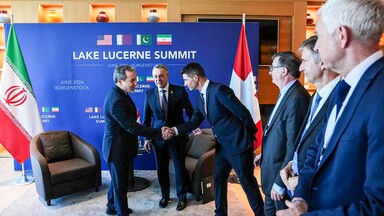
US-Iran talks in Switzerland over weekend saw some tensions flare, but talks continued, fueling optimism over lasting peace in Middle East, driving gold prices up
Global markets began the week that will see the release of key US macroeconomic data on a mixed trend after US-Iran talks continued to reach a permanent solution, easing risk sentiment.
US President Donald Trump’s harsh remarks at the Iranian delegation fueled concerns during negotiations in Switzerland over the weekend, but the Iranian side said they did not take Washington’s threats seriously.
Tensions flared at times during the talks, but the fact that both sides remained despite the shaky process kept hopes alive that peace may be established in the Middle East soon.
Maritime shipping traffic via the Strait of Hormuz fell compared to last week. Analysts say concerns over energy supply will not ease any time soon, even if progress is made in the talks, while all eyes are on the impact of slowing tanker traffic on oil prices.
The US Personal Consumption Expenditures index and growth will be released this week, revealing the effects of oil prices on the macroeconomy.
The Fed is expected to hike rates once by the end of the year with near certainty, following hawkish remarks by new chair Kevin Warsh and concerns that establishing lasting peace in the Middle East will take time.
Meanwhile, the US 2-Year Treasury bond yield rose to 4.22%, as it is one of the most sensitive indicators of Fed policy, while the 10-Year bond yield climbed 3 basis points to 4.48%. The US Dollar Index carried its upward trend into the new week amid expectations of a hawkish stance by the Fed, while the index stands up 0.1% at 100.9 on Monday.
Gold has come under pressure amid expectations of prolonged high interest rates and the Fed’s hawkish signals, but progress in US-Iran talks provided much-needed support, as gold started the week up 0.6% at $4,180 per ounce on Monday.
American indexes started the week on a negative note.
Amid the Middle East developments, European stock markets closed Friday lower except for Italy, while indexes in the bloc are trading in red on Monday.
Investors will be monitoring European Central Bank (ECB) President Christine Lagarde’s speech at the European Parliament’s Committee on Economic and Monetary Affairs meeting in Brussels.
The ECB is expected to raise the rates at least once more by the end of the year.
The region’s manufacturing and services Purchasing Managers’ Index will be released this week to provide insight into the economic activity.
Amid political developments in the region, Trump said British Premier Keir Starmer will resign due to “failing” in immigration and energy policies.
As for Asia, a positive trend came to the fore except for Hong Kong, while China maintained its one- and five-year credit interest rates at 3% and 3.5%, respectively.
Semiconductor gains came to the fore in Asia, as South Korea’s SK Hynix’s shares rose 3.9%, reaching a market cap of $1.3 trillion.
Near the close, Japan’s Nikkei 225 rose 1.9%, South Korea’s Kospi Index 0.5%, and China’s Shanghai Composite Index 0.8%, while Hong Kong’s Hang Seng Index fell 0.7%.
* Writing by Emir Yildirim.