Burhan Sansarlioglu and Emir Yildirim
17 September 2026•Update: 17 September 2026
- Fed chair Kevin Warsh’s emphasis on price stability leads indexes to rebound, while oil falls and gold rises
Global markets are trading positively on Thursday, replacing the selling pressure of the New York Stock Exchange from Wednesday, after the US Federal Reserve decided to hike rates by 25 basis points to the 3.75-4% range.
The bank cited strong productivity growth and capital investments for its decision, while noting that the rise in employment has kept pace with the expansion of the labor force, and that the unemployment rate remained largely unchanged.
The unanimous rate hike decision followed the last rate hike in July 2023.
The Fed upwardly revised its inflation forecast from 3.6% to 3.7% for this year, maintained the estimate for 2027 at 2.3%, upwardly revised its 2028 forecast from 2% to 2.1%, and set its 2029 expectation at 2%.
The dot plot revealed 16 out of 18 officials expect at least one more rate hike this year.
Fed chair Kevin Warsh said inflation has been very high for a long time, while the inflation data released throughout summer did not show any tangible progress in underlying trends, noting that the rate hike was a right step towards securing price stability.
US President Donald Trump, however, called for interest rates to be lowered to 1% or below.
Further rate hike expectations drove down risk appetite but Warsh’s emphasis on stability led indexes to rebound on Thursday.
The US Dollar Index rose above the 100 mark for the first time since Aug. 4 on Wednesday with rate hike expectations gaining strength, while trading sideways at 100.3 on Thursday.
Developments in Middle East
Meanwhile, Trump claimed Tehran directly reached out for a deal to end the war.
Recent reports showed that US officials held secret talks in Oman with Iranian-backed Yemeni Houthi militias, while Riyadh said it would provide additional crude oil shipments via Oman, boosting risk appetite.
November-delivery Brent crude oil fell 2.7% on Wednesday to $105.8 a barrel, while trading flat on Thursday.
Gold climbed 0.5% on Thursday to $4,287 per ounce as oil dropped, while the US 10-Year Treasury yield is hovering at 5.01%.
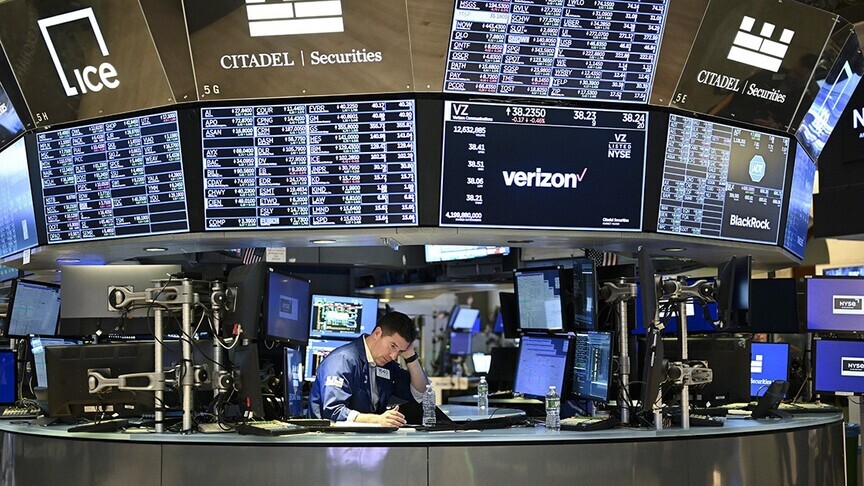
The New York Stock Exchange closed Wednesday lower after the Fed’s rate decision, as bank stocks declined and concerns over high interest rates slowing credit and economic growth came to the fore.
JPMorgan Chase shares fell 1%, Bank of America lost 2.7%, Wells Fargo dropped 3%, and Goldman Sachs shares contracted 4%.
The 30-year fixed-rate mortgage average in the US rose to 6.97% last week, its highest since May 2025.
The US’ retail sales climbed over expectations by 1.2% on a monthly basis, while the country’s import price index rose 0.7% month-on-month and its export price index increased 0.6% in August.
The Dow Jones Industrial Average fell 1.21%, the S&P 500 dropped 0.45%, and the Nasdaq was down 0.01% on Wednesday. American indexes opened Thursday on a positive note with reports of progress on a bill to regulate energy costs driving up Nasdaq futures.
European stocks
Meanwhile, European stock markets were positive on Wednesday driven by mining stocks, while oil prices eased and the selling pressure on bonds reduced.
The UK’s annual inflation reached its five-month highest at 3.1%, led by transport costs and gas prices. The country’s inflation is expected to reach above 4% in the coming months.
All eyes turned to the Bank of England’s (BoE) interest rate decision on Thursday.
The BoE is expected to maintain its policy rate but rising inflationary expectations may bring a rate hike in November.
Meanwhile, European Commission President Ursula von der Leyen said the EU is paving the way for Canada to become the bloc’s first associate member.
The UK's FTSE 100 rose 0.28%, Germany's DAX 40 grew 0.53%, France's CAC 40 grew 0.62%, and Italy's FTSE MIB 30 was up 0.8% on Wednesday. European indexes started Thursday on a positive trend.
Asian markets
Near Thursday’s close, Asian equity markets traded mixed after the Fed’s decision, while the drop in oil prices limited the downward trend in the region.
The Bank of Japan’s (BoJ) rate decision remained in focus, as the bank is expected to hike its policy rate by 25 points from its current 1% to bring it up to its highest level in 31 years due to inflationary concerns and the yen’s depreciation.
South Korea’s Kospi rose 0.9% and Japan’s Nikkei 225 grew 0.9%, while Hong Kong's Hang Seng fell 0.7% and China's Shanghai Composite contracted 0.4%.