28 January 2016•Update: 28 January 2016
By P Prem Kumar
KUALA LUMPUR
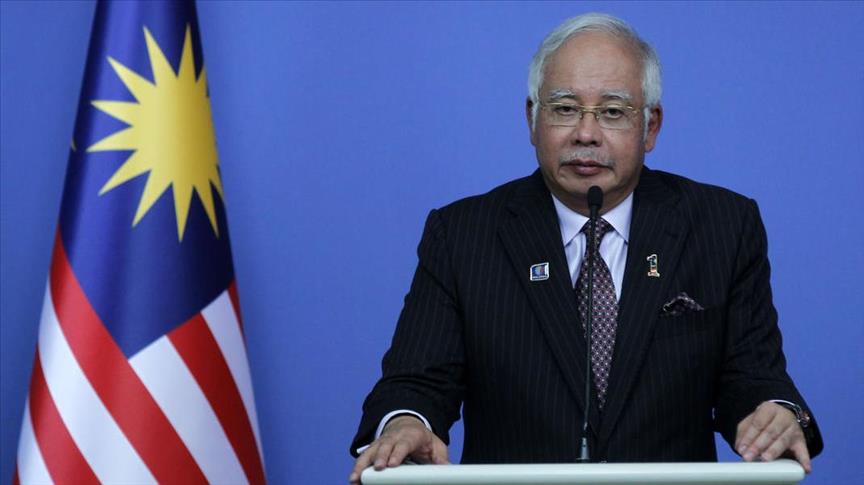
Malaysia’s prime minister announced a cut of up to $2.13 billion in the 2016 budget Thursday, as the government revises its expenditure based on a decrease in national revenue amid dropping global crude oil prices.
Najib Razak said in a televised special address that the revisions include 11 restructuring measures aimed at slashing development expenditure and operating expenditure by up to $1.18 billion and $948.3 million, respectively.
The cuts are in tandem with an anticipated loss of between $1.65 billion and $2.13 billion in government revenue in the oil-producing country this year due to a decline in oil-related revenue and other earnings.
"Malaysia will not be and currently is not in recession nor a technical recession," Razak insisted, noting that the global economy is expected to be more challenging this year than 2015.
Malaysia's gross domestic product (GDP) growth target has also been narrowed to 4-4.5 percent this year, from the wide 4-5 percent target announced last year, based on assumed global Brent crude oil prices of between $30 and $35 per barrel.
Razak told a 700-strong crowd in administrative capital Putrajaya Thursday that the fiscal deficit target, however, remained at 3.1 percent by year-end as the government would strive to reduce its debt-to-GDP ratio.
He said the International Monetary Fund, or IMF, had indicated that the global economy would grow at a slower pace of 3.6-3.4 percent while world trade is anticipated to decrease from 4.1 percent to 3.4 percent.
"This is on account of several economies such as South Africa, the United States, Brazil and China which are also expected to grow at a slower pace,” Razak said. “This trend proves that we are not alone in facing the global economic challenges."
The premier added that the nation’s revenue would be significantly impacted by global crude oil prices, which have dropped by 35 percent to $31 per barrel compared to the assumed $48 per barrel at the time the 2016 budget was tabled last October.
The ringgit has also depreciated by 11.3 percent against the U.S. dollar from 3.77 in June 2015 to 4.25 on Jan. 27, 2016.
"In fact, the ringgit is undervalued and does not reflect the true economic fundamentals,” Razak said. “However, the ringgit is expected to better reflect the strength of the economic fundamentals when global financial markets stabilize and oil prices recover to more reasonable levels.”
Last October, Razak had announced allocations worth $63.34 billion in the 2016 budget.
The revision announced Thursday was the second consecutive recalibration of annual budgets, after the operating expenditure for 2015 was slashed by $1.3 billion to a total $61.8 billion.
The move had forced the postponing of new assets purchases, cuts to overseas travel and allocations to government-linked companies as well as statutory bodies.
The 2015 budget had been drawn based on forecast oil prices of $100 per barrel, while the revision was made on assumptions of $55 per barrel.
Malaysia is ranked among the top four oil-producing countries in the Asia-Pacific region, and its national company Petroliam Nasional Berhad (Petronas) is one of the biggest oil firms in the world.
Malaysia was an oil revenue-reliant country, where dividends from Petronas account for up to 40 percent of the government's revenue.
However, taking into account the latest developments in oil prices, the government introduced last year a broad-based consumption tax of six percent, to mitigate losses from Petronas' dividends.
The goods and services tax also reduced Petronas' contribution to the government revenue from 40 percent to 17 percent.