The memory of the accident at the Chernobyl Nuclear Power Plant in northern Ukraine continues to last 40 years after the tragedy, as a reminder of the importance of nuclear safety.
Situated near the now-abandoned city of Pripyat, about 110 kilometers (68 miles) north of Kyiv, the capital of the then-Ukrainian Soviet Socialist Republic, Chernobyl, transliterated as Chornobyl in Ukraine, is the site of an accident considered the world's worst nuclear disaster.
It took place after a sudden surge of power during a reactor system test at the fourth unit of the nuclear power station on April 26, 1986.
A subsequent explosion at the fourth reactor exposed its core, resulting in the spread of radioactive material above the surrounding territory, which prompted the Soviet Union to create an exclusion zone with a radius of 30 kilometers (18.6 miles).
Thirty-one people died in the immediate months after the accident, while nearly 8.4 million in the former Soviet republics of Belarus, Russia and Ukraine suffered exposure to radiation that was released, based on numbers cited by the UN.
The same reports also indicated that an area of approximately 155,000 square kilometers (60,000 square miles) in those three countries was contaminated.
Research into the accident showed that radioactive clouds reached as far as the US, Canada and even Japan.
Separately, 600,000 people who lived, worked and took part in the disposal and cleaning operations in the initial exclusion zone of the disaster were exposed to high doses of radiation, according to data from the World Health Organization.
The exclusion zone’s borders have since been altered following the Soviet Union’s dissolution, with Ukraine's State Emergency Service administering the Chernobyl Exclusion Zone, while the Polesie State Radioecological Reserve in Belarus also serves to enclose areas in the country affected by the accident.
Decommissioning process
The Chernobyl Nuclear Power Plant is currently in a stage of decommissioning, with the last of the three reactors still operational at the site after the accident, having been shut down Dec. 15, 2000.
The first comprehensive program on the plant’s decommissioning was approved by a decree from the Ukrainian government in November 2000.
The document was then replaced in 2009, with the government adopting a law on fully decommissioning the plant in four separate stages, to establish an “environmentally safe system” in the area against radiation.
A strategy of “deferred sequential dismantling” was selected for the plant, according to its website, with an initial preparatory stage having taken place from 2000 until 2013, during which nuclear fuel at the site was transported to a facility designed for long-term storage.
The second decommissioning stage, involving a final shutdown and preservation of reactor installations, has been ongoing since 2015 and is expected to be completed in 2028.
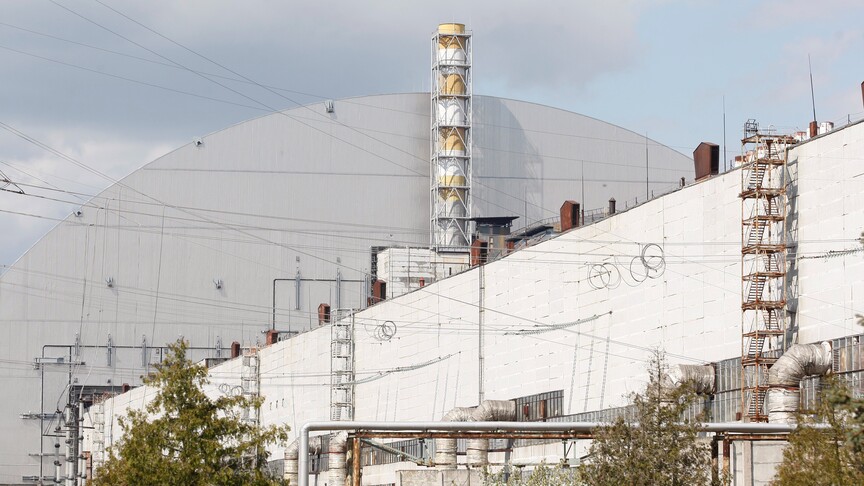
Amid the process, a new containment structure, the New Safe Confinement (NSC), was constructed to replace the sarcophagus that was hastily built after the accident at Chernobyl’s fourth reactor.
The NSC’s structure was completed in 2016 for $1.6 billion ($1.8 billion) and was slipped over the sarcophagus at the end of that year, but the project was finished and handed to Ukrainian authorities in 2019.
The second stage will then be followed by a third phase, which is scheduled to last roughly until 2045, and will concern the enclosure of reactor installations until radioactive contamination naturally decreases to an acceptable level.
Following that phase, a fourth and final stage of the decommissioning will take effect and oversee the dismantling of the reactors and clearing the site of the plant. That stage is expected to be finished by 2065.
Chernobyl’s current situation, future
The situation at the Chernobyl Nuclear Power Plant caught attention with the start of the Russia-Ukraine war on Feb. 24, 2022, when Ukrainian President Volodymyr Zelenskyy wrote on US social media company X that Russian forces were trying to seize the plant.
Ukrainian presidential adviser Mykhailo Podolyak announced the same day that Ukraine lost control of the plant after fierce clashes with Russian forces in the area.
Kyiv claimed to record an increase in radiation levels at the Chernobyl site but that the reason behind the increase could not be investigated due to clashes in the region. Russian officials denied the claims.
In this context, the International Atomic Energy Agency (IAEA) expressed "grave concern" about the situation at Chernobyl, appealing to both sides to exercise "maximum restraint to avoid any action that may put the country's nuclear facilities at risk."
On April 1, Ukraine's nuclear energy provider Energoatom announced that Russian forces withdrew from the site.
The nuclear power plant captured headlines again on Feb. 14, 2025, when a drone, which Ukraine claimed was Russian, hit the structure of the NSC overnight, causing a weeks-long fire and damaging its outer shell, but did not cause any release of radioactive substances. Russia denied Ukraine's allegations.
The IAEA said in December, following a "comprehensive safety assessment," that its personnel confirmed the NSC lost its “primary safety functions,” including its confinement capability, but found “no permanent damage to its load-bearing structures or monitoring systems.”
According to the European Bank for Reconstruction and Development (EBRD), initial assessments placed the estimated cost for repairs caused by the drone strike at a minimum of €500 million ($586 million), while EBRD President Odile Renaud-Basso reaffirmed the need for repairs in a statement on Friday.