Burak Bir
17 September 2026•Update: 17 September 2026
- 'Let us lead with responsible optimism, build AI safely and securely, open it to more people, expand our ambition and solve the problems that matter to the world,' says Nvidia CEO
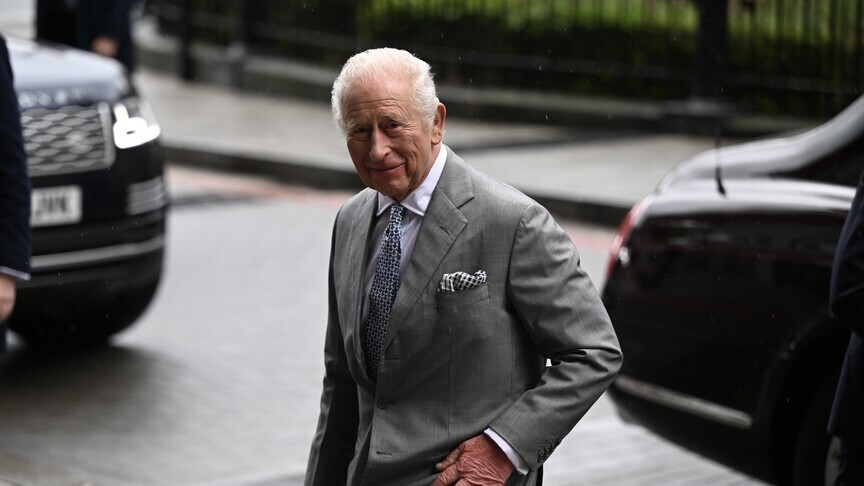
Hosting an artificial intelligence summit on Thursday, Britain’s King Charles warned AI leaders of the "existential dangers" posed by such technologies.
Charles hosted a gathering of leaders from the artificial intelligence industry, including Nvidia's Jensen Huang, at the Scottish headquarters of his King’s Foundation charity.
Speaking at the opening, Charles pointed to the ongoing row over AI, saying that those who have created these technologies are now “increasingly warning that AI risks developing darker capacities.”
The British monarch urged tech bosses to protect humanity and “not lose control of our destiny.”
"In this regard, if I may say so, there seems urgency in adequately considering the existential dangers of such technologies falling into the wrong hands, and being used in potentially catastrophic ways," he said.
The king added: “Surely, we need sufficient means of control before it is all too late.”
He touched on the importance of two questions, first "how can we harness the benefits of AI, with safety at its heart," and second, “how can we build international cooperation and consensus to achieve this, so no nation is left behind – but the human race is left in place.”
Saying that the development of AI, its substance and its pace, are both intriguing and deeply concerning in equal measure, Charles added: “Our humanity must remain sacred.”
The public is "anxiously seeking your reassurance that we will not lose control of our destiny, or our souls," he noted.
In recent months, a series of incidents in which AI went beyond what many thought possible and artificial intelligence insiders raised the alarm have led to calls for the technology to be slowed down and more tightly regulated.
Safety is ‘paramount’
Nvidia boss Huang told the summit that he believes safety is "paramount," and that firms should hold back a product and "keep engineering" if it was not safe enough.
The BBC reported that the Nvidia boss also highlighted the value of open models -- systems which give users direct access to the software -- as a way to “ensure that people and countries are not left behind.”
He noted that the systems must also be protected so "researchers, universities, start-ups and countries" can develop applications “none of us would have imagined alone.”
"Let us lead with responsible optimism, build AI safely and securely, open it to more people, expand our ambition and solve the problems that matter to the world," he was quoted by the British broadcaster.
Demis Hassabis, who co-founded the UK AI lab DeepMind that was later acquired by Google, offered a more cautious view on the pace of development.
He said the systems that are believed could be as good as or better than humans at multiple tasks, were "probably only a few short years away" and could have an effect “ten times that of the Industrial Revolution.”
The chance of something going wrong was "definitely non-zero," he said.
But he advocated for "a sensible middle way," saying humanity could address risks if collectively given the space and time to mitigate them.
"The future is not yet written," he said.