Melike Pala
14 October 2026•Update: 14 October 2026
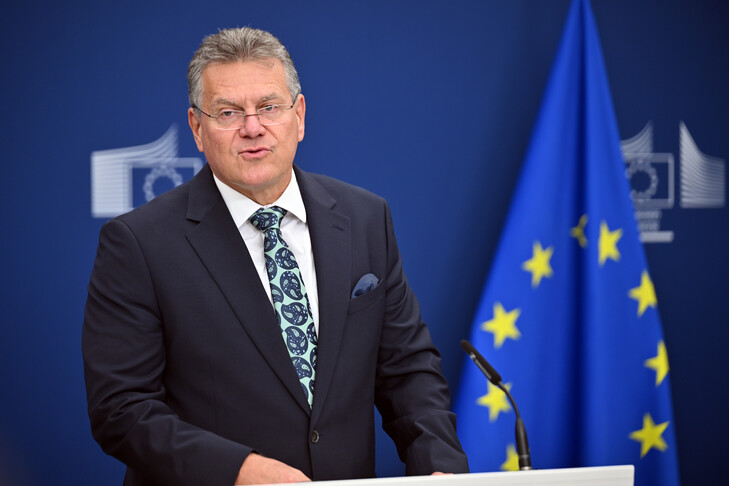
The European Commission's proposals on the "Made in EU" initiative aim to strengthen the bloc's competitiveness and help it adapt to changing global trade conditions, European Commissioner for Trade Maros Sefcovic told Anadolu on Tuesday.
Sefcovic said at a news conference with Türkiye's Trade Minister Omer Bolat following the High-Level EU-Türkiye Trade Dialogue in Brussels that the proposals were developed in response to changing trade realities, including concerns about state subsidies and trade-distorting practices.
Responding to Anadolu's question about concerns among some member states about the proposed "Made in EU" rules, Sefcovic defended the commission's approach.
"Many of the proposals which you highlighted are currently in the legislative process, so they go through the usual procedures when they're discussed in the parliament, in the (European) Council, but I believe that the goal is the same: to make sure that Europe is more competitive, stronger, and better fit for the current very volatile trade world," said Sefcovic.
The proposed rules have also exposed differences among EU member states about which countries should qualify under the initiative. France favors an EU-only approach, while Germany wants eligibility to be extended to trusted trade partners such as the United Kingdom, Canada and Japan, with Türkiye also potentially included.
He said the proposals followed a "very thorough reflection" on how to respond to new global trade realities, pointing to concerns that the European market had been flooded with goods amid strong suspicions that some trade practices did not comply with World Trade Organization rules.
Sefcovic said the EU was seeking new ways to address state subsidies, trade-distorting practices and other challenges while maintaining its commitment to free and fair trade.
He announced progress in addressing barriers related to Türkiye's import control system, TAREKS, saying Ankara had introduced several transparency measures to make the system easier for EU exporters to use.
The two sides also agreed on a Mutual Recognition Agreement covering their respective Authorised Economic Operator (AEO) programs, which was published in the EU's Official Journal.
Under the agreement, each side will recognize the other's trusted traders, allowing their goods to benefit from faster border procedures.
"This is a real step forward for smooth trade flows and customs cooperation within the current Customs Union framework," said Sefcovic.
Türkiye urges inclusion in EU industrial strategies
Bolat stressed that Türkiye should be fully integrated into the EU's new industrial strategies, arguing that the two sides' economies and supply chains have become deeply interconnected through three decades of the Customs Union.
Türkiye is not merely a trading partner but an "indispensable part" of Europe's production ecosystem and value chains, said Bolat, pointing to the automotive sector as a key example of the integration.
He urged the EU to consider Türkiye a partner country, or equivalent partner from the outset of its proposed Industrial Accelerator Act and "Made in EU" initiative.
Bolat also welcomed the constructive dialogue with the European Commission, saying the two sides maintained regular contact to address trade-related problems and identify new areas of cooperation, particularly in the green and digital transitions.