Melike Pala
10 June 2026•Update: 10 June 2026
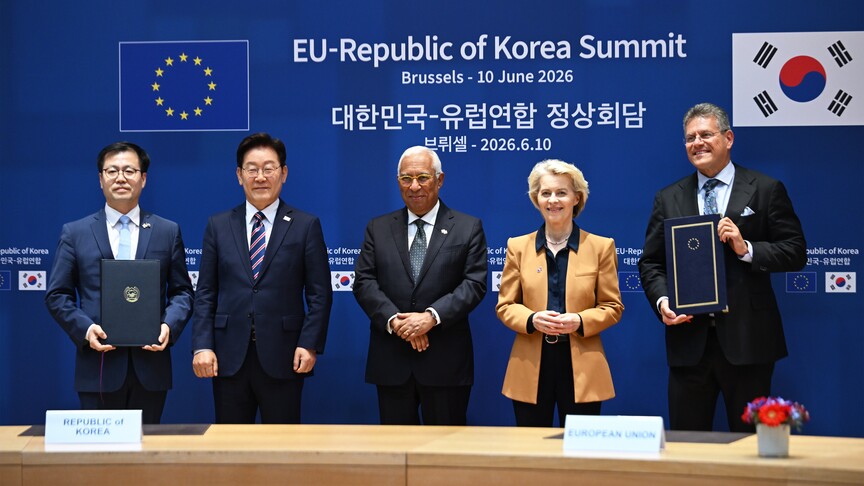
The European Union and South Korea pledged Wednesday to deepen their cooperation, stressing that security in Europe and the Indo-Pacific has become increasingly interconnected amid growing global challenges.
At the 11th EU-South Korea Summit in Brussels, European Council President Antonio Costa, European Commission President Ursula von der Leyen, and South Korean President Lee Jae-myung agreed to begin negotiations on a Security of Information Agreement, a move aimed at facilitating the secure exchange of classified information.
"Our security is more interconnected than ever," von der Leyen said, citing the North Korean troops fighting alongside Russian forces in Ukraine as evidence that developments in one region can have direct implications for another.
She praised Seoul for its support for Ukraine, describing South Korea as "one of Europe's closest partners in the Indo-Pacific region and on the global stage."
Von der Leyen said the partners would also work together to strengthen economic resilience, secure access to critical raw materials, and protect sensitive technologies from external vulnerabilities.
Echoing that view, Lee said security in the Indo-Pacific and Europe is becoming increasingly linked as uncertainties in the international order grow.
"We agreed to begin negotiations on a security of information agreement to strengthen bilateral security and defense cooperation with growing uncertainties in the international order," Lee said, expressing hope that the accord would be adopted soon to enable the safe sharing of confidential information.
Lee called for continued EU support in addressing North Korea's nuclear program and advancing peace on the Korean Peninsula.
Costa said the EU and South Korea are "trusted strategic partners and friends" that share a commitment to democracy, the rule of law, multilateralism, and a rules-based international order.
"I believe we agree that we cannot allow any state to use military aggression to threaten the peace, sovereignty, and territorial integrity of any country. Otherwise, the global order would collapse into chaos," he said.
The leaders also agreed to establish a new competitiveness partnership and a high-level economic dialogue covering trade, investment, industrial policy, economic security, and artificial intelligence.
Alongside security cooperation, the two sides signed a landmark Digital Trade Agreement designed to strengthen data flows, boost e-commerce, and deepen digital economic integration.
The summit additionally focused on energy security, with both sides agreeing to expand cooperation in hydrogen, offshore wind, and nuclear energy, including small modular reactors, supported by a new high-level energy dialogue.
The leaders also discussed regional and global security issues, including the Korean Peninsula, the Indo-Pacific, the Middle East, and the ongoing war in Ukraine.