Melike Pala
26 May 2026•Update: 26 May 2026
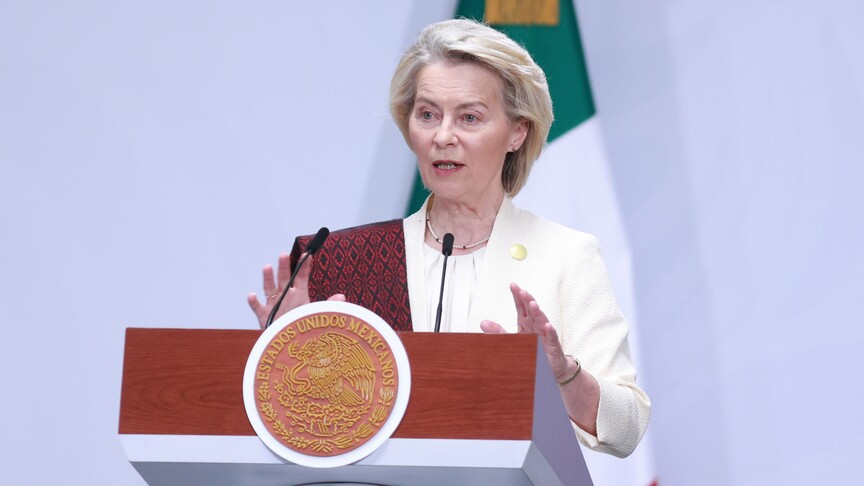
European Commission President Ursula von der Leyen on Tuesday said that recent security incidents in the Baltic region show Europe is facing a unified security challenge, unveiling new measures to strengthen the EU's eastern flank and counter hybrid and aerial threats.
Von der Leyen said at a joint press conference in Vilnius, Lithuania's capital, alongside the host country's president and the presidents of Estonia and Latvia, Gitanas Nauseda, Alar Karis, and Edgars Rinkevics, respectively, that the situation in the Baltic states reflects a broader European security reality.
"Europe stands in full solidarity and unity with Estonia, Latvia, and Lithuania, because when Baltic states are being tested, Europe as a whole is being tested," von der Leyen added.
Her remarks came after recent drone incidents and airspace violations reported across Lithuania and neighboring states, which authorities described as part of a broader pattern of hybrid pressure linked to the ongoing war in Ukraine.
She said the incidents were "not isolated" but part of a "deliberate strategy" aimed at destabilizing European democracies through hybrid tactics, cyberattacks, and disinformation campaigns.
She announced that Baltic states would receive an additional €12 billion (about $13 billion) under the SAFE security mechanism, alongside a reallocation of €1.5 billion from cohesion funds to support defense preparedness, border surveillance, and economic security.
"We have adapted our existing tools to the new realities on the ground, and we will follow the same approach in the next long-term budget," von der Leyen said.
She said the Eastern Flank Watch should become a flagship pillar of Europe's security architecture, including a joint NATO assessment of counter-drone and early warning systems to identify gaps in air defense and surveillance.
Von der Leyen said the EU must accelerate the development of counter-drone systems and strengthen regional coordination to respond to evolving threats.
She also called for a European protocol for hybrid incidents, including cyberattacks, foreign interference, and disinformation campaigns, to enable rapid mobilization of EU instruments in crises.
Asked about calls from the United States to lift European Union sanctions on Belarusian fertilizers, von der Leyen said there is no basis for easing restrictions as long as the underlying conditions have not changed.
Responding to questions about reports of a possible EU envoy for direct talks with Russian President Vladimir Putin, including speculation around possible candidates, von der Leyen declined to comment on names but stressed that Europe remains committed to peace.
Lithuanian President Gitanas Nauseda said recent drone activity near Lithuanian and regional airspace demonstrated that Europe is facing a "new security reality."
"I want to state very clearly the Baltic States have not allowed and will not allow their territory or airspace to be used for attacks against other countries," he said, responding to Russian claims about approval for Ukrainian drone flights.
Nauseda said Baltic states are "not sufficiently secure today" and called for faster implementation of the Eastern Flank Watch initiative, including enhanced airspace surveillance, air defense systems, and military mobility across the region.
"Words of solidarity alone are no longer enough. Europe must take swift and concrete action," he said.