- 'It's very problematic because it creates like a normalization of the violence which is going on,' Belgian actress and one of key organizers behind event, Katrien De Ruysscher, tells Anadolu
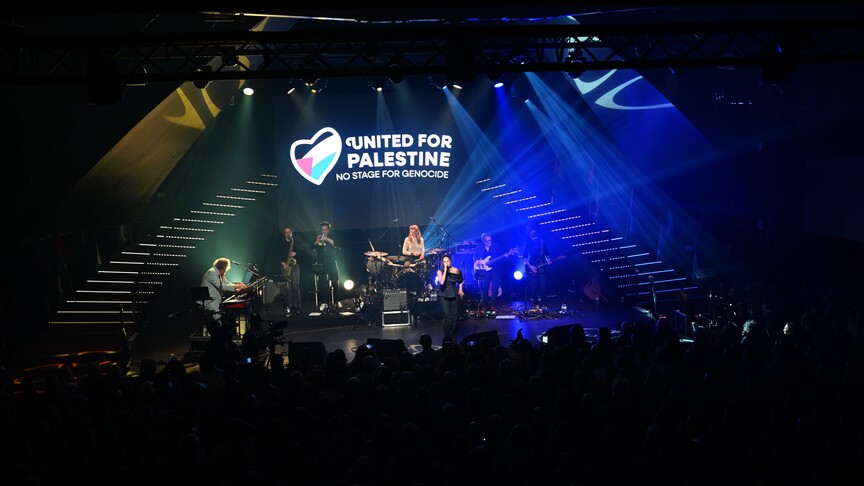
Artists staged an alternative musical event in Brussels in protest against Israel's participation in the Eurovision Song Contest, with organizers saying the competition has abandoned its founding values of unity and human rights.
Speaking exclusively to Anadolu, Belgian actress and one of the driving forces of the event, Katrien De Ruysscher, said the initiative, titled "United for Palestine," was created after organizers learned Israel would participate in this year's Eurovision while Belgian broadcasters would continue participating in the contest.
"We found that the participation of Israel is very problematic due to the genocide in Gaza and everything. So we decided maybe we should create like a counter event, an event that focuses on the meaning of the Eurovision Song Contest, which is uniting people and the values of human rights. And that's why we try to create this event," De Ruysscher said.
The event, held on Tuesday in Brussels, coincided with the Eurovision first semi-final in which Belgium and Israel appeared on the same night.
Organized by Belgian NGOs, unions, and solidarity groups, the festival carried the slogan "Don't watch Eurovision. No stage for genocide."
The program featured former Belgian Eurovision contestants, local musicians, and Palestinian artists, combining musical performances with solidarity messages.
'Normalization of violence'
Israel's participation in this year's Eurovision competition in Vienna has triggered growing criticism across Europe.
Following the European Broadcasting Union's (EBU) decision to allow Israel to compete, broadcasters in Iceland, Ireland, the Netherlands, Slovenia, and Spain decided to withdraw from the contest.
De Ruysscher said Israel's inclusion in Eurovision contributes to what she described as the normalization of violence in Gaza.
"It's very problematic because it creates like a normalization of the violence which is going on. And that is very problematic in the cultural world, but also in the academic world. We have to give important signals that we don't allow it," she said.
She also criticized Belgian political leaders for failing to take stronger action over the war in Gaza, saying: "They act too little; they don't do enough."
"I think it's very important that the public and the people in the audience speak up and that we continue to protest," De Ruysscher stressed.
Referring to Saturday's Eurovision final, De Ruysscher argued that the competition's future legitimacy is now called into question.
"I think this weekend on Saturday, when the final of the Eurovision Song Contest will take place, the future of the Eurovision Song Contest will be written," she said.
EBU made Eurovision 'political'
The EBU, which organizes Eurovision, has repeatedly defended the contest as a non-political event.
But De Ruysscher rejected that argument, pointing to Russia's exclusion from the competition following the war with Ukraine.
"They say Eurovision is not political, but they made it political... Russia is not allowed to participate; Israel is. I think within the form that the Eurovision Song Contest is right now, it has no future," she said.
"I think it has to go back to the real values of the contest, which was after the Second World War: to unite the countries, and now the countries are all separated. So I think within the form it is now, I don't believe it will exist," De Ruysscher noted.
She said artists have a responsibility to address political and humanitarian crises rather than remain silent.
"I think arts and culture are always related to the world we live in. In music, in theater, in everything. It's the importance of the reality we live in," De Ruysscher said.
Acknowledging that Eurovision performers represent their countries on an international stage, she stressed that artists carry an important moral responsibility.
"I think artists have to speak out. They have a very, very, very important and valuable voice. So it's my call; speak up, don't be silent," she added.