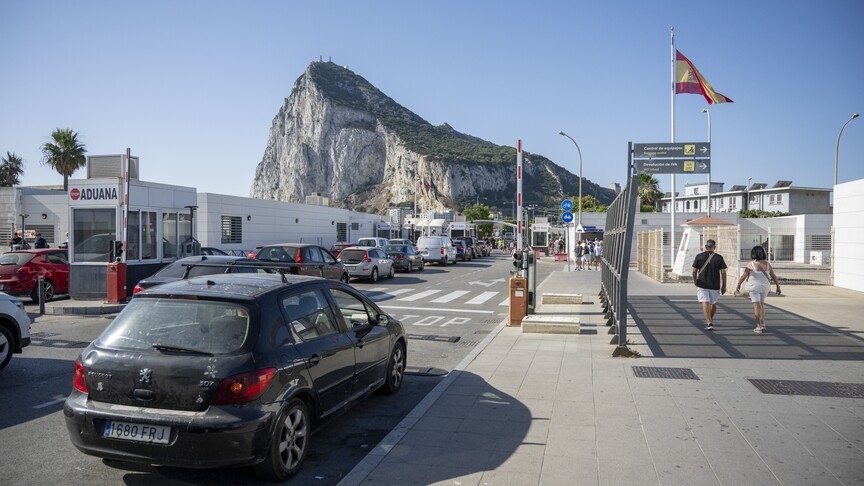
The UK and the EU are expected to formally sign a long-awaited agreement governing Gibraltar’s relationship with the bloc after Brexit, marking a significant step toward resolving one of the most complex outstanding issues left by Britain’s departure from the EU.
The deal focuses on the movement of people and goods across the Gibraltar-Spain border, aiming to preserve economic ties while avoiding a hard land border.
Here is what to know about Gibraltar and why the agreement matters.
What is Gibraltar?
Gibraltar is a British Overseas Territory located on the southern tip of the Iberian Peninsula, overlooking the entrance to the Mediterranean Sea.
Covering just under 7 square kilometers (2.7 square miles), it shares its only land border with Spain while facing Morocco across the Strait of Gibraltar.
Despite its small size, Gibraltar occupies one of the world’s most strategically important maritime locations, controlling access between the Atlantic Ocean and the Mediterranean.
Why is Gibraltar British?
Britain captured Gibraltar during the War of the Spanish Succession in 1704.
Under the Treaty of Utrecht in 1713, Spain formally ceded Gibraltar to Britain “in perpetuity.”
Spain, however, has never abandoned its claim to the territory, arguing that Gibraltar should ultimately return to Spanish sovereignty.
The sovereignty dispute remains one of Europe’s longest-running territorial disagreements.
What do Gibraltarians want?
Residents have consistently rejected Spanish sovereignty.
In a 1967 referendum, nearly all voters chose to remain British.
A second referendum in 2002 overwhelmingly rejected a proposal for Britain and Spain to share sovereignty.
Successive British governments have pledged not to alter Gibraltar’s status without the consent of its people.
Why did Brexit create a problem?
Although Gibraltar is British, it was part of the European Union through the UK’s membership.
When Britain left the EU in 2020, Gibraltar also exited the bloc.
Unlike Northern Ireland, Gibraltar had no permanent arrangement governing its relationship with the EU after Brexit.
Without a new agreement, customs checks and border controls risked disrupting the daily movement of workers, tourists, and goods.
Why is the border so important?
Around 15,000 people cross the Gibraltar-Spain border every day, many of them Spanish residents who work in Gibraltar.
The territory’s economy relies heavily on this cross-border workforce, particularly in financial services, tourism, online gaming, construction, and hospitality.
Any significant delays at the border could have major economic consequences for both Gibraltar and neighboring Spanish communities.
What does the new agreement do?
The agreement seeks to maintain smooth movement across the frontier while preserving Gibraltar’s British sovereignty.
Although implementation details will continue to evolve, the framework includes easier movement of people across the land border, simplified customs procedures for goods, closer cooperation between British, Spanish, and EU authorities, as well as measures aimed at preventing long queues and economic disruption.
The deal does not transfer sovereignty over Gibraltar to Spain.
Why does the agreement matter?
For Britain, the agreement removes one of the final unresolved issues stemming from Brexit.
For Spain and the EU, it provides greater certainty over border management and regional cooperation.
For Gibraltar, the deal offers greater economic stability by protecting access for workers, businesses, and visitors.
Why is Gibraltar still strategically important?
Beyond the political dispute, Gibraltar remains one of the world’s most significant military and maritime locations.
The Royal Navy maintains a permanent presence there, while commercial vessels passing between Europe, Africa, and Asia continue to transit through nearby waters.
Its position at the entrance to the Mediterranean has made Gibraltar strategically valuable for more than three centuries, and it continues to play an important role in NATO maritime operations and international shipping.
As the UK and EU move to implement the agreement, Gibraltar is expected to remain British while becoming more closely integrated with its European neighbors in practical day-to-day matters, reducing one of the last major sources of Brexit-related uncertainty.