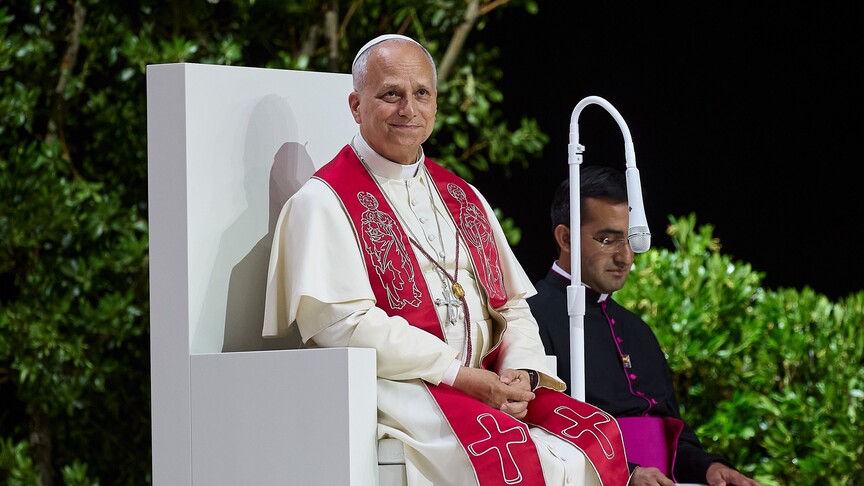
Pope Leo XIV's weeklong visit to Spain is already proving historic on several fronts, marking the first papal trip to the country in 15 years, the first address by a pope to Spain's parliament and the first papal visit to the Canary Islands, a key gateway for migrants reaching Europe from Africa.
But beyond the symbolism, the visit is also offering one of the clearest indications yet of the priorities of Leo's papacy. Through a series of speeches, meetings and symbolic stops, the pontiff has placed migration, peace and social cohesion at the center of his message at a time when Europe faces growing political divisions over border policy and international conflicts.
Leo arrived in Spain on Saturday for a visit running through June 12, with stops in Madrid, Barcelona and the Canary Islands.
Welcomed by King Felipe VI, Queen Letizia and Prime Minister Pedro Sanchez, the pontiff became the first pope to visit Spain since Pope Benedict XVI attended World Youth Day in Madrid in 2011.
The trip also marks Leo's first visit to a major European Union country outside Italy since becoming pope and comes two months after his apostolic journey to Africa.
One of the most significant moments of the trip came on Monday when Leo became the first pope in history to address Spain's parliament during a joint session of the Congress of Deputies and the Senate.
In a speech that drew a seven-minute standing ovation, Leo urged political leaders to place moral responsibility above shifting political interests and warned against the growing polarization that has come to characterize public debate in many democracies.
"Those who exercise public responsibility have a special obligation to safeguard language and help disarm rhetoric," he said, calling for disagreement without humiliation and political debate without contempt.
The pope also used the address to reiterate his support for diplomacy and international law, warning against the assumption that military rearmament is an inevitable response to global instability.
The message echoed positions that have increasingly put Leo at odds with the US government. During his flight to Madrid, the pope rejected suggestions that the conflict involving Iran could be considered a "just war," arguing that modern weapons have rendered traditional just-war concepts increasingly obsolete.
Earlier this year, he directly described US President Donald Trump’s threat to wipe out the entire Iranian civilization as “unacceptable,” prompting the US president to accuse the pontiff of being "weak and terrible on foreign policy.”
During his address on Monday, he also stressed the importance of historical memory rooted in truth and reconciliation, a particularly sensitive issue in Spain where debates over the legacy of the Civil War and dictatorship remain politically divisive.
He also condemned abortion and euthanasia, both of which are legal in Spain and remain subjects of political debate.
Migration has emerged as a central theme throughout the visit.
In his parliamentary address, Leo argued that migration should be viewed not merely as a question of managing borders but as a moral and legal issue requiring respect for human dignity.
He called for stronger search-and-rescue efforts, legal migration pathways and policies that address the root causes driving people to leave their homes, including conflict, poverty and climate-related pressures.
"The tragic drama of migration challenges the conscience of nations and the ethical foundations of the international order," he said.
The pope also warned against discrimination based on nationality, ethnicity, religion, language or social status, arguing that such practices undermine the principle of equal human dignity.
The focus reflects a priority of Leo's papacy, which has consistently emphasized the plight of migrants and refugees.
Another notable moment during the visit is expected to be Leo's private meeting with victims of sexual abuse within the Catholic Church on Monday.
The meeting marks a first during a papal visit to Spain, although some advocacy groups have criticized the closed-door format and called for greater transparency and accountability.
The issue has also featured prominently in the pope's public remarks during the trip.
Speaking to Spanish bishops on Monday, Leo described clergy abuse as one of the Church's most painful challenges and referred to it as a "plague" that demands a response based on "listening, truth, justice and reparation."
"Each wounded person must be able to find sincere listening, welcome, protection and real paths to healing," he said.
The issue remains particularly significant in Spain, where a 2023 report by the national ombudsman estimated that 1.13% of Spain's current adult population, or roughly 440,000 people, suffered abuse during childhood.
From Tuesday, Leo will continue his trip in Barcelona, where he is scheduled to visit Brians 1 prison, underscoring his vision of a Church focused on marginalized communities and those living on the edges of society.
The visit coincides with the centenary of the death of Antoni Gaudi, the Catalan architect behind the Sagrada Familia basilica.
Construction of the landmark church began in 1882 and continues today, making it one of the world's most famous unfinished religious buildings and a symbol of Barcelona itself.
Leo is expected to celebrate Mass at the basilica and bless the Tower of Jesus Christ, which will become the tallest structure within the Sagrada Familia complex.
Perhaps the most symbolically significant stage of the trip will come in the Canary Islands, where migration will again take center stage.
The Spanish archipelago has become one of Europe's main entry points for migrants attempting the dangerous Atlantic crossing from West Africa, with tens of thousands arriving each year and more than 12,000 dying on the voyage since 2024, according to the NGO Walking Borders.
Leo's visit will mark the first time a pope has traveled to the Canary Islands.
During his stay, he is expected to meet migrants, aid organizations and local church representatives working on the front lines of one of Europe's most pressing humanitarian challenges.
The pope will also visit the Las Raices reception center and hold meetings with organizations assisting migrants arriving on the islands.
The trip reflects Leo's repeated calls for governments to approach migration through the lens of human dignity rather than political rhetoric.
In a message marking last year's World Day of Migrants and Refugees, he said: "In a world darkened by war and injustice, even when all seems lost, migrants and refugees stand as messengers of hope."
Taken together, the stops in Madrid, Barcelona and the Canary Islands suggest a papacy increasingly focused on some of the world’s most contentious issues, while seeking to promote dialogue, reconciliation and solidarity.
news_share_descriptionsubscription_contact