Anadolu staff
20 July 2026•Update: 20 July 2026
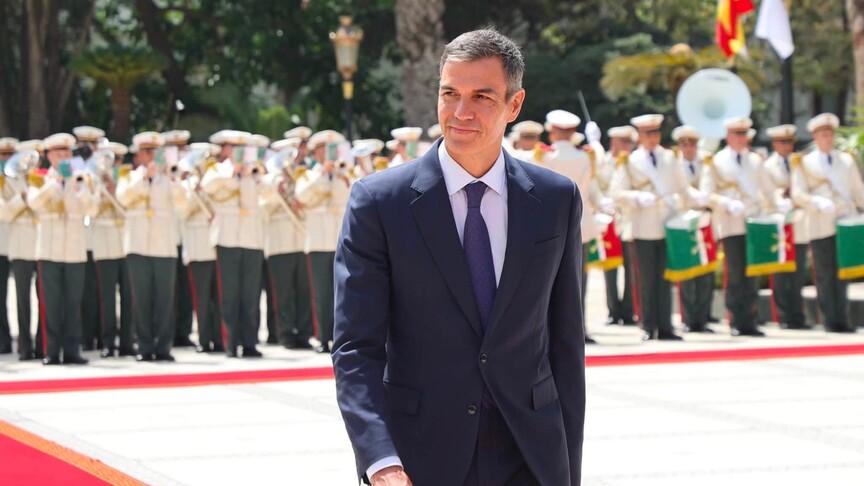
Spain and Algeria are seeking to strengthen a relationship that has steadily recovered from one of the deepest diplomatic crises in their recent history, as Spanish Prime Minister Pedro Sanchez arrived in Algiers on Monday for an official visit.
The visit is expected to mark the highest-level political engagement between Spain and Algeria since the two countries rebuilt diplomatic ties following a dispute over Western Sahara, a sparsely populated territory on Africa's Atlantic coast whose political status has remained unresolved for decades.
Sanchez flew from New York after attending Spain's World Cup final win over Argentina. He is traveling with Deputy Prime Minister and Ecological Transition Minister Sara Aagesen and Foreign Minister Jose Manuel Albares.
During his one-day visit, he will hold talks with Algerian Prime Minister Sifi Ghrieb and President Abdelmadjid Tebboune. A joint statement by Sanchez and Tebboune is expected afterward, followed by an official lunch. Sanchez is also due back in Madrid later Monday to receive Spain's World Cup-winning squad at the Moncloa Palace.
Why the relationship broke down
The diplomatic freeze began in March 2022 due to a sharp disagreement over Western Sahara, a vast and resource-rich territory in North Africa which was administered by Spain until 1975.
For nearly five decades, the status of Western Sahara has been a major source of tension in the region.
It remains contested because Morocco claims sovereignty over the territory, while the Algeria-backed Polisario Front is seeking independence and has declared the Sahrawi Arab Democratic Republic, recognized by some African Union member states. The UN considers Western Sahara a non-self-governing territory.
For decades, Spain avoided publicly supporting either side's preferred outcome, instead backing the UN-led peace process.
In 2022, Spain shifted policy by endorsing Morocco’s proposal for limited autonomy for Western Sahara under Moroccan sovereignty.
Algeria viewed the shift as a break from Spain's longstanding position and responded by recalling its ambassador, suspending a bilateral friendship treaty and restricting parts of its trade with the country.
Why the visit matters
Spain and Algeria are separated by less than 200 kilometers (125 miles) across the Mediterranean, making them close economic and security partners.
Algeria is one of Spain's main suppliers of natural gas, while the two countries also cooperate on migration, counterterrorism and stability in North Africa and the Sahel.
For both governments, maintaining that cooperation has become increasingly important as Europe seeks reliable energy supplies and countries around the Mediterranean face shared security challenges.
Energy and migration high on the agenda
Beyond diplomacy, energy security is a driving motive for the visit.
Algeria supplies roughly 34% of Spain's gas imports, delivered mainly through the Medgaz pipeline alongside liquefied natural gas shipments, and Madrid is seeking to grow that volume while also exploring joint renewable and green hydrogen projects.
Executives from four major Spanish energy companies — Repsol, Naturgy, Moeve and Enagas — are accompanying the delegation, underscoring how central the energy relationship is to the trip.
Two-way trade topped 8.5 billion euros last year, with over 100 Spanish firms present in the Algerian market.
Migration cooperation is also expected to feature in the discussions. Spain and Algeria have worked together in recent years to address irregular migration across the western Mediterranean, an issue that remains a shared priority alongside counterterrorism and regional stability.