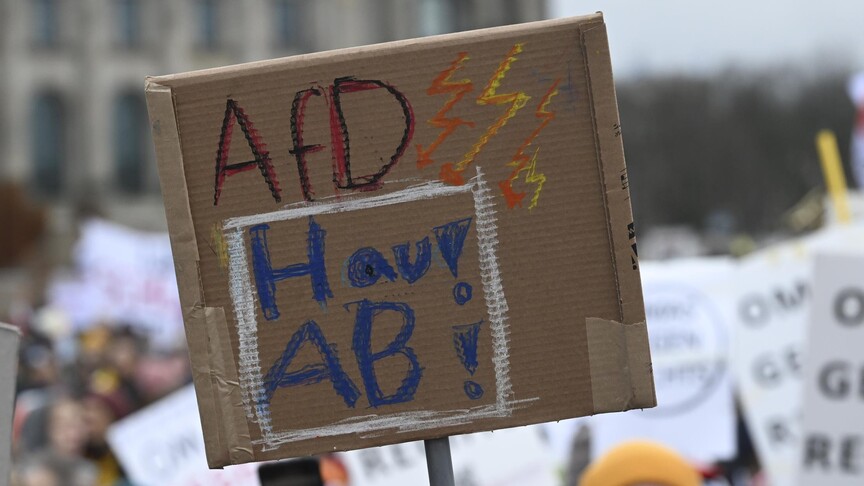
Voters in the eastern German state of Saxony-Anhalt elect a new parliament on Sunday, with the far-right Alternative for Germany well ahead of every other party and Chancellor Friedrich Merz’s Christian Democrats (CDU) sliding toward one of their weakest results in a region they have governed for decades.
Polls put the AfD above 40%, which would be the party’s strongest showing in any state election. If several smaller parties fall short of the 5% threshold needed to enter the legislature, the far right’s path to an outright majority — and to forming a state government for the first time — could become possible.
According to experts who have long studied political and social change in Germany’s ex-communist east, the AfD’s surge there has been fueled by the migration crisis, the economic fallout of later shocks — including the war in Ukraine — and the failure of Chancellor Merz, the CDU and recent coalition governments to address eastern voters’ concerns.
“Even after nearly 36 years of reunification, the East has not reached West Germany’s prosperity level,” said Jana Hensel, an expert on eastern Germany, adding that enormous economic and social differences remain between the western states and the east.
“We still conduct all the important inner-German debates from a West German perspective. Many East Germans have the feeling of living on the periphery of the country and of not being seen,” she told Anadolu.
That discontent has become most evident in the collapse of support for Merz’s Christian Democrats in Saxony-Anhalt. The CDU has governed the state with changing coalition partners for decades. In 2021, it won 37.1% and formed a government with the Social Democrats and Free Democrats. Five years later, the same party is polling around 23%.
Hensel, who has written several books on eastern Germany, said Sunday’s election is not only about state and local politics. Anger at Merz’s economic policy in Berlin and at the government’s course on Ukraine has fed the AfD’s gains, she said.
“In East Germany, there is a widespread feeling that people do not feel seen. And of course this state election is also a ‘no’ to Friedrich Merz,” she said. “It’s also a vote against the federal government’s policies. It’s a vote against Friedrich Merz’s reform package,” she added, pointing to the chancellor’s unpopular plans on tax, pensions and healthcare.
Antipathy toward Merz in Saxony-Anhalt has been strong enough that CDU lead candidate and Premier Sven Schulze spent the campaign distancing himself from Berlin, while the chancellor largely stayed away from major public rallies and voter-facing events.
The AfD has gained momentum in Saxony-Anhalt behind Ulrich Siegmund, a popular far-right politician who has reached beyond the party’s traditional base.
The 35-year-old has run a highly visible campaign, with a strong social media operation and close contact with voters. So confident of victory, he has already published a government program and a 100-day plan built around tougher immigration rules.
Siegmund has pledged to expel people without legal status “from the first minute,” expand deportation detention from a handful of sites to hundreds and require asylum seekers to work or lose benefits.
Steffen Mau, a professor of sociology at Humboldt University in Berlin, noted that the message is resonating in a state with weaker growth than much of Germany, higher unemployment and an older, shrinking population.
“The population overall is shrinking, but migration is increasing,” Mau told Anadolu. “So very often shrinking societies fear migration, fear newcomers.” That pattern, he added, “is something that we can observe not only there, but also in other East German parts.”
While the AfD climbs on an anti-immigration platform, mainstream parties warn that a far-right victory would sour the political climate, deepen polarization and further embolden neo-Nazis and other right-wing extremist groups.
Germany’s domestic intelligence agency has classified the AfD’s Saxony-Anhalt branch as a confirmed far-right extremist organization. Citing that assessment, the CDU and the other mainstream parties have said throughout the campaign that they will not cooperate with the AfD or enter a coalition with it after Sunday’s vote, regardless of the result.
As the AfD has campaigned hard in Saxony-Anhalt, the war in Ukraine has been its other main line of attack on Merz. During the election campaign, the party has said Germany should end military and financial support for Kyiv, lift energy sanctions on Moscow and return to cheap Russian gas.
Experts say the war has laid bare the gap in priorities between west and east. In much of western Germany, cutting Russian energy and arming Ukraine were widely seen as a strategic necessity. In parts of the east, those same policies were often treated as decisions imposed from outside, with ordinary households left to pay the price in higher energy bills.
“Nothing has benefited the AfD as strongly as Russia’s war of aggression against Ukraine. Since then it has grown again,” Hensel said. The party, she continued, “grew in 2015 during the migration crisis and now again since the start of Russia’s war of aggression. That is the decisive reason.” East and West, she added, “look at this conflict differently.”
Hensel said Merz’s government had not answered those eastern doubts and that, unlike under former Chancellor Angela Merkel, the lack of diplomatic efforts has further strengthened the AfD’s hand on this topic.
As the latest polls show the AfD still rising and the CDU heading for one of its worst results, many analysts expect a large far-right win and a weak night for the conservatives on Sunday to reopen debate over Merz’s standing inside his own party.
“I think it's quite significant, we will have a shift in the political landscape, an enormous success, most possibly for the right-wing extremist AfD,” Mau said. “And this will have repercussions on the federal government in Berlin. It will put Chancellor Merz very much under pressure.”
A poll by public broadcaster ARD this week found 83% of eligible voters nationwide dissatisfied with Merz’s performance, the lowest satisfaction rating the survey has recorded for a sitting chancellor.
Hensel said the result in Saxony-Anhalt would likely shake politics in Berlin and could have consequences for Merz, triggering a debate within his own party.
“What happens in Berlin in the coming days, nobody can say at the moment. I don’t think the coalition government will collapse,” she said. “But whether Friedrich Merz will continue to be chancellor of the Federal Republic — one can at least put a question mark after that.”
A leadership fight in the Christian Democrats after the election would not by itself dissolve the Bundestag or trigger a snap election. If party pressure forces Merz out, parliament could elect a new chancellor without a national vote.
news_share_descriptionsubscription_contact

contact_the_ombudsman
is_there_an_error_in_this_story