Oliver Towfigh Nia
23 October 2026•Update: 23 October 2026
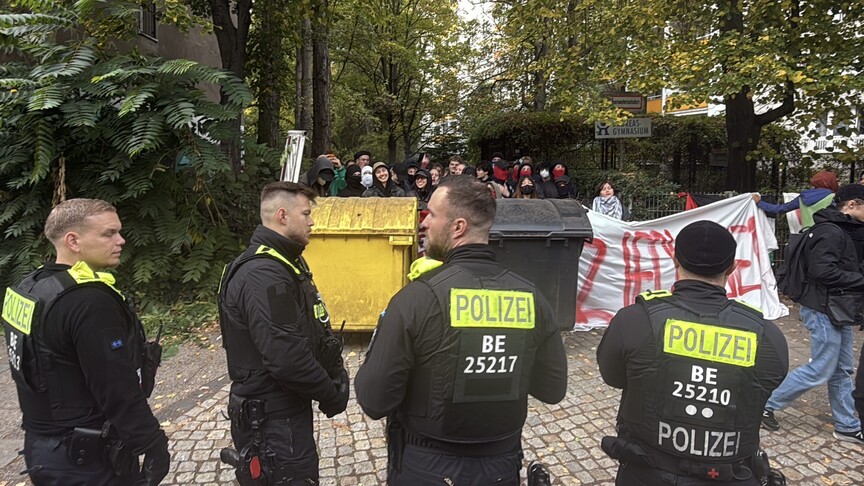
A German student organization and opposition party The Left voiced support Thursday for protests planned for late October calling for increased funding and investment in education and better conditions at schools, according to press reports.
The Federal Student Conference supports the protests planned for Oct. 31 in many German cities, Isabelle Seltenreich, a spokesperson for the organization, told the daily Rheinische Post newspaper.
She added that students have both the right and every reason to take to the streets to advocate for improvements to the education system.
The youth and student movements GenZ regelt’ (Gen Z Takes Charge) and GenZ steht auf (Gen Z Stands Up) have launched online campaigns to mobilize support for the protests.
They also advocate for greater climate protection, measures to address the rising cost of living and opposition to mandatory military service, with the initiative explicitly rejecting the use of violence.
Seltenreich said the Federal Student Conference shares many of the demands that have also emerged during protests in France and Italy.
"These include, among other things, better facilities and infrastructure in schools, a sufficient number of teachers, smaller class sizes, improved learning conditions, and an education system that offers equal opportunities to all young people, regardless of their social background," she said.
With regard to France and Italy, she warned that such protests could be exploited by various political groups.
Seltenreich’s support for the protest movement was partially echoed by Ines Schwerdtner, the co-chairwoman of the opposition party The Left.
In a video briefing with the Socialist Democratic Student Association (SDS), she said that what is working in France—connecting various movements—must now also be achieved in Germany.
Schwerdtner assured the activists of the SDS—an organization currently under surveillance by the domestic intelligence agency in the southern states of Bavaria and Baden-Wuerttemberg—by saying: "I will stand in your defense—no matter who attacks you, whether it be the police or the media."
In France, students have been protesting since the end of September, calling for better school facilities, more teachers, and improved learning conditions. Similar protests have since spread to Italy. In both countries, these demonstrations have also involved acts of violence.
Separately, Jochen Kopelke, the federal chairman of the German Police Union (Gewerkschaft der Polizei), said he believed that the German police are better prepared to handle violent protests than their French counterparts.
"I believe the quality and professionalism of the German police are of a different caliber," Kopelke told newspapers belonging to the Mediengruppe Bayern.
He noted that the "guardrails"—the operational frameworks—in Germany are more modern and place a much greater emphasis on communication.
"We employ different tactics and use different equipment," he noted.
Baden-Wuerttemberg Interior Minister Manuel Hagel told the daily BILD newspaper that there are concrete indications that the protests are set to spread to his state.
"We will do everything in our power to prevent this 'protest tourism' from reaching our state," he said.
Hagel added that there are now "specific calls to bring the violent protests from France over to us in Baden-Wuerttemberg."
He was backed up by his Bavarian counterpart Joachim Herrmann, who also announced a zero-tolerance strategy.
“In Germany, we must do everything in our power to ensure that riots like those in France are prevented from the outset. We certainly protect the right to freedom of assembly—there is no question about that. But we will deploy a strong police presence to ensure that no violent confrontations, acts of arson, or similar incidents occur—the kind we witnessed in France,” Hermann told BILD.