- Bloc needs more independent, diplomacy-driven approach less reliant on US, he tells Anadolu
- He further blames Brussels for applying international law selectively in its responses to Russia and Israel, calling it 'geopolitical choice'
- While the bloc has rapidly adopted 20 packages of sanctions against Russia since 2022, it has taken no comparable measures against Israel, he says
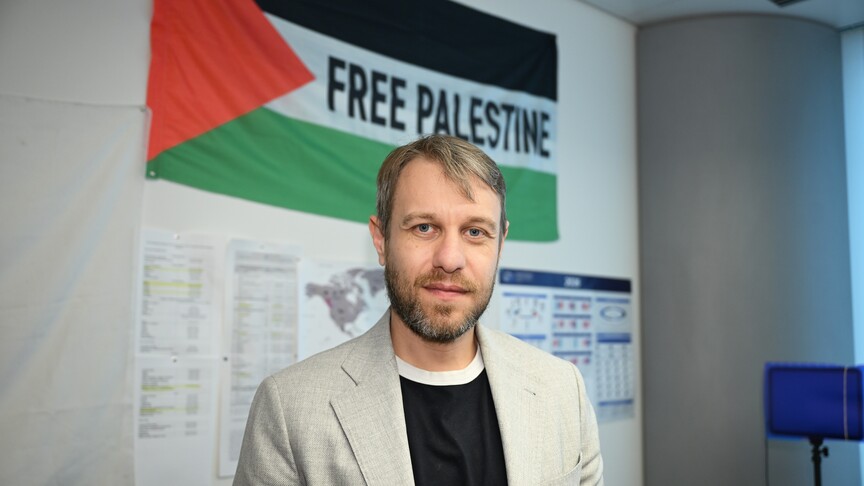
EU's foreign policy is driven by geopolitical choices and double standards rather than a consistent commitment to international law, Italian Member of the European Parliament Danilo Della Valle told Anadolu, calling for a fundamental overhaul of the bloc's external relations strategy.
In an exclusive interview, Della Valle delivered a scathing critique of the bloc's diplomatic trajectory, arguing that its inability to apply the same principles to Israel's actions in Gaza as it does to war in Ukraine exposes a deep-seated geopolitical double standard.
Della Valle's remarks come amid growing debate within Europe over the future direction of EU foreign policy, including disagreements over Russia, Gaza, and the bloc's broader role on the world stage.
He criticized what he sees as an excessive focus on Eastern Europe and security concerns linked to Russia, arguing that the bloc's foreign policy does not adequately reflect the priorities of Southern European member states.
"Now our foreign policy is based on the Eastern front," he said.
Referring to Kallas, who is from Estonia, and EU Defense Commissioner Andrius Kubilius of Lithuania, Della Valle suggested that the leadership's geographic background has influenced the EU's strategic outlook.
'Russia is our neighbor’
Della Valle further rejected the idea that Europe should isolate Russia indefinitely.
The criticism follows comments by EU foreign policy chief Kaja Kallas, who recently rejected suggestions that the bloc should seek a neutral role in efforts to end the Russia-Ukraine war, insisting that Europe would "never" be an impartial mediator because it has "been clearly on Ukraine's side."
For Della Valle, such positions illustrate what he views as a narrow and increasingly ineffective foreign policy approach centered primarily on confrontation rather than diplomacy.
"We need to base our foreign policy on diplomacy, cooperation... We need diplomacy to solve the war, because Russia is our neighbor, and geographically we will have Russia there also in 30 years, 40 years, so we need to speak also with them," he said.
"We have to speak with Ukraine, with Russia, with all countries involved in war, and also in countries that we consider the enemy," Della Valle added.
The debate has intensified as discussions continue within the bloc over whether to appoint a special envoy for future Russia-Ukraine peace talks.
While Kyiv has urged Europeans to take a more active role in negotiations amid the current diplomatic stalemate, Kallas has argued that the EU should focus instead on defining a common position regarding concessions, conditions and red lines for any future settlement.
"Maybe she (Kallas) wants a war with Russia, maybe she wants to fight. I don't know. Honestly, I don't understand her approach and her views about it," Della Valle said.
EU's double standards on Gaza
He added that Europe should apply the same level of commitment to Palestinians as it has demonstrated toward Ukraine.
"Why we are not helping Palestinian people with the same help that we are giving to Ukraine?" the Italian lawmaker asked.
Della Valle further accused EU institutions of applying international law selectively, particularly in their responses to war in Ukraine and Israel's actions in Gaza and the occupied Palestinian territories.
"We denounced the complicity of the EU a lot of times, because for us it's totally unacceptable that EU is not saying anything for the genocide in Gaza," he said.
While the bloc has rapidly adopted 20 packages of sanctions against Russia since 2022, it has taken no comparable measures against Israel despite the staggering humanitarian toll of its attacks in Gaza, which has claimed nearly 73,000 Palestinian lives, according to local health authorities.
"We never had a debate to condemn the Israeli violence in Palestine. We never voted on a resolution to condemn Israel and the US that are violating international law... For us (it) is unacceptable, and it shows the double standard policy of the European Union," Della Valle said.
This discrepancy, Della Valle insists, is not an oversight but a deliberate strategy.
"It is clear enough that we are adopting sanctions for Russia, not just because Russia is violating international law. Russia is violating international law, of course, but so why for Israel or US that are violating international law, we didn't adopt sanctions? Because this is a geopolitical choice," he said.
Most citizens want independent foreign policy
A recent Eupinions survey found that 73% of EU citizens believe the bloc should pursue a more independent foreign policy and "go its own way" internationally, up from 63% in a previous survey wave.
The study also recorded a significant decline in confidence in the United States.
Only 31% of respondents identified Washington as the EU's most important ally, compared with 51% in autumn 2024, while majorities in several Western European countries described the US as increasingly unreliable.
"I think Europe should change totally inside... and also outside," Della Valle said, adding that "Europe won't be truly independent" if the bloc does not have an independent policy and instead depends on the US.