Anadolu Ajansı © 2026


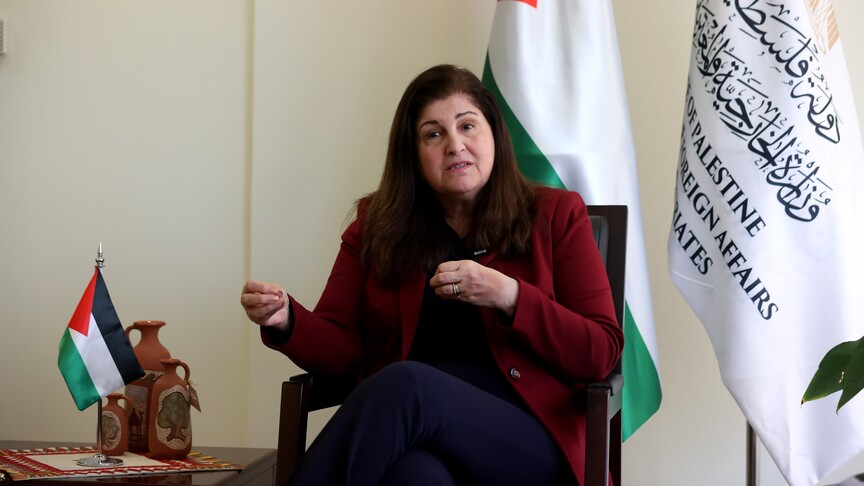
Palestinian Foreign Minister Varsen Aghabekian Shahin said a noticeable shift is emerging in the positions of several countries, particularly in Europe, regarding the Israeli occupation and illegal settlements, but stressed that this change must be translated into "practical measures on the ground."
In an interview with Anadolu, Shahin said there is "a growing trend toward Israel’s international isolation and greater sympathy for Palestinians," but warned that expressions of sympathy alone are no longer sufficient.
"The Palestinian issue is clear to the entire world and no longer needs more explanation," Shahin said, adding that what is lacking today is not understanding, but "the political will to turn that understanding into practical steps."
The world, she said, "fully understands what is happening in both the West Bank and Gaza," but continues to limit its response to statements of condemnation.
“What is needed now are practical decisions, not more statements,” she added.
Shahin said there has been a "noticeable change" in the rhetoric of several countries, particularly in Europe, where governments have become "more explicit" in describing Israeli occupation, settlements and occupier violence.
Spain, she said, has been "at the forefront in calling for concrete action," while Germany has also begun speaking "more openly about the occupation, settlements and attacks by Israeli settlers."
The Netherlands and other countries are also adopting more advanced positions, she added.
Shahin described this shift as significant and worth building on, but said it remains "below the level required."
“We need to accelerate this process and turn it into tangible steps on the ground,” she said.
According to Shahin, the current moment requires a transition from expressions of solidarity to real accountability.
“Israel does not respond unless there is a real price to pay,” she said, warning that reliance on condemnation alone only "encourages further violations."
“When there is no accountability, violations continue. This is what we have seen for many years, because Israel has become accustomed to impunity,” she added.
The International Criminal Court issued arrest warrants in November 2024 for Israeli Prime Minister Benjamin Netanyahu and former Defense Minister Yoav Gallant over war crimes and crimes against humanity in Gaza, but neither has been arrested.
Shahin said Palestinians are calling for clear measures, "whether through sanctions, legal action or diplomatic steps that reflect the seriousness of the international community."
“International law is clear, but the problem lies in its implementation,” she said.
Shahin said Palestinian diplomacy is moving intensively across international forums to push for stronger action.
She said Palestinian officials "are working at the United Nations and the Human Rights Council, while presenting files related to settlements, attacks by Israeli settlers, freedom of worship and the prisoners' law."
These efforts, she added, extend beyond international organizations to include direct engagement with governments and parliaments worldwide.
According to Shahin, these efforts have already led to important decisions, but the current stage requires more than decisions. “We need implementation.”
Shahin linked the urgency of international action to the deteriorating situation on the ground, particularly in the occupied West Bank.
“There is continued settlement expansion, repeated attacks by Israeli settlers and growing restrictions on the daily lives of Palestinians,” she said.
According to Shahin, Palestinians are facing some of the greatest pressure in decades, with the current phase carrying existential implications.
“The world cannot continue watching this reality without real intervention,” she added.
Her remarks come as Israeli military raids and attacks by Israeli occupiers in the occupied West Bank have intensified sharply since October 2023, fueling Palestinian fears of a de facto annexation.
Shahin said annexation is not a future possibility but an ongoing reality.
“Annexation never stopped. What we are seeing today is the gradual consolidation of this reality,” she said.
“The discussion of annexation is not new, but today we are seeing a faster effort to impose it on the ground,” she added.
Palestinians warn that these measures are paving the way for Israel to formally annex the occupied West Bank, ending prospects for a Palestinian state.
Shahin said living conditions in the occupied West Bank continue to worsen amid economic decline and rising unemployment.
“There are workers who have lost their sources of income and families that are unable to meet their basic needs,” she said.
She added that the Palestinian government’s financial crisis, particularly due to Israel’s withholding of Palestinian tax revenues, has further worsened the situation.
Israel has withheld large portions of Palestinian tax revenues for years and halted transfers completely in May, plunging the Palestinian Authority into one of its worst financial crises.
On Gaza, Shahin described the humanitarian situation as "catastrophic."
“Despite all the talk about agreements, the reality has not changed enough and aid is still not reaching Gaza in the required quantities,” she said.
“The health sector is on the verge of collapse, infrastructure has been devastated and civilians urgently need international intervention,” she added.
Shahin said one of the main challenges today is reorganizing Gaza’s administration within a unified Palestinian national framework, while preventing the emergence of parallel bodies outside the broader Palestinian political system.
She said contacts are underway with international actors regarding what has become known as the National Committee for the Administration of Gaza (NCAG).
The non-political body, formed under a US-backed plan, is tasked with managing Gaza’s day-to-day civil affairs.
Shahin said any future arrangements in Gaza must be fully coordinated with the Palestinian government in the occupied West Bank in a way that preserves the unity of Palestinian decision-making.
“Any absence of unified coordination will further complicate the situation,” she said, stressing that what is needed is a single political and administrative authority.
Shahin said Türkiye has been among the strongest supporters of the Palestinian cause, both politically and humanitarianly.
She said Ankara was among the first capitals to send aid to Gaza and has continued to support relief and development projects in the occupied West Bank and East Jerusalem.
“This support leaves a real impact on the ground,” she said.
Shahin added that Palestinian-Turkish relations are rooted in Türkiye’s longstanding support for Palestinian rights in international forums.
She thanked both the Turkish government and people for their continued solidarity with Palestinians, saying it "strengthens Palestinians’ ability to remain steadfast in the face of the current reality."
*Writing by Tarek Chouiref
news_share_descriptionsubscription_contact