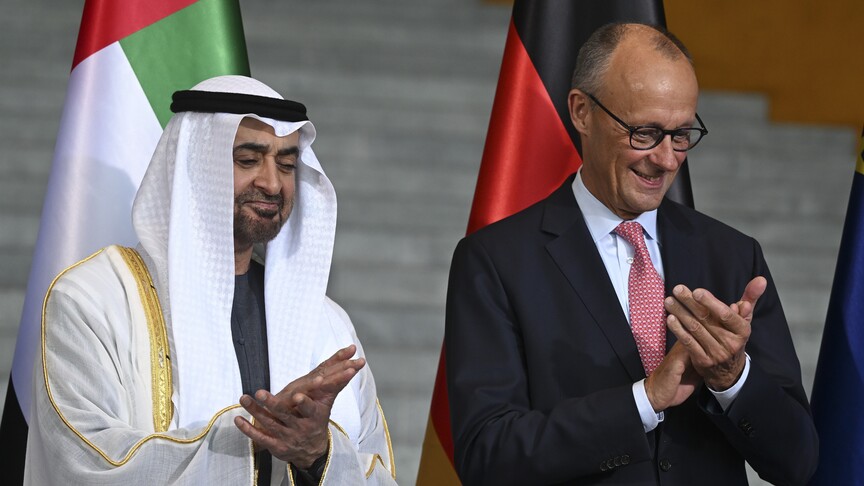
The leaders of the United Arab Emirates and Germany condemned Iranian attacks on the UAE and other regional states and reaffirmed support for a two-state solution to the Israeli-Palestinian conflict, according to a joint declaration issued Thursday.
The talks between UAE President Sheikh Mohamed bin Zayed Al Nahyan and German Chancellor Friedrich Merz, held at the Federal Chancellery in Berlin as part of bin Zayed’s state visit to Germany, covered cooperation in the economy, energy, renewable energy, innovation, technology, artificial intelligence, culture, and education.
Bin Zayed said the UAE views its relations with Germany as a long-term strategic partnership built on more than five decades of cooperation, trust, and shared interests.
He expressed hope that the launch of a “strategic dialogue” between the two countries during the visit would provide a new framework for their broad partnership.
Separately, the UAE announced plans to invest €40 billion ($46.8 billion) in Germany, targeting sectors including industry, advanced technology, artificial intelligence, digital infrastructure, and energy.
Of the total, €10 billion ($11.7 billion) will be allocated to the German state of Bavaria, said the official Emirates News Agency (WAM).
The UAE said the investment is aimed at strengthening its long-term economic partnership with Germany, supporting innovation and future technologies, and opening new opportunities for companies in both countries.
Bin Zayed also highlighted the 2026 UN Water Conference, which the UAE is set to host later this year, saying Germany would play an important role in the conference and praising Berlin’s contribution to global water sustainability.
The two leaders also reviewed regional and international issues, particularly developments in the Middle East, and exchanged views on them.
Iran, Strait of Hormuz, nuclear weapons
In their joint declaration, the two leaders condemned “in the strongest terms” Iranian attacks on the UAE and other regional states, including attacks on civilian infrastructure, describing them as violations of sovereignty, territorial integrity, and international law.
Bin Zayed expressed appreciation for Germany’s support and solidarity with the UAE in the face of Iranian attacks, while Merz reaffirmed Berlin’s solidarity with the UAE and other regional partners.
They also condemned what they described as Iran’s “de facto closure” of the Strait of Hormuz and its threats and attacks against merchant and commercial vessels.
The leaders demanded that Iran refrain from actions or threats aimed at closing or obstructing the right of transit passage through the strait or targeting merchant and commercial vessels in and around the strategic waterway.
They also reiterated the need to prevent Iran from acquiring a nuclear weapon and called for addressing what they described as threats from Tehran’s missile program, unmanned aircraft systems, and support for proxies and non-state actors.
Palestine, Sudan
On Palestine, bin Zayed and Merz reaffirmed their commitment to a negotiated, comprehensive, just, and lasting peace based on a two-state solution, leading to a sovereign, independent and viable Palestinian state alongside Israel based on the June 4, 1967 lines.
They backed implementation of the plan to end the conflict in Gaza, including the withdrawal of Israeli forces, reconstruction of the enclave and reunification of the occupied Palestinian territory under a reformed Palestinian Authority.
The two leaders called on Israel to abide by its commitments under the Sharm El-Sheikh protocol and on Hamas to cease all military operations, while urging all parties to support conditions for peace and security for Palestinians and Israelis.
They also “categorically” rejected unilateral measures aimed at altering the status of the occupied Palestinian territory, changes to the historical and legal status quo in Jerusalem, and actions leading to territorial or demographic changes, including the forced displacement of Palestinian civilians.
On Sudan, the leaders condemned attacks on civilians and humanitarian personnel and urged the Sudanese army and the paramilitary Rapid Support Forces (RSF) to immediately cease military operations that put civilians at risk. They called for an immediate humanitarian truce leading to a permanent ceasefire and an independent civilian-led government.
Lebanon, Syria, Ukraine
The two leaders also expressed solidarity with Lebanon and reaffirmed support for its unity, sovereignty, and territorial integrity. They backed the Lebanese government’s efforts to consolidate arms under state authority and welcomed the trilateral framework agreement between Lebanon and Israel.
On Syria, they stressed the importance of preserving the country’s unity, sovereignty, and territorial integrity and called on all parties to respect international law and the 1974 Disengagement Agreement.
The leaders also reaffirmed support for a comprehensive, just, and lasting peace in Ukraine in line with international law and the UN Charter, while calling for an urgent ceasefire in the Black Sea to facilitate grain exports and ensure global food security.
On bilateral relations, the joint declaration said the newly established strategic dialogue will cover regional and international security, defense, trade and investment, energy and climate, emerging technologies, digitalization, transportation, environment, culture, and education.
The leaders also welcomed the signing of 29 business-to-business memorandums of understanding and agreements between Emirati and German companies worth more than €9.35 billion.
They further agreed to deepen defense and security cooperation, welcoming letters of intent on exploring defense cooperation and on police and security cooperation.
Both sides also expressed their intention to continue working together to further develop bilateral relations and build on cooperation achieved in recent years.