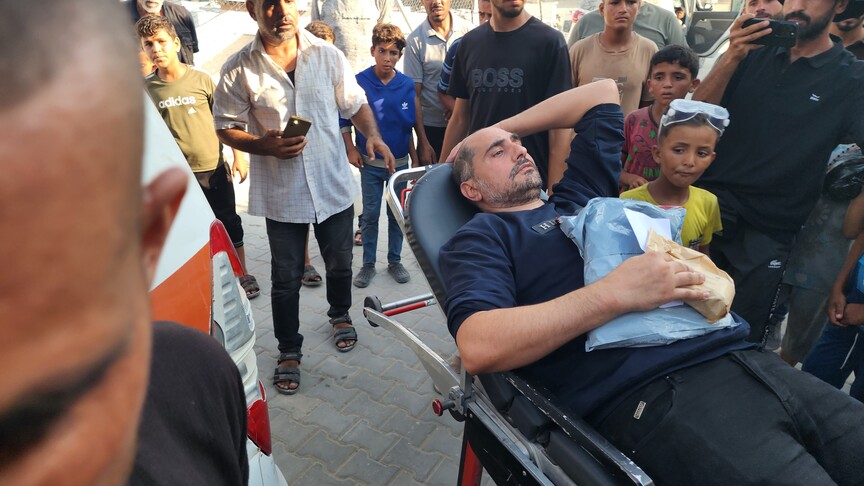
Frail, exhausted, and visibly injured, 60 Palestinians released from Israeli detention arrived Monday at the Nasser Medical Complex in Khan Younis in the southern Gaza Strip, where emotional reunions with relatives quickly gave way to harrowing accounts of torture, beatings, and months of isolation behind bars.
Dozens of family members gathered outside the hospital ahead of their arrival, anxiously awaiting loved ones who had spent months, and in some cases nearly two years, in Israeli detention. The wait gave way to scenes of relief as the former detainees arrived.
Several arrived in wheelchairs, with others looking visibly injured and exhausted. Medical teams immediately began checking their condition.
The group is the largest released yet from Gaza since the prisoner exchange carried out during phase one of the ceasefire agreement that took effect last October, under which Israel freed around 1,700 Palestinians from the enclave.
Amani Al-Naoq, spokeswoman for the International Committee of the Red Cross (ICRC), told Anadolu that its teams helped transfer the 60 Palestinians from the Kerem Shalom crossing to the Nasser Medical Complex.
She said the ICRC has helped transport more than 2,500 released Palestinian detainees since 2023.
Held for months, then declared no longer wanted
Despite months of detention that former prisoners said involved beatings, starvation, and prolonged isolation, the Israeli army said they were released after completing interrogations followed by determinations that they were no longer wanted, according to Israeli daily Haaretz.
The newspaper said the 60 Palestinians had been held at Ofer Prison and the notorious Sde Teiman military detention facility.
It described the release as the largest since last October’s prisoner exchange, adding that the army said those released this time were not considered security suspects.
According to Israeli rights group HaMoked, Israel currently holds about 1,300 Palestinians from Gaza under the designation of “unlawful combatants.”
A law passed by Israel’s Knesset in 2002 allows authorities to detain individuals indefinitely without filing charges or presenting sufficient evidence in court, according to the Al Mezan Center for Human Rights.
The law denies detainees protections under the Third and Fourth Geneva Conventions and allows Israeli courts to extend detention on undisclosed security grounds, according to the center.
‘I still can’t believe I’m free’
Among those released was Abdullah Kilani, who arrived at the Nasser Medical Complex in a wheelchair after spending more than 18 months in Israeli custody.
Kilani told Anadolu that he was detained in December 2024 on Salah al-Din Street in central Gaza before being transferred to Negev Prison and later to the Sde Teiman detention facility.
He and another detainee were shot while being held there, he related.
“The conditions were extremely harsh,” he said. “I still can’t believe I’m free.”
Sde Teiman, a military base in Israel’s Negev desert, has been the subject of repeated allegations of severe abuse against Palestinians detained from Gaza.
Palestinian and Israeli media and rights groups have documented beatings, prolonged restraint, medical neglect, and deaths in custody at the facility. It has drawn comparisons to the US detention center located at Guantanamo Bay, Cuba.
Another released Palestinian, who identified himself only as Abu Ibrahim, said detainees were forced to sit on concrete floors or iron slabs from dawn until evening, regardless of their age.
“There was no distinction between young men and the elderly,” he told Anadolu.
He said he was injured by guards who beat him with rifle butts.
Cut off from the outside world
Mohammed Jabr Al-Majdalawi, 43, spent one year and nine months in Israeli detention, including six months at Sde Teiman.
He said he remained cut off from the outside world throughout his detention and didn’t learn he was being released until he met Red Cross personnel.
“I’m crying because we suffered so much,” he said. “Words cannot describe what we went through. The prisoners who remain inside are still in danger.”
Al-Majdalawi urged international institutions and what he called the “free world” to act to protect Palestinians still held in Israeli prisons.
Palestinian rights groups say more than 9,600 Palestinians remain in Israeli prisons, including around 350 children and 84 women, amid continued reports of torture, medical neglect, and ill-treatment.
Despite the ceasefire that took effect on Oct. 10, 2025, the Israeli army has continued its daily attacks in Gaza, since that day killing at least 1,203 Palestinians and injuring 3,900 others.
The ceasefire agreement was reached after two years of genocide launched by Israel on Oct. 8, 2023, wreaking widespread destruction affecting 90% of civilian infrastructure, with reconstruction costs estimated by the UN at around $70 billion.