- ‘It’s about creating an enemy to gain political mileage,’ political analyst Andre Duvenhage tells Anadolu
- ANC could lose ground but remain well placed to negotiate coalitions where no party wins a majority, analyst says
South Africans are heading to the polls Wednesday to elect local government representatives, weeks after a wave of anti-immigrant protests and violence swept across the country.
Municipal elections usually turn on whether residents can count on running water, reliable electricity and regular garbage collection, Dirk Kotze, a political science professor at the University of South Africa, told Anadolu.
This year, however, many parties have made undocumented immigration a campaign issue, he said.
“No one can justify illegal immigration in South Africa,’’ he said.
South Africa has long attracted migrants from across the continent, whom vigilante groups and some political parties now blame for deteriorating public services and high unemployment.
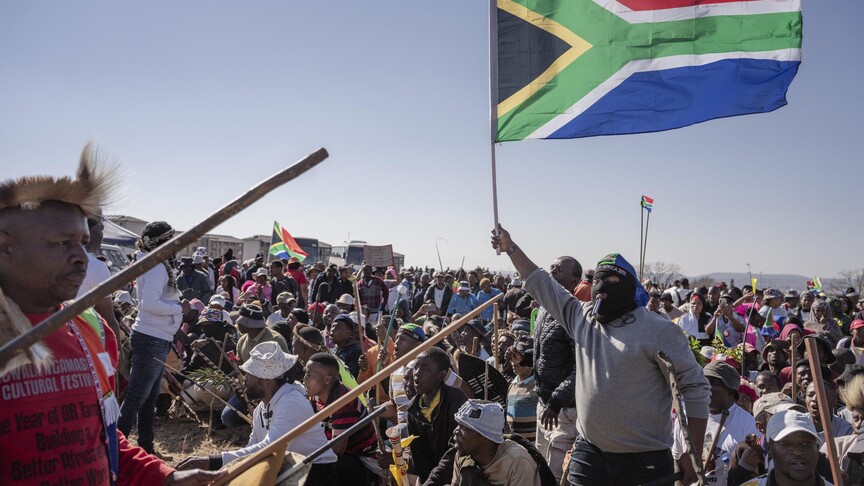
For several months this year, vigilante groups such as Operation Dudula and March and March have held protests against undocumented migrants, accusing them of committing crimes and taking jobs and business opportunities from South Africans.
Anti-immigration groups gave undocumented migrants until June 30 to leave the country. The deadline had no official standing, but threats also extended to people living in South Africa legally. Groups reportedly went door to door, pressuring foreign nationals to leave their homes and businesses.
By August, more than 178,000 African migrants had left South Africa amid attacks and a government crackdown.
The exact number of undocumented migrants remains unknown, but anti-immigration groups claim there are more than 3 million in a country of roughly 65 million people.
The UN refugee agency says South Africa hosts more than 167,000 refugees and asylum seekers, mainly from Burundi, Congo, Somalia, South Sudan, Rwanda and Zimbabwe.
Are migrants being used for political gain?
Andre Duvenhage, a politics professor at North-West University, said migration should be controlled but argued that some political parties were exploiting the issue for political gain.
“It’s about creating an enemy to gain political mileage,” he told Anadolu.
Duvenhage described March and March as closely allied with former President Jacob Zuma's uMkhonto weSizwe (MK) party and warned of possible instability in KwaZulu-Natal during or after the vote.
KwaZulu-Natal has been the epicenter of anti-immigrant violence in the country and is also Zuma's strongest electoral base.
Last week, President Cyril Ramaphosa ordered the deployment of hundreds of soldiers to help police maintain law and order during the election period in the province.
Opposition parties, including the Patriotic Alliance and ActionSA, have also made undocumented immigration a major campaign issue.
Dissatisfaction with local government
Duvenhage said Wednesday's elections could be the most important since the end of apartheid in 1994, with more than 400 political parties and individuals registered to contest elections in 257 municipalities.
“It’s the biggest in our history,’’ he told Anadolu.
While migration is one of the most polarizing issues, recent polling points to widespread dissatisfaction with local councils.
An Ipsos survey published Monday found that 55% of registered voters distrusted their local government. More than two-thirds said that poor sanitation resulting from water interruptions poses a serious health risk in their communities. Similarly, 66% believe current local governments do not sufficiently understand the importance of maintaining infrastructure required for reliable service delivery.
In Johannesburg, the water utility’s annual report helps explain why. The city loses about a third of its water supply, with aging infrastructure, burst pipes, leaks and illegal connections among the main causes.
“I don’t think illegal immigration is responsible for broken water pipes, uncollected refuse or broken traffic lights. It’s our greedy politicians who have failed us. There is rampant corruption which needs to be checked,’’ Johannesburg resident Precious Ntombi told Anadolu.
Will Nelson Mandela's ANC suffer another electoral setback?
The ANC, which Nelson Mandela led to victory in South Africa's first democratic election in 1994, has already had to learn to govern without a majority.
The party held a parliamentary majority for nearly three decades, governing the country on its own.
However, in the 2021 municipal elections, it fell below 50% of the vote nationwide. In 2024, it lost its parliamentary majority for the first time and formed a national unity government with the Democratic Alliance (DA) and other parties.
Duvenhage expects the ANC to continue losing ground in some municipalities but remain the largest party nationally and well placed to negotiate coalition agreements.
Drawing on the 2024 results, he estimated that the ANC could win about 35% of the vote and MK about 14%, with the DA in second place. Control of each council will depend on local results and, where no party wins a majority, which parties agree to govern together.
The ANC was forced to form coalitions in around 70 municipalities where it failed to secure a majority in 2021. Duvenhage expects more than 100 coalition arrangements to emerge from Wednesday’s vote.
Kotze said coalition governance could be beneficial but warned that prolonged disputes between partners could lead to repeated attempts to remove mayors, delaying budgets and the services they fund.
Ntombi said her experience of voting twice already weighs on whether she will go to the polls again.
“I have voted twice, but I haven’t seen any meaningful change yet,” she said. “Crime is still high, potholes are on the roads and there is interrupted electricity supply.”