- Best way for NATO is to seek strategic stability with China rather than confrontation or sanctions, warns Henry Wang of Center for China and Globalization
- Europe, US ‘increasingly agree' that China 'is their principal long-term strategic competitor,’ says Beijing-based China analyst Einar Tangen
Could the "growing divide" in NATO work in China's favor?
Experts say it is too early to draw that conclusion, arguing that transatlantic differences remain "tactical" rather than "strategic."
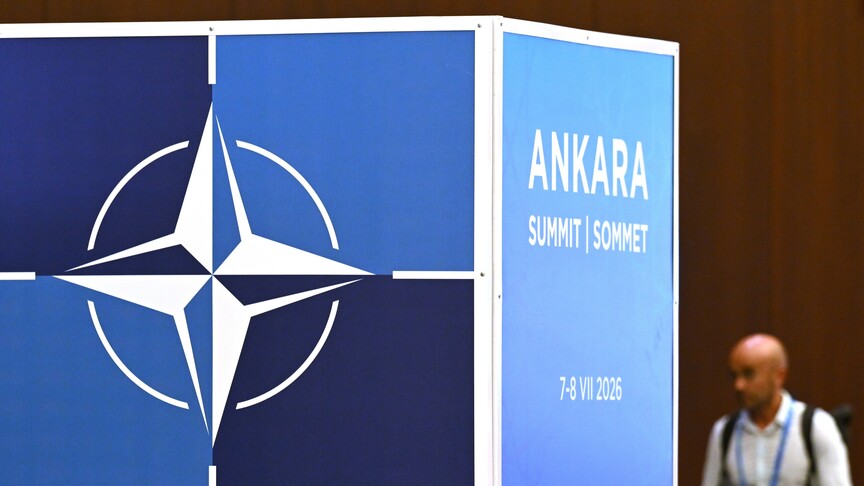
This comes as NATO successfully concluded its 36th summit in the Turkish capital Ankara last week.
The six-point declaration at the end of the summit “doesn't mention China or label China as a rival like they labeled Russia, which I think is good sign,” Henry Huiyao Wang, founder of Beijing-based Center for China and Globalization, told Anadolu.
Still, NATO Secretary-General Mark Rutte addressed China during the summit and met with the alliance's four Indo-Pacific partners — Australia, Japan, New Zealand, and South Korea, collectively known as the IP4.
NATO "cannot be naive" about China's military buildup, Rutte said, hours after Beijing launched an intercontinental ballistic missile over the Pacific Ocean in the second such test since 1980.
Jingdong Yuan, director of the China and Asia Security Program at the Stockholm International Peace Research Institute (SIPRI), said Beijing "is less concerned about NATO countries spending more on defense if these increases are driven by concerns over Russia and support for Ukraine."
“One could clearly see (US President Donald) Trump's continued criticism … of the NATO, Europe, largely due to the allies' defense spending and their reluctance in offering unconditional support of US military actions against Iran,” he said. “In this context, China probably is relieved.”
Longtime China analyst Einar Tangen told Anadolu that the Ankara summit “shows that the transatlantic differences remain tactical rather than strategic.”
“Europe and the United States continue to disagree over burden sharing, but they increasingly agree that China is their principal long-term strategic competitor,” Tangen said.
“Whether that consensus can survive growing economic pressures remains an open question,” he added.
Mission beyond Europe?
Jingdong said China “in principle” normally responds when NATO summit meetings issue statements with explicit reference to the Indo-Pacific region, in particular with regard to Taiwan or the South China Sea.
Soon after the Ankara summit, Beijing was quick to reject any reference targeting China as a threat to Euro-Atlantic security.
It urged NATO to shun the “Cold War mentality” and address its “perception of China.”
According to Tangen, China sees NATO's “growing presence in Asia as a strategic mistake.”
The alliance's expanding partnerships with Japan, South Korea, Australia and New Zealand “reinforces the view that NATO is searching for a mission beyond Europe,” he said.
Beijing and Southeast Asian nations “want Asian security to be managed by Asian countries, not by an alliance of post-colonial countries created to defend the North Atlantic that has its own agenda,” said Tangen.
The NATO summit “reinforces China's belief that the alliance is becoming more global, more focused on China and more determined to build long-term military and industrial resilience,” he added.
“From Beijing's perspective, expanding NATO's global mission is an attempt to mask its structural weaknesses,” said Tangen.
“Despite its internal constraints, NATO is attempting to export bloc politics into the Indo-Pacific, a region that has achieved decades of growth through economic integration rather than military alliances,” he added.
Defense spending and industrial ecosystem
Tangen noted the flaw in NATO's argument of higher defense spending.
“China sees several weaknesses in this strategy. … Higher defense spending will either increase already unsustainable debt or divert resources from pressing social and economic priorities,” he said.
Such decisions also faced “practical constraints,” he said.
“Building a larger defense industrial base requires time, technology, skilled labor, and secure supply chains that cannot be created overnight,” he said.
According to Tangen, now NATO’s primary competition would be over industrial ecosystems.
“Manufacturing capacity, technological innovation, supply chains, engineering talent, and control of strategic resources will determine military power far more than headline spending targets,” he said.
Will NATO follow Trump on China?
Wang said NATO was seeing a “growing divide” over Greenland and Iran war, as well as defensing spending, as Trump threatens to evacuate American soldiers from Europe if allied nations do not increase defense spending to 5%.
“The best way for NATO,” he stressed, is to “follow Trump’s visit early this year to China to seek strategic stability with China rather than confrontation or sanctions or things like that.”
Trump held a summit with Chinese President Xi Jinping in May, where the two leaders pledged to build a “constructive relationship of strategic stability on the basis of fairness and reciprocity.”
“Hopefully, NATO will follow Trump's new policy on China, to seek strategic stability. That'll be right way to go,” said Wang, who earlier served as a state councilor in China.