- - Amnesty’s Julia Duchrow says Berlin’s “dialogue-first” stance is failing, isolating Berlin
Pressure is mounting on Germany to abandon its opposition to an EU initiative that would partially suspend the bloc’s trade agreement with Israel.
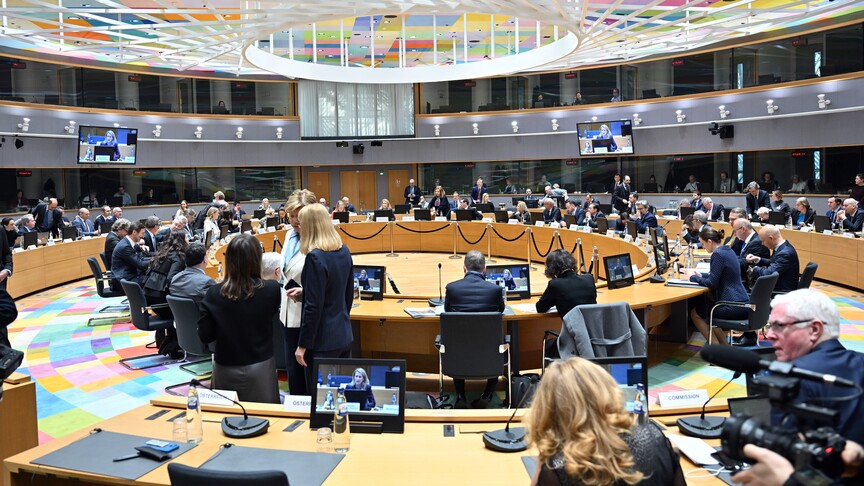
European foreign ministers are expected to revisit the contentious issue early this week, ahead of a summit of EU heads of state and government.
Spain and Ireland — among the EU’s most vocal critics of Israel — are spearheading the push for a tougher EU stance, backed by more than a dozen other member states.
Germany, however – one of Israel’s closest allies in Europe – continues to block any strong sanctions, arguing they could provoke a sharp backlash from Tel Aviv.
German Foreign Minister Johann Wadephul said last week that Berlin is not prepared to back new measures targeting Israeli officials or extremist settlers.
Germany prioritizes dialogue over pressure
The German government has insisted that the EU should keep diplomatic channels with Israel open, raising concerns through bilateral talks rather than punitive measures, in the hope of influencing the Israeli government’s policies.
Chancellor Friedrich Merz has repeatedly echoed this approach, arguing that Germany seeks to foster improvements in Gaza and curb the expansion of illegal settlements through “trust-based dialogue amongst friends.”
Yet human rights organizations say this strategy has demonstrably failed. Despite Berlin’s preference for quiet diplomacy, Israeli actions in the occupied Palestinian territories have not eased but intensified in recent months, with continued massive violations of international and humanitarian law.
Amnesty urges immediate policy shift
Julia Duchrow, secretary-general of Amnesty International Germany, urged the Merz government to change course amid the alarming situation in Gaza and the West Bank and to back the EU initiative to partially suspend the EU-Israel trade agreement.
“Germany says they have policies in line with international public law, but what we see is a complicity, not a clear stance,” she told Anadolu.
Duchrow said Berlin’s approach of keeping channels open and raising concerns in bilateral talks had failed to produce any positive results so far.
“We have seen that the situation got worse and worse and these channels have not been helpful at all,” she said, adding that the Israeli government has further accelerated its policy of ethnic cleansing and annexation in the West Bank.
"So we have to have an action now and it has to be quick," Duchrow said.
Germany’s vote crucial to any decision
The EU has been debating a tougher line on the Israeli government for more than a year, but Germany’s opposition has blocked any strong decisions.
After an initiative led by Spain and Ireland — backed by more than a dozen other EU countries — the European Commission last year formally proposed suspending parts of the trade provisions in the EU-Israel Association Agreement.
Suspending the entire agreement would require unanimous approval from all 27 member states. A partial suspension, however, needs only a qualified majority: at least 15 countries representing 65% of the EU’s population.
Germany’s resistance, along with opposition from Italy and others, has stalled progress. With nearly 84 million people — about 19% of the EU total — Germany’s support is effectively decisive in any qualified-majority vote.
Why the trade deal matters to Israel
Critics say the EU’s expressions of concern — and even targeted measures against a handful of extremist settlers — fall short. They argue the bloc must use its economic leverage to respond to the Netanyahu government’s repeated violations of international law.
Duchrow said the EU-Israel association agreement is especially significant, and that suspending it could help drive meaningful policy change.
“The EU is the biggest trading partner of Israel and the association agreement gives privileges to the Israeli trade and economy and for Israel, it is an issue when the EU member states together decide on something,” she said.
“We have seen that last year, in 2025, when the EU Commission said that Israel is violating Article 2 of the EU association agreement and there was almost a majority to suspend the association agreement, we saw a shift of the Israeli policy. So it means that political pressure has an impact and it is important,” she added.
Berlin increasingly isolated
Germany’s staunch defense of Israel reflects a longstanding policy, with the Merz government frequently invoking Germany’s historical responsibility — rooted in the Nazi era and the Holocaust — to guarantee Israel’s security.
Human rights groups and international observers, however, contend that this blanket backing has emboldened the Israeli government to escalate violations in Gaza, the West Bank, and Lebanon.
“Yes, due to our history, Germany has a special responsibility to protect Jewish life. But it is equally true Germany has a special responsibility because of that same history to protect human dignity, the universality of human rights, and international law,” Duchrow said.
She also pointed to Germany’s “selective” approach to international law — strongly condemning Russia’s war in Ukraine while responding far more cautiously to massive violations by Israel.
Duchrow said the stance is increasingly isolating Germany diplomatically, eroding its credibility and weakening its foreign policy clout.
UN seat loss seen as cost of Israel stance
Germany’s failure to secure a non-permanent seat on the UN Security Council for the 2027–28 term was widely viewed as a diplomatic rebuke for its stance on Israel.
“I would have been happy if the vote would have turned out differently, but it's clear that there is a big disappointment in the international community and Germany has lost credibility,” Duchrow said.
“The international community has been really disappointed about Germany's stance, a selective stance towards international law,” she added.
Berlin could begin to rebuild trust, she said, by taking a clearer position and dropping its blockade of a partial suspension of the EU–Israel association agreement.
“The German government must show that their reference to international law and human rights is more than mere lip service,” she said.