- Former FIFA governance chief Mark Pieth calls situation ‘very serious,’ says Infantino has ‘lost the support of Asia’
- FIFA governance commentator Herve Verhoosel says surviving a vote, retaining political authority to lead ‘are not the same thing’
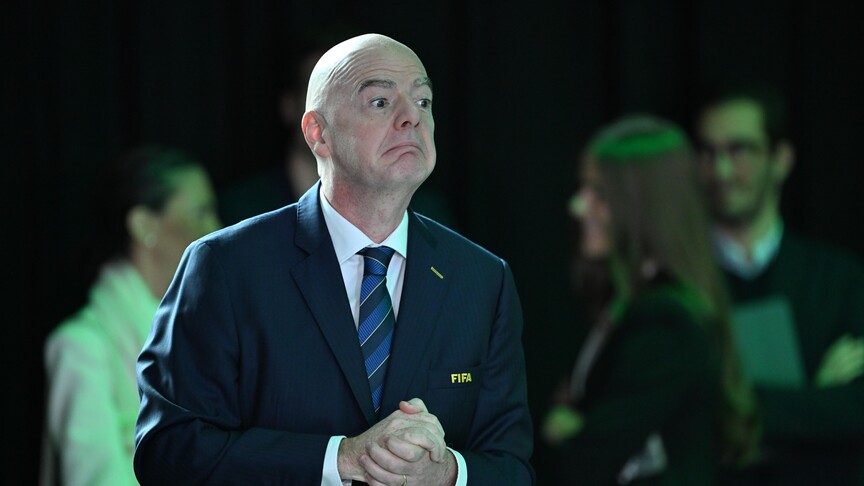
The revolt against FIFA President Gianni Infantino by half of the world’s football confederations is widening, raising questions about whether he can secure enough votes to win another term.
UEFA, the Asian Football Confederation (AFC) and Concacaf sharply escalated their confrontation with FIFA on Monday, accusing its leadership of a “fundamental breach of trust” and “deception” over the handling of an abandoned proposal to sell a stake in the FIFA World Cup to private investors.
In their joint statement, the confederations rejected the suggestion that the controversy amounted merely to a communications or procedural failure, arguing instead that the attempt represented a serious failure of judgment. They also called for an independent review.
The confrontation comes at a sensitive moment for Infantino, who announced in May that he would seek another term in 2027.
FIFA’s electoral arithmetic may still favor a president capable of building support association by association. Each of its 211 member associations has one vote, meaning opposition from confederation leaders does not automatically translate into votes against Infantino.
Votes versus political authority
Herve Verhoosel, a former senior UN official who now writes and comments on FIFA governance, told Anadolu in a written statement that the political calculation behind those votes has changed.
Once a confederation has publicly declared a “fundamental breach of trust” with FIFA’s leadership, he said, "it becomes considerably more difficult for its individual associations, particularly smaller ones, simply to take the opposite position."
“They still have their vote. But the political cost of that vote has changed,” Verhoosel said.
For Verhoosel, the larger question is no longer simply whether Infantino can assemble enough individual votes to remain in power, but whether he would retain sufficient authority to govern an increasingly divided organization.
“A president may still be able to assemble enough individual votes to survive. But surviving a vote and retaining the political authority to lead are not the same thing,” he said.
If a substantial part of FIFA no longer trusts its leadership, Verhoosel argued, "every major decision risks becoming another confrontation, every vote another test of loyalty and every initiative another battle between blocs."
“That is not sustainable -- and, more importantly, it is not in the interests of world football,” he said.
Verhoosel said the question facing FIFA’s 211 associations could therefore become larger than whether they support or oppose Infantino.
He added that the associations may ultimately have to consider whether maintaining the status quo is still in FIFA’s best interests.
Infantino made 'mistakes,' acted 'disrespectfully'
Mark Pieth, former chair of FIFA’s Independent Governance Committee, told Anadolu in a written statement that the situation is “very serious.”
“Of course he can try to survive with individual votes from Associations, but he has made mistakes; just look at Jordan,” Pieth said.
Pieth was referring to a recent dispute involving Jordan Football Association President Prince Ali bin Al Hussein, a former FIFA vice president.
Prince Ali accused FIFA and Infantino of “blackmail” last week, saying Jordan had faced unresolved issues including World Cup-related costs and unpaid Arab Cup prize money. He alleged that he was verbally told during the World Cup that endorsing Infantino would “go a long way” toward helping the Jordanian association.
Jordan, which qualified for its first World Cup in 2026, had not previously endorsed Infantino, and Prince Ali said it would not do so.
Two days after Prince Ali made the allegation, he said FIFA had paid the outstanding prize money to Jordan’s players and coaching staff. He welcomed the payment but said it did not change his concerns about FIFA’s leadership or his position that Jordan would neither endorse nor vote for Infantino.
FIFA did not publicly comment on the blackmail allegation.
Pieth said Infantino had “acted disrespectfully, including to many non-European associations.”
“This is one reason why he has lost the support of Asia,” he added.
The AFC’s role in the current confrontation is particularly notable because the Asian confederation had backed Infantino’s bid when he announced his intention to seek re-election earlier this year.
The three confederations -- out of a total of six -- are now challenging FIFA. But Infantino’s political fate ultimately rests with national associations voting individually rather than confederations voting as blocs.
That leaves him room to rebuild alliances before the 2027 election, but in a political landscape that has shifted considerably in a matter of months.
With the nomination deadline for the 2027 FIFA presidential election approaching in November, the question is therefore not only whether Infantino can assemble the votes for another term, but whether a president facing open resistance from half of FIFA’s continental confederations can retain the trust and political authority needed to govern world football.