Anadolu Ajansı © 2026


By Evelyn T. Kpadeh
MONROVIA
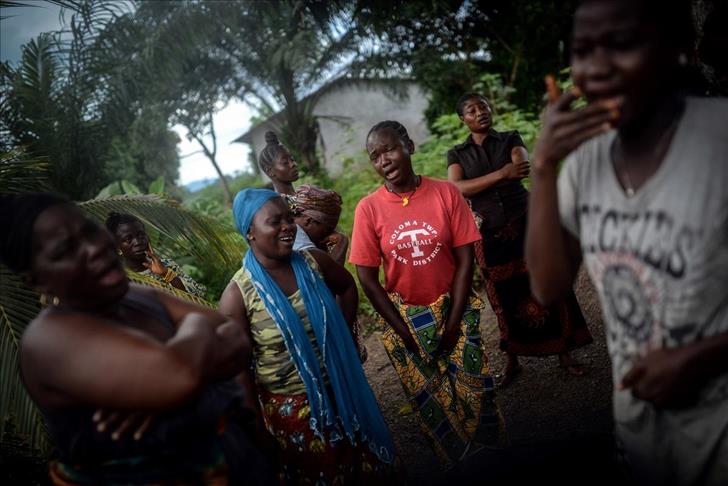
Lorpu Gayflor considers herself lucky after her six orphaned siblings found a place at a local orphanage in Liberia after their widowed father died of Ebola.
"The home is good for my brothers and sisters because my father passed away during the Ebola crisis," Gayflor, 20, told Anadolu Agency.
After their father's death, Gayflor's siblings found shelter at the Child Survival Foundation, a community-based initiative supervised by a clergyman for orphans.
Gayflor said the orphanage had spared her early parental responsibilities, as her siblings now receive free primary education at the orphanage's kindergarten, which also feeds them each day.
"I do not have anyone to pay my brothers' and sisters' school fees, so Child Survival is helping them for free. I am happy for them," she said.
However, Gayflor, who is now pursuing her dream of becoming a flight attendant at an airline school, has been upset by repeated assertions by government officials that the government was helping children orphaned by Ebola start a new life and go to school.
"Since school opened, we have not yet heard from the government," she said.
The head of the Child Survival Foundation, which is hosting 24 children orphaned during the recent Ebola outbreak, voiced fears that the government had plans to relocate them to foster-care homes.
"How can they put the children with families who already don't have enough for themselves in a poverty stricken-country?" Reverend Othello Findley, who is also vice-president of the National Union of Liberia Orphanages and Children Welfare Institutions, told Anadolu Agency.
The clergyman and philanthropist went on to express concern that, when Ebola orphans are incorporated into families, there is a high chance that they will be maltreated, subject to a lack of adequate education, or even used to hawk wares on the nation's street corners.
In Liberia, many poor families tend to use children – often as young as five years old – to generate money by selling biscuits, water or other goods on the streets.
"This is where we have our problem. The government is saying we should not put these children in the homes permanently. But how will they make a complete assessment as to how to take care of these orphans?" he asked.
Instead, Findley said the government should step up its efforts to speedily place them in schools and provide necessary support for care homes.
"Every time we [the Union of Orphanages] go to a meeting with the government, they do not tell us how many of these children have been placed in schools," said Findley.
Before the outbreak, according to Findley, the country had registered around 2,850 orphans countrywide distributed throughout 74 orphanages.
But the lethal disease made even matters worse, putting additional pressure on the country's already-struggling orphanage services.
"Before Ebola, we had more than 2,000 orphans and Ebola added 3,192 more to this number. We, as children welfare institutions, are asking: what will be done with these children?" said Findley.
Since last year, Ebola – a contagious disease for which there is no known treatment or cure – has killed more than 10,000 people, mostly in West Africa.
In Liberia alone, the virus has claimed at least 4,806 lives.
The Liberian authorities have launched a massive campaign aimed at containing the epidemic. The last Ebola case was registered in March 27, prompting the World Health Organization (WHO) to declare Liberia Ebola-free earlier this month.
-Defense-
The ministry responsible for child protection, however, defended the plan, saying it was doing its best to provide assistance to children orphaned by Ebola.
"Given the negative experiences we had in the past with orphanages, we have asked that no orphanage takes in any Ebola orphan," Lydia-Mai Sherman, deputy minister for gender, children and social protection, told Anadolu Agency.
According to Sherman, the ministry – with the support of social workers across the country – has registered a total of 4,539 children who had been made orphans or were otherwise affected by Ebola.
Of these, 1,562 children have benefited from a cash assistance program sponsored by the UN children's fund (UNICEF), including many who were placed with foster families.
Each affected child received $150 through their foster family to cater to their various needs, she said.
"People are saying that we're doing nothing but that's not true. At least 1,562 children have [so far] received their package," she noted.
She admitted, however, that some families at least had failed to use the money wisely.
"There is a family that has 36 affected children, each of whom received $150. But when we visited the home, we found that – even though the children seemed healthy – the roof of the home was deplorabl and didn't protect them from rainfall," she lamented.
"I was very upset. What did they do with the money when 36 children received a total of $5,400?" she asked.
When asked about why the money was not used to place the orphans in schools, she stressed that this had not been the plan.
"UNICEF did not give this money for education," Sherman said.
She did not say how many orphans had been put in foster care, but stressed that assessments were ongoing and that some Ebola orphans had been taken in by relatives and well-meaning citizens.
The UNICEF program hopes that 8,000 children will benefit from the financial package. Its representative in Liberia, however, said the organization's support for the Liberian government was not aimed at placing Ebola orphans in orphanages.
"We are funding the government to take care of Ebola orphans through the ministries of gender and health – but we don't support institutionalizing Ebola orphans," Sheldon Yett, the UN's representative in Liberia, told Anadolu Agency.
According to Yett, Ebola orphans "do not belong in orphanages".
He asked: "How will they get a better life and education beyond the little support they receive from a little community orphanage?"
According to him, UNICEF believes the issue should be dealt with just like any other problem involving vulnerable children.
The government, he asserted, should ensure that families who had taken in Ebola orphans were able to provide the kind of support the children require.
That's why UNICEF's assistance to the country also includes training social workers on how to provide support for the foster families that care for Ebola orphans.
"We need to ensure that social workers are empowered and in place. This country had almost no social workers before Ebola – just a handful – but now they are more, but still not enough," Yett noted.
news_share_descriptionsubscription_contact

contact_the_ombudsman
is_there_an_error_in_this_story