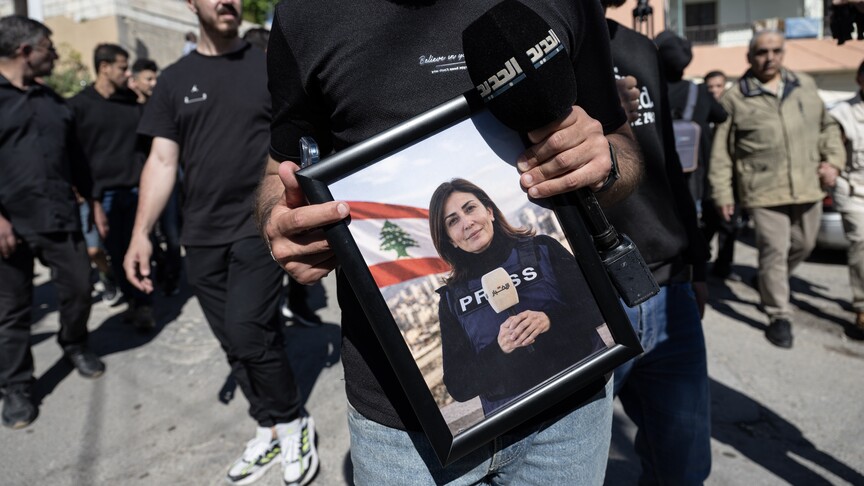
On the afternoon of April 22, the messages from journalist Amal Khalil were brief.
Writing to her anxious colleagues at the Lebanese daily Al Akhbar, she sent word on the group chat that she was fine and that her vehicle had not been the target of a deadly Israeli airstrike.
For a moment, a collective sigh of relief swept through the newsroom.
"We thought that it was over … Amal is fine, and the situation was fine and over," Roaa Kassem, a colleague speaking from Beirut, told Anadolu.
But the horror was only beginning.
As time passed, reports of secondary strikes by Israel in southern Lebanon in the town of al-Tayri began to surface.
The newsroom realized with growing dread that the new targets were in the exact same location as Khalil and another colleague, photojournalist Zeinab Faraj.
"Then we knew that she was also injured this time, but she didn't want to tell us and tell her family that she was injured," said Kassem.
Khalil and Faraj fled and sought refuge under a nearby shelter, which Israel bombed shortly after.
In the aftermath of the strikes, witnesses and colleagues report a calculated effort by Israel to prevent a rescue.
Faraj was eventually pulled wounded from the debris, but Israeli forces opened fire and blocked civil defense teams and ambulances from reaching Khalil.
"They (civil defense) were allowed to rescue Zeinab, but they (Israeli) didn't want them to rescue Amal particularly," said Kassem, holding back her tears.
Khalil remained under the rubble for more than six hours, until Lebanese authorities and the Red Cross were given clearance to reach the scene. Her body was retrieved shortly before midnight.
The double-tap strike brought Khalil’s two-decade career to a brutal end, with colleagues and press freedom advocates saying her killing reflects a broader pattern of Israeli attacks on journalists.
Since March 2, at least nine journalists have been killed by Israeli forces in southern Lebanon, says the Committee to Protect Journalists (CPJ).
Khalil, 42, a journalist known for her fierce commitment to documenting Israeli atrocities in southern Lebanon, had been living under the shadow of death for months.
The death threats began in 2024 with a message to her phone threatening to "separate her head from her shoulders." This was followed by calls to the newspaper demanding she stop reporting from the southern part of the country.
A few days before Khalil’s death, Avichay Adraee, an Israeli army spokesperson, reposted a video showing her rescuing a cat from the rubble of a destroyed building, while hurling abuses at the newspaper, on US social media platform X.
Despite the pleas of her family and friends to stop reporting from the border, Khalil refused.
"Amal knew that it was dangerous for her to be there and that her life was in danger," said Kassem.
"But she wanted to continue reporting from the south because it is important for her and for us and for every journalist that is there to transmit what is happening there- the Israeli aggressions, the massacres."
Kassem, who was in touch with Khalil every day about her work, said that she wanted to report from the "hard places" that few reporters could access and that received little media attention.
Khalil’s death is part of Israel's broader and systemic campaign to silence the media, press freedom activists and experts say.
Since October 2023, when Israel's war on Gaza began, more than 260 journalists have been killed by Israel across the Middle East region, including in Gaza, Yemen, Lebanon and Iran.
"Most of them were targeted killings, which means that Israel targeted those journalists and killed them on purpose," Sara Qudah, CPJ’s Middle East and North Africa regional director, told Anadolu.
During the Gaza war, when Israel expanded its strikes into Lebanon, it killed at least six journalists, she added.
In a report published earlier this year, the group said a record 129 journalists and media workers were killed worldwide last year, with Israel responsible for two-thirds of the deaths.
"Israel has not been held responsible for its actions, and those who killed the journalists," said Qudah.
She added that Israel’s impunity sets a dangerous precedent as "more journalists will continue to be killed and no one will be afraid of the punishment."
Israel has never provided evidence in any of the cases that the journalists it targeted were not civilians, Qudah said, while also failing to substantiate repeated claims that the reporters were “terrorists” – a label Israeli authorities have frequently used following such killings.
The CPJ official highlighted a recurring pattern in Israel’s attacks on journalists, including the use of double-tap strikes – the practice of following up one strike with another in the same place several minutes later.
She pointed to the recent killings of Lebanese journalists Fatima Ftouni, Ali Shoaib and Mohamad Ftouni, as well as the attack that killed Khalil.
"We have seen that in Gaza before … We have seen journalists being killed in double-tap. This happened and sometimes in multiple strikes, not just double-tap," said Qudah.
Israel also frequently uses drones to target journalists.
"Israel has the most advanced technologies in the world. When they use the drone, they know exactly who is their target and what they are doing, so they know that the person they are targeting is a journalist, especially if they are wearing their gears and their vests or holding their cameras,” she said. “Yet, it still uses a drone to locate them and then kill them.”
Qudah also pointed to what she described as a growing pattern during the Gaza war: blocking medical crews from reaching wounded journalists and civilians, including Palestinian child Hind Rajab.
She pointed to the case of prominent journalist Wael al-Dahdouh and Al Jazeera cameraman Samer Abu Daqqa, who were injured in a drone strike in Gaza. While medical crews were able to evacuate al-Dahdouh, they were prevented from reaching Abu Daqqa, who died, she said.
"We saw that with Amal Khalil,” Qudah said. “Those tactics are becoming a pattern."
Qudah described Khalil’s death as particularly tragic, as there was a hope and a chance to get her to safety before she was killed.
"The killing of Amal is by itself a deliberate killing because the Red Cross was blocked from rescuing them while they knew that Amal was trapped under the rubble, yet they did not allow the Red Cross to evacuate her.”
According to Qudah, this might constitute a "war crime" because journalists are protected under international humanitarian law as long as they do not engage directly with any hostilities. The obstruction of rescuing civilians is another war crime, she added.
Colleagues said Khalil had become a constant presence in the newsroom during the war, sending updates daily from southern Lebanon as Israeli airstrikes intensified.
“We used to contact her every day,” Kassem said. “She sent us breaking news from the south, covering the Israeli airstrikes and everything happening there.”
Beyond reporting for the newspaper, Khalil also produced videos and field reports for social media platforms, documenting the devastation unfolding in villages along the border.
Because Khalil spent much of her time reporting from the field, Kassem only met her in person a handful of times, but remembered her as kind, constantly smiling and friendly with everyone.
Khalil’s final report sent to the newsroom was a haunting video from the village of Beit Lif, showing a man standing in tears as Israeli airstrikes destroyed his home and much of the surrounding area.
“It was a really emotional story because it was for a person who was standing and actually watching and filming his village getting destroyed. So it was really emotional. It was really important also for us,” Kassem said.
She urged the Lebanese government to do more to protect journalists.
"I would like the world to remember Amal as ... resilient, strong – she wasn't scared of anything even after she knew that she was threatened."
news_share_descriptionsubscription_contact