Aamir Latif
11 January 2016•Update: 11 January 2016
KARACHI, Pakistan
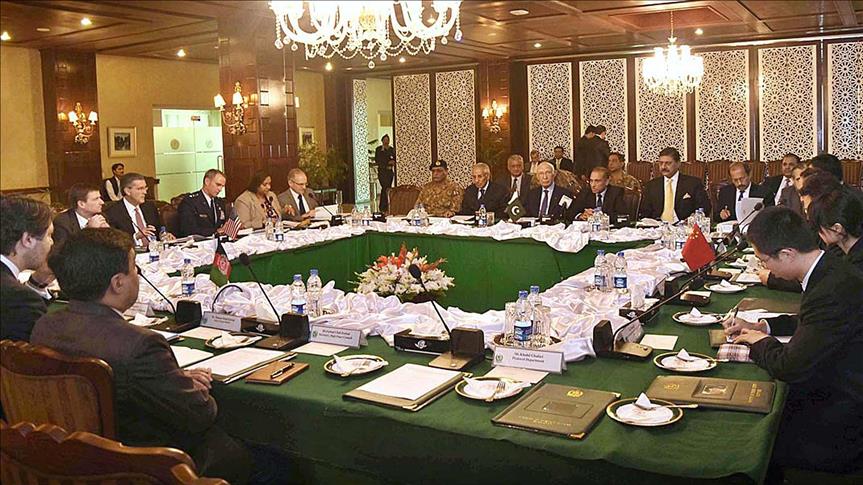
A four-nation meeting devoted to Afghan reconciliation has called for an immediate resumption of stalled talks between the Afghan government and the Taliban with a view to ending the war-racked country’s 13-year-long insurgency.
Held in Islamabad on Monday, the first session of the Quadrilateral Coordination Group on Afghanistan -- comprised of Pakistan, Afghanistan, China and the U.S. -- emphasized the need for direct talks between the two sides in hopes of ending a conflict that has claimed thousands of lives.
No Taliban representative attended the first meeting, which was limited to discussing means of -- and setting terms for -- the resumption of stalled peace talks.
A joint declaration issued at the conclusion of the day-long meeting, which was inaugurated by Pakistani foreign affairs advisor Sartaj Aziz, reiterated participants’ commitment to supporting the Afghan-led reconciliation process "with a view to achieving a lasting peace".
Meeting discussions, according to the declaration, focused on means of making a realistic assessment of the opportunities for establishing peace in Afghanistan, anticipated obstacles, and measures aimed at creating an environment conducive to successful talks.
Participants agreed to continue holding regular meetings with a view to promoting the peace process, the statement read, adding that the group’s next meeting would be held in Kabul on Jan. 18.
The meeting was attended by Afghan Deputy Foreign Minister Hekmat Khalil Karzai, Pakistani Foreign Secretary Aizaz Chaudhry, and the U.S. and Chinese special envoys for Pakistan and Afghanistan, Richard Olson and Deng Xijun.
Pakistan had organized landmark peace talks between Kabul and the Taliban in July of last year, but the process broke down after the militant group announced the death of its longtime leader, Mullah Omar.
The breakdown of talks was followed by a series of brazen Taliban offensives across Afghanistan, including the temporary capture of the strategically important city of Kunduz and several districts of Helmand province.
Describing the four-nation initiative as "significant" and a "step forward", analysts nevertheless see a long road ahead.
"The Taliban is clearly divided into two groups, the smaller of which has refused to take part in any process organized by a third country," Rahimullah Yusafzai, a Peshawar-based expert on Afghan affairs, told Anadolu Agency.
The larger group, meanwhile, led by Mullah Mansour Agha, he added, wanted to resolve rifts within the group that were prompted by Mullah Omar's death.
"They [the Taliban] want to enter talks as a single entity rather than as different groups," Yusufzai asserted. "They want to sort out their internal differences first."