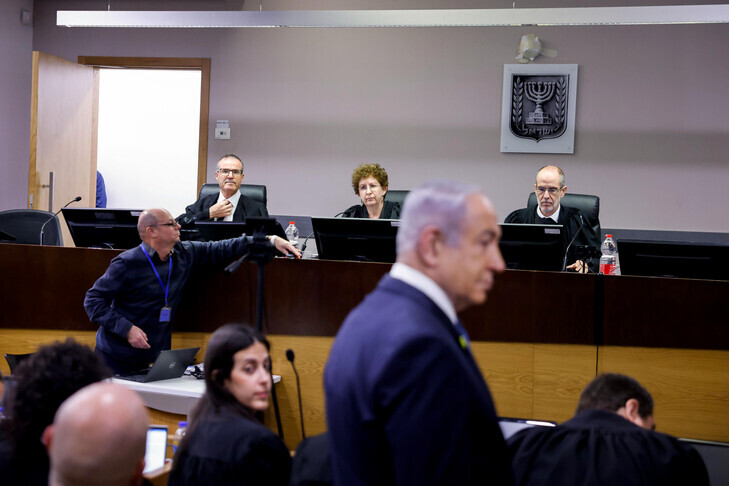
- Netanyahu is facing charges of bribery, fraud and breach of trust in three separate cases
A hearing in the graft trial of Israeli Prime Minister Benjamin Netanyahu was postponed Monday for security and diplomatic reasons, further delaying proceedings that have stretched on for more than five years.
Netanyahu's ongoing trial has deepened political divisions in Israel and raised questions about the rule of law while he remains in office.
His trial began in 2020, making him the first sitting prime minister in Israeli history to face criminal charges. He has repeatedly denied all accusations, describing the case as a “political campaign” against him.
Netanyahu has dominated Israeli politics for decades, serving several terms as prime minister since first taking office in 1996 and becoming the country’s longest-serving leader.
Alongside the domestic proceedings, Netanyahu has also been wanted since 2024 by the International Criminal Court (ICC) over accusations of war crimes and crimes against humanity linked to Israel’s war in Gaza.
What are the cases?
Netanyahu is facing charges of bribery, fraud and breach of trust in three separate cases, known as Case 1000, Case 2000 and Case 4000, stemming from investigations that began in 2016.
All three cases are being heard in a single ongoing trial.
He is accused of fraud and breach of trust in Case 1000 and Case 2000, and of bribery as well as fraud and breach of trust in Case 4000.
In Case 1000, Netanyahu is accused of fraud and breach of trust over allegations that he and his wife Sara Netanyahu received expensive gifts, including cigars and champagne from Israeli businessmen Arnon Milchan and Australian billionaire James Packer in exchange for political favors.
The value of the gifts has been estimated at around 700,000 shekels ($234,698).
Case 2000 centers on accusations of fraud and breach of trust.
According to these allegations, Netanyahu negotiated with media publisher Arnon Mozes of the Yediot Ahronot newspaper for more favorable coverage in return for efforts to limit the circulation of a rival publication, Israel Hayom.
The most serious allegations are in Case 4000, where Netanyahu faces charges of bribery, fraud and breach of trust.
Prosecutors say Netanyahu, who at the time concurrently served as the premier and the communications minister, granted regulatory benefits to telecom tycoon Shaul Elovitch in exchange for positive coverage on the Walla news website.
Elovitch and his wife have also been charged and deny any wrongdoing.
According to the prosecution, the arrangement was worth 1.8 billion shekels (about $600 million) and involved regulatory decisions benefiting Bezeq, the telecommunications company formerly controlled by Elovitch.
The requests allegedly included shaping coverage to favor Netanyahu and limit reporting on his political rivals, media reports said.
Where does the trial stand?
The case was formally filed by then-attorney general Avichai Mandelblit in 2019, and proceedings began in May 2020 at the Jerusalem District Court.
Since then, the trial has moved slowly, with more than 300 witnesses involved. Hearings have been repeatedly delayed, first due to the COVID-19 pandemic and later because of the Gaza war.
In late 2024, Netanyahu began testifying as a defendant, an unprecedented moment for a sitting Israeli prime minister. Prosecutors began cross-examining him in June 2025 after 36 defense-led sessions, according to local media.
As of early 2026, Netanyahu has appeared dozens of times in court and has been through extended cross-examinations in the key cases.
His legal team has frequently sought adjustments to the schedule, citing national security demands and health concerns.
Netanyahu himself has argued that appearing in court multiple times a week is “an impossible demand.”
This February, Netanyahu appeared before the Tel Aviv District Court for the 79th time to respond to corruption charges against him.
In December 2025, prosecutors concluded their cross-examination of Netanyahu in Case 1000, during which he claimed that his former lawyer’s recollection of events during the investigation was affected by his illness.
Will Netanyahu be granted a pardon?
The proceedings continue amid debate over a possible pardon from Israeli President Isaac Herzog.
Netanyahu reportedly requested clemency in late 2025 without admitting guilt or resigning, a key sticking point for critics who argue that any pardon should be conditional on both.
Israeli law allows the president to grant a pardon only after a defendant acknowledges wrongdoing, while there is no precedent for issuing a pardon while the trial is ongoing.
US President Donald Trump has on several occasions called for an end to Netanyahu's trial. In his latest remarks, Trump lashed out at Israeli President Isaac Herzog, calling him “weak and pathetic” and accusing him of lying about a supposed promise to pardon Netanyahu.
A senior Israeli official pushed back on Trump's account, saying Herzog had never made such a promise and had told Trump advisers that he would consider the request in line with legal procedures.
Even after the testimony concludes, legal experts say a final verdict could still take years.
If convicted, Netanyahu could face at least 10 years in prison. His supporters argue that a pardon could help end years of political turmoil, while critics warn it would undermine judicial independence and accountability.