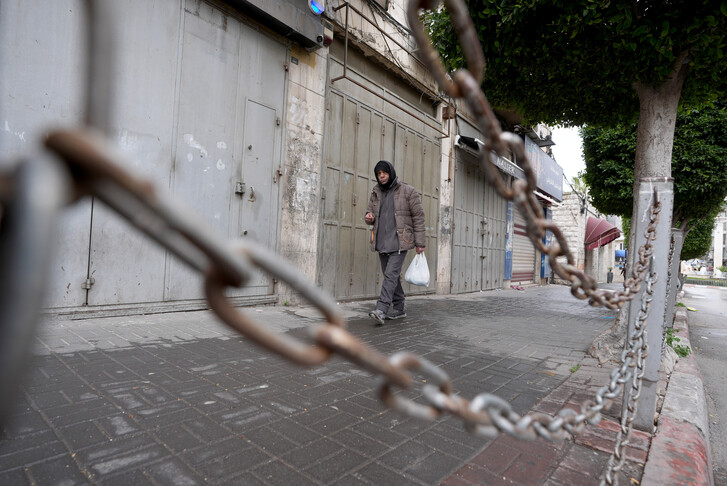
Palestinian Labor Minister Enas al-Attari says Israeli restrictions on the Palestinian economy have pushed unemployment to around half a million people, as officials seek to hold Israel accountable internationally for ongoing violations.
In an interview with Anadolu in Ramallah marking International Workers’ Day on May 1, al-Atari said Palestinian workers are facing “unprecedented conditions,” driven by a combination of direct field-level restrictions and mounting economic pressure.
She described the environment as among “the most fragile in the region,” noting that Israeli military checkpoints across the West Bank do more than restrict movement — they “reshape the Palestinian economic geography.”
“These checkpoints isolate cities and towns, disrupt the movement of workers and goods, and directly affect productivity and job opportunities,” she said.
“The Palestinian worker today is not only facing unemployment, but an entire system of restrictions that begins at the checkpoint and does not end with the loss of income.”
She added that these policies fall under a “political and economic siege” affecting various sectors.
Economy under pressure
Al-Attari said Israel’s continued withholding of clearance revenues remains one of the most significant pressure tools on the Palestinian economy.
These revenues are taxes collected on goods imported into Palestinian areas, either through Israel or border crossings under Israeli control, and transferred to the Palestinian Authority.
Since 2019, Israel has deducted billions of dollars from these funds under various pretexts, contributing to a chronic financial crisis that has affected the Palestinian government’s ability to pay salaries and meet obligations to the private sector.
The minister said these funds represent the main source of Palestinian government revenue, used to cover wages and essential expenditures.
“Withholding or delaying these funds affects not only the government, but extends to the private sector and labor market, reducing liquidity, halting projects and leading to layoffs,” she said.
She stressed that the Palestinian economy “does not operate under normal conditions,” but under complex political and financial constraints that limit growth and job creation.
Labor market shock
In one of the clearest indicators of the crisis, al-Attari said the Palestinian labor market has experienced a severe shock since October 2023, when about 200,000 workers employed in Israel suddenly lost their jobs.
They joined more than 300,000 people already unemployed in the domestic market, bringing the total number of unemployed to around half a million, she explained.
“We are facing an unprecedented figure relative to the size of the Palestinian economy,” she said. “This creates enormous pressure on the government, society, and the social protection system.”
Al-Attari added that the sudden loss of such a large number of jobs in a short period created a “structural imbalance” in the labor market that is difficult to address without large-scale interventions.
In October 2023, Israel launched a genocidal war on the Gaza Strip, which has killed more than 72,000 Palestinians, most of them women and children, and destroyed about 90% of the enclave’s infrastructure, with reconstruction costs estimated by the United Nations at around $70 billion.
At the same time, the Israeli army and Israeli occupiers escalated attacks in the West Bank, including killings, arrests, destruction of homes and facilities, forced displacement of Palestinians and expansion of settlements on occupied land.
Government initiatives
Despite limited resources, the Labor Ministry has launched several initiatives to mitigate the impact of the crisis.
Among them is the “Bader” program, which offers interest-free loans of up to 60,000 shekels (about $20,000), with a six-month grace period and repayment over four years, to finance small projects for unemployed workers.
Al-Attari said the first phase supported 767 projects, with a second phase recently launched to expand beneficiaries.
Other measures include free health insurance, educational exemptions for workers’ children, temporary employment programs, and support for cooperatives.
However, she stressed that “these initiatives, despite their importance, cannot resolve a crisis of this scale,” because “the root of the problem is political, linked to the (Israeli) occupation and its policies.”
Field violations
The minister also pointed to incidents involving arrests and injuries of Palestinian workers attempting to reach their workplaces, particularly inside Israel. She described such practices as “a blatant violation of labor rights and freedom of movement,” adding that the ministry is pursuing these cases through multiple channels.
The ministry is coordinating with human rights organizations and lawyers, while also raising the issue internationally, she added.
As an observer member of the International Labour Organization, Palestine is seeking to activate the body’s role in holding Israel accountable, she said.
Digital shift
As part of efforts to find sustainable solutions, al-Attari highlighted the launch of the Job Match platform, designed to connect job seekers directly with employers.
Launched in December 2025, the platform includes around 590,000 registered job seekers and 42,000 businesses, forming a broad database for the Palestinian labor market.
It uses artificial intelligence to match candidates with available jobs, enabling more precise alignment between skills and employer needs.
She said the platform also serves as a policy tool by providing data on labor market needs and skill gaps, helping guide education and training strategies.
On the international front, al-Attari said the platform includes cooperation with countries such as Qatar, Türkiye and Jordan to bring in external employers and create additional job opportunities.
She noted a particular focus on remote work, especially in Gaza, as a way to overcome movement restrictions. “The goal is not to encourage migration, but to create opportunities while retaining talent within the Palestinian market,” she said.
Vocational training
Al-Attari also highlighted vocational training programs, noting that dozens of centers offer 74 training programs, more than half of which have been digitized.
Employment rates among graduates range between 70% and 80%, while others go on to start their own businesses.
She said on-the-job training programs also help integrate young people into the labor market through partial wage support.
Marking International Workers’ Day, al-Attari paid tribute to Palestinian workers, describing them as “a symbol of national resilience,” and reaffirmed that the government places them at the top of its priorities.
“The Palestinian people are our most important investment,” she said, pledging continued efforts to support their resilience under current conditions.
*Writing by Mohammad Sio in Istanbul