- Relative tells Anadolu she may have been targeted for her prominent role shaping generations in Gaza
- Gaza’s small Christian community, long part of the enclave’s social fabric, has also come under attack during genocide
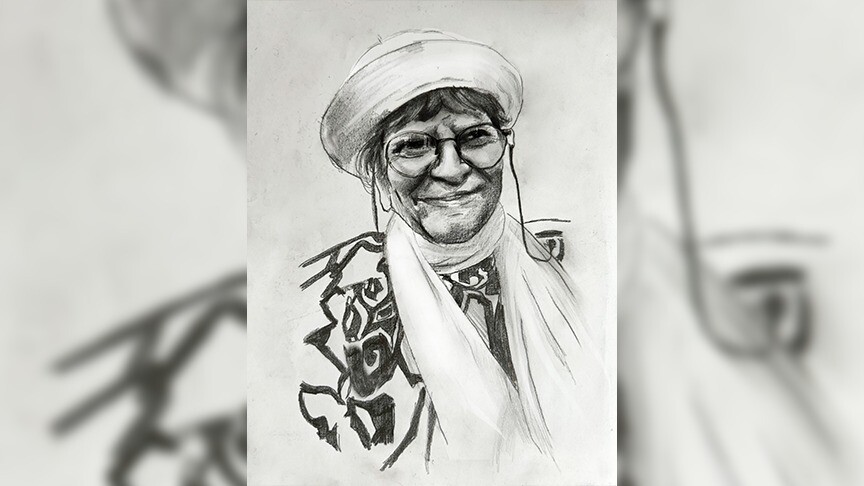
On Nov. 12, 2023, 84-year-old Elham Farah, a retired music teacher and member of Gaza’s small Palestinian Christian community, left her church without telling anyone, determined to return to her home despite the danger outside.
She got into a vehicle, but was soon left lying wounded in the street after being shot by an Israeli sniper, calling family members as she waited for help that never came.
Her killing is one of countless human tragedies unfolding during Israel’s genocide in Gaza, which has claimed more than 70,000 lives since October 2023, including large numbers of civilians, children and the elderly.
Life has become increasingly perilous for all civilians in Gaza, including the enclave’s Christian community, which has also been affected by Israel’s ongoing military campaign. Though a minority, Palestinian Christians have long been an integral part of Gaza’s social fabric, with deep historical roots in the territory.
Elham Farah, who lived in Gaza’s al-Rimal neighborhood, had spent decades teaching music to generations of students and was the daughter of renowned Palestinian poet Hanna Farah.
Her final moments, however, would unfold in isolation.
‘A war crime’
Her grandnephew, Hammam Farah, 43, based in Toronto, where he works as a psychoanalytic therapist, became emotional while describing the circumstances of her death in an interview with Anadolu.
He said she slipped out of her church in Gaza City, into a vehicle -- likely a taxi -- but the driver did not take her all the way back to her home. After a short distance, the driver stopped, warning that it was too dangerous to continue because Israeli soldiers were positioned on rooftops.
"So she was a very strong person. She got out of the car and kept going on foot,” he said.
As she approached her home, Elham Farah noticed Israeli snipers positioned above.
"And one of the snipers shot her in the leg,” he said. “She collapsed on the floor and screamed in pain. And her cell phone was working."
Despite her injuries, she managed to call family members sheltering at the church, including Hammam’s aunt.
“And they couldn't do anything. They panicked, of course,” he explained.
“They called the Red Cross … but the Red Cross said they have to get permission from the Israeli army and that the Israeli army was not responding to their calls,” he said.
Alone and bleeding, Elham Farah made a series of final calls. She asked a priest at the church to recite last rites and spoke briefly with Hammam’s mother in Canada.
"My mother told her: ‘Hold on, just keep holding on. They'll get to you,’” he said.
Hammam Fara said it was a “common tactic” used by the Israeli army to shoot people in the leg in order to lure others -- possibly Hamas fighters -- so they could also be targeted.
"But in the early hours of the morning, the Israeli army decided to run her over with a tank and just finish her off. She was still alive from what I know,” he said.
"They found her purse squished over her head, her face, which indicates she put the purse over her face as the tank was approaching. And the neighbors could hear her screaming until the tank ran her over."
"Then the screaming stopped,” he added. “And that's how she was killed. They didn't tell us about the tank part until later, because they wanted to spare us the gruesome details.”
The family learned of her death the following day. Hammam Fara described her killing as a “100% war crime.”
Targeting prominent figures in Gaza society
When asked why Elham Fara may have been targeted, her grandnephew said Israeli forces do not distinguish between civilians and fighters, and that prominent figures can be singled out.
“My great aunt was well known in Gaza,” he said. “In times of genocide, the perpetrator usually likes to target people who are known … as a way of killing off the society."
"They have to get rid of the social structure … and my great aunt was well known as a music teacher. She was Gaza’s first modern-day music teacher."
He said Elham Fara had lived in Gaza since the Nakba in 1948, teaching generations of Palestinian children despite decades of conflict.
“She shaped generations,” he said, adding that her life deserved to be “honored.”
Christian community under fire
Elham Fara’s killing came just weeks after another deadly incident involving members of Gaza’s Christian community. Her relatives, Nahida Khalil Anton and her daughter Samar Kamal Anton, were killed inside the Holy Family Church compound.
"No warning was given, no notification was provided. They were shot in cold blood inside the premises of the parish, where there are no belligerents,” the Latin Patriarchate of Jerusalem said in a statement at the time.
The Holy Family Church, Gaza’s only Catholic church, has served as a refuge for displaced families during the war. Church authorities have reported multiple attacks on the compound since the war began, resulting in casualties and damage to essential infrastructure.
In 2025, Pope Leo said he was “deeply saddened” after another attack killed three more people sheltering in the church and injured nine others.
In that incident, the Latin Patriarch of Jerusalem told Vatican News the church was hit by a tank shell.
While strongly condemning the attack, the patriarch added: “This tragedy is not greater or more terrible than the many others that have befallen Gaza. Many other innocent civilians have also been harmed, displaced and killed.”