- Flag states have a separate obligation to defend their citizens and sovereignty, lawyer and rights activist Huwaida Arraf tells Anadolu
Legal experts say Israel’s interception of a Gaza-bound aid flotilla in international waters constitutes a breach of international law, raising concerns over freedom of navigation and the rights of detained activists.
"The actions of the IDF...are a fundamental violation of the freedom of navigation that these vessels enjoy in the Mediterranean," Donald Rothwell, a professor of international law at the Australian National University, told Anadolu.
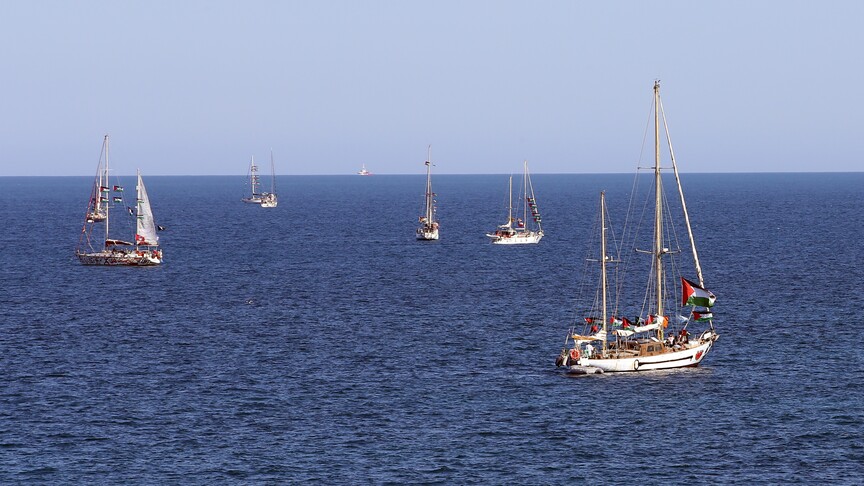
Israeli forces surrounded vessels traveling with the Global Sumud Flotilla off the coast of the Greek island of Crete late Wednesday, detaining more than 180 activists and seizing 21 boats, according to organizers.
The group says the mission is carrying humanitarian aid to Gaza and aims to challenge Israel’s longstanding naval blockade of the territory.
Legal expert Rothwell said the interception appeared to have taken place at a considerable distance from Gaza, unlike previous interdictions over the past year.
"This is a clear violation of international law. It is a clear violation of the freedom of navigation of the vessels that make up the flotilla, which were seeking to exercise the freedom of navigation," he said.
Responsibility of flag states
Expert Rothwell said the principal right to respond to Israel's actions lies with the “flag state” — the state of registration of the yacht or the vessel, whose right of freedom of navigation has been interfered with.
In addition, he said the state of nationality of those detained by Israel will also be concerned about the treatment of their nationals.
Rothwell noted that in previous flotilla interception incidents, detainees were taken to Israel, processed and deported, with some undergoing judicial proceedings while others resisted the process.
"There have been various allegations made about poor treatment, and so the state of nationality can protest to Israel against the treatment of their citizens if they have been mistreated as a result of misconduct."
According to the Global Sumud Flotilla, the sabotaged vessels fly flags of Poland, Italy, Spain, Slovenia and France.
Lawyer and activist Huwaida Arraf agreed and said that flag states have a separate obligation to defend their citizens and sovereignty.
"Israel's attack is an attack on those countries, because when a boat flying a flag is sailing in international waters, this is the territory of that country that Israel attacked."
Arraf, who was on board the Handala vessel as part of the Freedom Flotilla Coalition last summer, called on the flagged governments to impose sanctions on Israel and halt weapons transfers, urging them to move beyond what she described as symbolic responses.
"If they don't do that, they are responsible for the safety and well-being of their civilians, for the continued genocide of the Palestinians, and for the complete destruction of anything called an international legal order."
No threat to Israel
Rothwell said the distance from Gaza significantly weakens any argument Israel may make that the flotilla posed an immediate security threat to it.
"This is the furthest Israel has sought to interdict the flotilla," he said.
He said a security threat from the flotilla is "purely speculation" on Israel's part, as the interdiction has occurred so far from Gaza, adding that there are multiple scenarios in which the flotilla may have turned back or its voyage may have been interrupted, including bad weather.
"So there is no possible argument that Israel could make that these vessels in the middle of the Mediterranean, hundreds of kilometers from the Gazan coast, could pose any security threat to Israel."
Rothwell said that this reflects a general position of the Israeli government to neutralize potential threats, adding that persons on board these vessels have no real intention to actually enter Israel.
"They rather wish to enter the state of Palestine, particularly the territory of Gaza, which is part of the state of Palestine."
The expert said that the principle of freedom of navigation is reflected in the 1982 United Nations Convention on the Law of the Sea.
Rothwell said that while Israel is not a party to the convention, the principle of freedom of navigation is not only reflected in that treaty but also in customary international law.
"The effect of that is that countries that are not parties to the convention are still required to respect, uphold and acknowledge that principle of international law."