- Sudanese army is estimated to have more than 60% of territory under its control, while RSF is occupying 40%, says expert Jihad Mashamoun
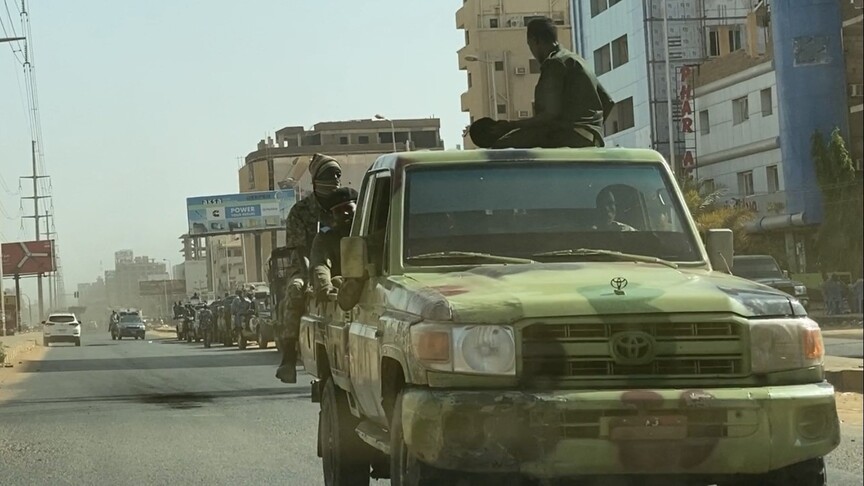
More than three years into Sudan’s devastating civil war, the balance of power on the battlefield has shifted, with the Sudanese Armed Forces (SAF) regaining key areas in central Sudan and advancing into strategic parts of North Kordofan.
Despite these gains, analysts warn that the war is far from over.
Experts say the conflict has effectively divided Sudan into competing zones of influence, with the army holding much of the country’s east and center, while the paramilitary Rapid Support Forces (RSF) maintains control over large parts of Darfur and continues to contest territory in some parts of Kordofan and other regions.
According to Anadolu data, the Sudanese army currently controls the eastern, northern, and central parts of the country, including North Kordofan, South Kordofan, Khartoum, Al-Jazira, White Nile, Kassala, El-Gedaref, River Nile, Blue Nile, Red Sea State, and Sennar.
Meanwhile, the RSF has El-Fasher, East Darfur, Central Darfur, South Darfur, West Darfur and West Kordofan under its control.
Jihad Mashamoun, an expert analyst on Sudanese affairs and researcher on Horn of Africa, said that a few months ago, SAF was estimated to have 60% of Sudan under its control, while the RSF was occupying 40%.
"With the recent advance of SAF, it is marginal increase, but carries significant military and political weight on the balance of power in Sudan."
Joseph Tucker, International Crisis Group's senior analyst for the Horn of Africa, said that the army’s recapture of Khartoum in mid-2025 signaled a turning point in the conflict and shifted the main frontline to the Kordofan region.
"This has effectively partitioned the country, giving the RSF control over most of Darfur, while the SAF holds eastern and central parts of the country."
According to the analyst, while the RSF was able to open a new offensive in the Blue Nile state near the Ethiopian border earlier this year, the recent loss of the key border town of Kurmuk constrains the RSF’s ability to advance northward.
"The SAF has thus been able to protect the central core of the country, but the RSF is still a significant presence in strategic locations that could limit the army’s ability to recapture much more territory in the short term."
He said that while the Sudanese army is likely to try and build on its recent successes in North Kordofan by undertaking further offensives, it remains to be seen just how far this will shift the overall trajectory of the war.
North Kordofan, a strategic breakthrough
In recent days, the Sudanese army said it recaptured Bara, Jabrat Al-Sheikh, and Umm Sayala in North Kordofan.
According to Tucker, the reported retaking of these towns and control of the 350-kilometer Al Sadarat highway is a "key advancement" for the Sudanese army, warning that reports also suggest that clashes may be continuing in some of these areas.
"If army control is consolidated over the highway, this would be the first time since the beginning of the war that the road has been wholly under their control," he said.
Tucker explained that the development would give the army a second, shorter route from Khartoum to the key North Kordofan capital of El Obeid, an important logistical center and garrison for the 5th Infantry Division.
Prior to this, the primary route for the army to access the city was the long road west from White Nile state. Consolidation of these gains should relieve some pressure on the city, which has been under partial siege by the RSF and subject to drone attacks that have damaged key infrastructure and harmed civilians, he added.
"The army should take advantage of this new opening to facilitate additional humanitarian access into El Obeid and other war-affected locales. The city hosts around 100,000 IDPs. Additionally, nearly 400,000 civilians there and across neighboring districts have reached emergency levels of food insecurity."
He warned, however, that the army and its allies will still face a regional threat from the RSF.
"Counterattacks may be possible and could be occurring, and contested areas could change hands. The RSF retains control over the western reaches of El Obeid and it is unclear just how far the army repulsed the RSF beyond the highway and recaptured towns."
According to Tucker, the army will need to quickly consolidate its gains to stave off ground attacks and protect against drones that could continue to threaten its operations and civilian populations.
Difficult road toward Darfur
Analysts said that while the RSF and its allies are also occupied with fighting in Darfur, Blue Nile, and other parts of Kordofan, it still largely stands in the way of a serious army push west into Darfur.
"The army would need to overtake key parts of western Kordofan still under RSF control," said Tucker.
"Solid supply chains would then need to be in place before the army could sustain operations into Darfur. It would also need to ensure that such a build-up did not leave other parts of the country vulnerable to RSF assaults," he said.
The army still faces challenges from the RSF and its Sudan People’s Liberation Movement-North (SPLM-N) allies in other parts of Kordofan south of El Obeid that could prevent its control of the entire territory, he added.
RSF command under pressure
Analysts also highlighted reports of RSF leader Mohamed Hamdan Dagalo, widely known as Hemedti, declaring that frontline commanders can now independently undertake offensives without prior approval from superiors.
Mashamoun explained that RSF does not have command and control over its forces, adding that in one instance Hemedti had mentioned that a lot of their fighters are mercenaries, and coming to loot.
He said the current state of the RSF shows it is weakening, adding that there are growing "cracks" and defections to the SAF.