- Palestinian architect and activist says campaign to conserve village of Lifta became part of his effort to protect Palestinian history in exile
- 'I will not return as long as there's an Israeli at the border telling me what to do,’ Raffoul tells Anadolu
On the morning of April 8, 1948, a seven-year-old Antoine Raffoul climbed onto the back of an open truck with nine members of his family and left behind the Palestinian port city of Haifa.
The family packed light, thinking it would just be a temporary escape from the violence spreading across Palestine in the final months before the establishment of Israel.
Recounting the events of that day in a video interview with Anadolu, he said he remembers sitting under a table that his grandfather had placed on the truck to shield the children from the sun.
He gripped the railing as the vehicle moved north toward Lebanon and worried about the bicycle that he left behind, but desperately wanted to take with him.
"We will come back," his father said. "Don't worry, we will come back and collect it."
The family locked their home, handed the key to neighbors and fled north toward Lebanon.
But they were never able to return.
Seventy-eight years later, Raffoul and hundreds of thousands of other Palestinians expelled from their homes in 1948 have still not been able to return.
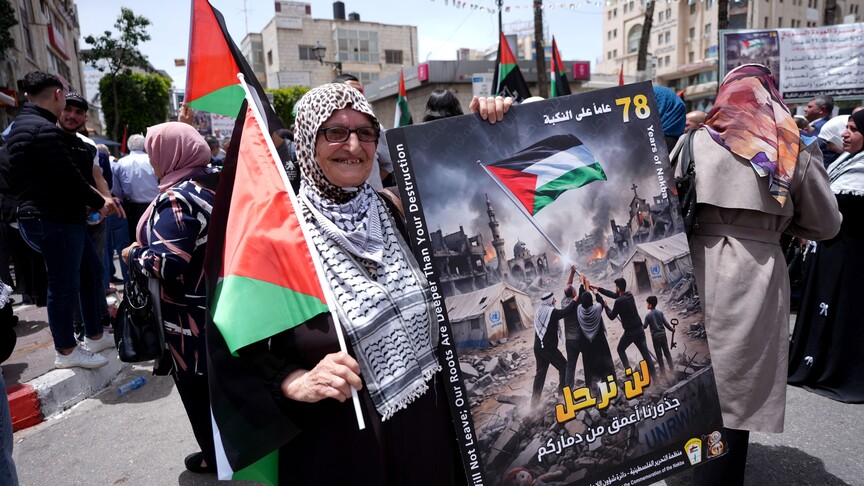
More than 800,000 Palestinians were forcibly displaced during the events surrounding the establishment of Israel in 1948 -- a catastrophe Palestinians commemorate annually on May 15 as the Nakba.
During that time, Israel closed borders and barred most refugees from re-entering, and passed laws such as the Absentees’ Property Law in 1950, which allowed the state to take control of land and homes belonging to Palestinians who had fled or were displaced during the war.
Many refugees had lost ownership of their homes or their entire villages had disappeared.
Childhood in Haifa
Raffoul, an 84-year-old architect and activist now living in the UK, was born in Nazareth in 1941 after his mother temporarily left Haifa during World War II bombings.
He belonged to a middle-class family, living with his parents, grandparents and six siblings in a house built by his grandfather in Haifa.
"Life was very peaceful at that time in the early forties," he recalled.
But as violence escalated in Palestine later in the 1940s, he remembers overhearing conversations among adults about Zionist militias, massacres in Palestinian towns and the bombardment of transport facilities in Haifa.
"My father and my grandfather decided to make a plan to leave temporarily to the safe zone of Lebanon in the north."
The day they left, Raffoul recalled seeing armed Haganah fighters waiting beneath trees with machine guns near the Lebanese border.
“I asked my father who they were,” Raffoul said. “He told me, ‘They are the enemy.’"
As the truck advanced, the Mediterranean stretched to one side while the hills of Palestine faded behind him.
The family eventually settled in Tripoli, Lebanon.
Raffoul later moved to the US, where he studied architecture at the University of Illinois on a foreign student fellowship before working in New York City.
He settled in the UK and established his own architectural practice for more than three decades.
Preserving Palestine in exile
Once settled in Lebanon, Raffoul’s father managed to go back to Haifa by sea to retrieve family archives and belongings before access became impossible.
Among the possessions preserved for decades were photographs, official papers and the key to their home.
After his father passed away, Raffoul inherited boxes filled with these memories of his family’s life in Palestine, he said emotionally.
As an adult, his political activism became closely tied to his work as an architect.
Following the expansion of Israeli settlements in the occupied West Bank after the Second Intifada, he began campaigning against architects and firms involved in settlement construction.
"I realized that the settlement building in East Jerusalem and in the West Bank is done by some of the foreign architects they brought in. They want to make money on our backs. And it's totally illegal."
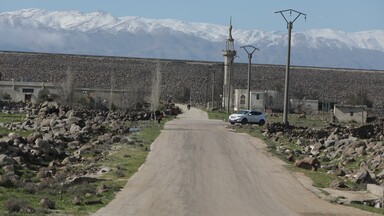
One of his most significant campaigns focused on Lifta, a depopulated Palestinian village on the outskirts of Jerusalem that has remained largely abandoned since 1948.
One day, while researching Palestinian architecture and geography, Raffoul came across Lifta -- the only historic Palestinian village that was neither repopulated nor destroyed after the Nakba.
Calling Lifta a beautiful village and a ‘jewel in the crown,’ Raffoul said the campaign to preserve its history took a decade.
"I began to campaign against a plan by the municipality of Jerusalem to demolish the village and to build luxury hotels, shopping centers for rich Jews, of course -- no Palestinian is going to be there."
Together with others, Raffoul’s campaign managed to put Lifta on the UNESCO tentative World Heritage Sites list and gain recognition from the World Monument Fund.
The hope of return
Now in his eighties, Raffoul said his focus has turned towards Gaza and the future of Palestinians displaced across generations.
He has developed architectural plans to help rebuild Gaza following Israel’s genocidal war on the enclave.
"You can talk about the Holocaust, but the Holocaust has finished. For 78 years we have been going through incremental genocide that went into full exposure in October 2023."
Calling it the “end of the road” for the Zionist entity, Raffoul said Palestinians have endured “enough of genocide, enough of the killing, enough of the expulsions.”
"I am waiting for all those two million plus refugees to come back to their homes, including those who were in Gaza -- 90,000 went into Gaza in 1949 from the surrounding areas,” he said.
Raffoul has not been back to Palestine and said he will not go under the Israeli occupation.
"I will not return as long as there's an Israeli at the border telling me what to do."
“I hope to go back to a free Palestine for everybody where I don’t have to be questioned at the border,” he said. “I don’t have to be asked ‘where were you from.’”