Laith Al-jnaidi, Lina Altawell
24 September 2026•Update: 24 September 2026
- Recovered artifacts include massive funerary relief from Palmyra, 14 rare mosaics looted from
- Roman villa in Syria Damascus credits Syrian-US cooperation, efforts by Manhattan District Attorney's Office for return of cultural heritage
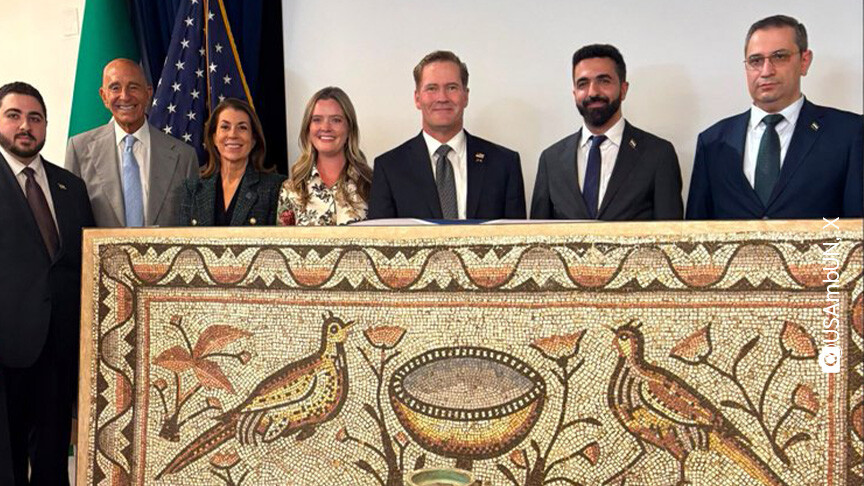
Syria recovered 36 looted antiquities from the US worth more than $5 million, including a massive funerary relief from the ancient city of Palmyra and 14 rare mosaics stolen from a Roman villa in the country.
The artifacts were returned during a ceremony in New York this week as part of efforts to combat the illicit trafficking of antiquities and recover looted cultural property, Syrian news agency SANA reported.
Manhattan District Attorney Alvin Bragg, US Deputy Secretary of State Christopher Landau, and US Special Envoy to Syria and Iraq Tom Barrack attended the ceremony, along with Syria's charge d'affaires in Washington Mohammad Nasser Qanatri, its UN Ambassador Ibrahim Olabi, and other officials and diplomats.
“Repatriation ceremonies are a powerful reminder that preserving cultural heritage transcends any border or nationality,” Bragg said in a statement published by his office.
He described the investigation that led to their recovery as “incredibly complicated, multi-faceted.”
The return of the artifacts would not have been possible without “close partnerships that spanned the globe," Bragg added.
Among the recovered pieces are a massive stone relief looted from the archaeological site of Palmyra and 14 rare mosaics stolen from a Roman villa in Syria, he said.
Bragg said his office's Antiquities Trafficking Unit seized 31 antiquities from the Middle East and North Africa as part of the investigations.
The Palmyra relief was smuggled from its original site during a period when the terrorist group ISIS (Daesh) was responsible for systematic looting of archaeological sites in Syria, he added.
Funerary relief from Palmyra
The Palmyrene funerary relief dates to the late second century and consists of a massive limestone sculpture depicting a reclining man surrounded by a woman and three children, according to the Manhattan District Attorney's Office.
The relief once decorated the wall of a burial chamber in ancient Palmyra and weighs more than 1,000 pounds (454 kilograms).
The artifact appears to have been carefully removed from the wall to avoid damaging the figures carved into it, according to the same source.
Mosaic dating to 3rd century BC
The recovered collection also includes the "Telete and Eros" mosaic, a large section of a mosaic floor dating to the third century BC.
The piece depicts the mythological wedding of Telete and Eros, made from hundreds of small colored stone cubes known as tesserae.
The Manhattan District Attorney's Office said it seized the piece in July 2021 along with 22 other mosaics stolen from Syria and Lebanon.
The recovered antiquities also include three female "Syro-Hittite" figurines dating to the second millennium BC and made in northwestern Syria.
The three figurines first appeared on the art market in the late 1980s and early 1990s in the possession of New York art dealer Edward Merrin, who was later convicted in federal court of crimes related to antiquities trafficking, before they were sold to the collection of antiquities collector Michael Steinhardt, according to the source.
Bragg said four of the artifacts returned to Syria were among 180 antiquities worth a total of $70 million seized by his office from the Steinhardt collection following a years-long criminal investigation spanning several countries.
‘Part of Syria’s history is finally returning home’
“Through Syrian-American cooperation, a part of Syria’s history is finally returning home thanks to the efforts of the Manhattan District Attorney’s Office,” Qanatri said.
“This achievement demonstrates how mutual respect and a shared commitment to protecting cultural heritage can build lasting bridges between our two countries,” he added.
Syrian archaeological sites suffered widespread looting, trafficking, and destruction during years of civil war, including Palmyra, which is listed as a UNESCO World Heritage site.
In 2015, the UN Security Council adopted Resolution 2199, imposing binding measures to combat the illicit trafficking of Syrian antiquities and cultural property amid concerns that proceeds from such trade could be used to finance armed groups.
The US imposed emergency restrictions in 2016 on imports of Syrian archaeological and ethnological materials illegally removed from the country on or after March 15, 2011, referring to the start of the long civil war.
Washington said at the time that the measures were intended to curb the looting and trafficking of Syrian cultural heritage.
The US restrictions cover objects made of stone, metal, ceramics, glass, ivory, bone, and textiles, as well as paintings, mosaics, and other Syrian cultural property.
Palmyra was particularly subjected to looting and destruction during ISIS’ control of the city in 2015, while UNESCO later documented the destruction of the temples of Bel and Baalshamin, the Arch of Triumph, and parts of the city's museum and its collections.