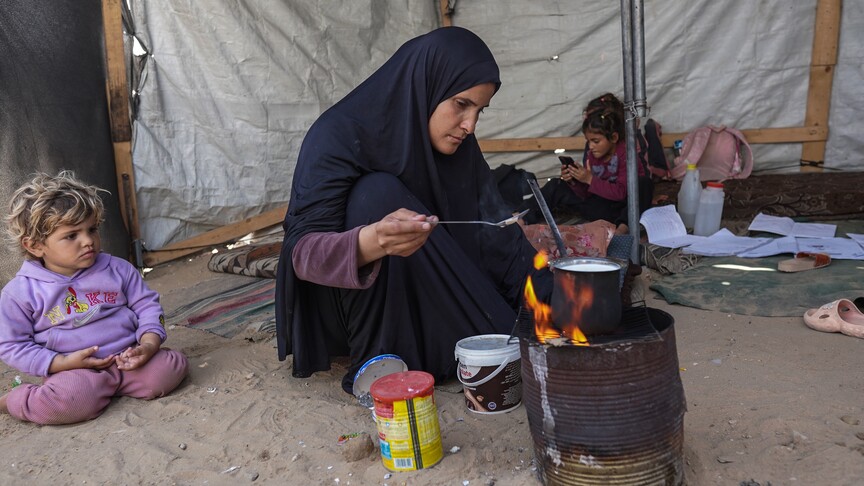
Inside displacement camps scattered across Gaza, thousands of Palestinian women are navigating a life reshaped by loss, hunger and responsibility after losing their husbands in Israel’s genocidal war.
Among them are Duaa Al-Saudi and Shorouq Abu Sukran, two women now carrying burdens that once belonged to entire families. One struggles to feed and raise four children alone after her husband was killed. The other lost both her husband and her legs in separate Israeli attacks and now depends on her elderly mother for nearly everything.
Their stories mirror the reality of thousands of widows in Gaza, where women who lost their husbands are now left to secure food, medicine, shelter and education for their children amid collapsing living conditions and shrinking humanitarian aid.
According to UN Women, more than 16,000 women in Gaza had lost their husbands by October 2025, while one in every seven households became headed by a woman during the war.
Repeated displacement, overcrowded shelters, disease outbreaks and severe shortages of water and medicine have only deepened the suffering of widows and their families, according to UN agencies and relief organizations.
-Raising four children alone
Al-Saudi now lives with her children inside a displacement camp after losing her husband, who had been the family’s only source of income.
“We receive nothing except aid. There is no stable financial support for orphans or widows,” she told Anadolu.
She said even basic food has become difficult to obtain, especially fruit and vegetables.
“If I can buy two apples, I divide them among my children,” she said.
Before her husband was killed, he provided for every aspect of the family’s life. Now, she says, even school notebooks have become a burden she cannot always afford.
“One of my sons needs surgery, treatment and special food, but I cannot provide any of it,” Al-Saudi said.
She described carrying the responsibility of four children entirely on her own while struggling to survive inside displacement camps.
Appealing to the international community, she urged the world not to forget Gaza’s widows and orphans.
“The responsibilities have become greater than we can bear,” she said.
Pain that does not fade
For Abu Sukran, the war left wounds far beyond displacement.
She was severely injured in an Israeli strike that targeted her home on Aug. 31, 2024, killing several people inside while she survived alongside her son.
“I lost my legs in the bombing,” she told Anadolu. “The pain grows worse every day to the point that I can no longer sleep, despite taking strong painkillers.”
She said her deteriorating condition could force doctors to amputate what remains of one of her legs.
Abu Sukran said she can no longer move independently or manage her daily needs.
“My mother takes care of everything for me,” she said.
Before her injury, she had already lost her husband in an Israeli attack while they were walking together on Al-Wahda Street in Gaza City.
“My husband was killed before my eyes,” she said. “Then my injury came and doubled my suffering.”
Earlier this month, Gaza’s Health Ministry said Israel was preventing 17,000 Palestinians approved for medical treatment abroad from traveling, warning that delays were increasing deaths among patients awaiting care.
‘We are not just images’
Abu Sukran said widows in Gaza continue to suffer without enough support or attention.
“We are not just images or video clips people watch and then move on from,” she said. “We have the right to live, to receive treatment and to have the basic necessities of life.”
She called for greater support for widows and their children, particularly young women who lost their husbands during the war.
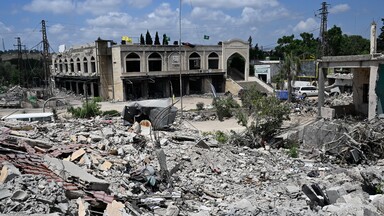
Gaza’s health care system has been devastated by Israel’s genocidal war, which destroyed hospitals and medical infrastructure while creating severe shortages of medicine, fuel and medical supplies.
According to Gaza’s Health Ministry, at least 1,029 Palestinians have been killed and 3,294 injured in near-daily Israeli attacks in violation of a ceasefire in place since Oct. 10, 2025.
The ceasefire followed more than two years of a genocidal war that killed over 73,000 Palestinians, wounded more than 173,000, and devastated about 90% of the enclave’s infrastructure.
*Writing by Tarek Chouiref