Shukri Hussein and Lina Altawell
17 September 2026•Update: 17 September 2026
Yemeni Presidential Leadership Council Chairman Rashad al-Alimi on Thursday called for shifting the government’s relationship with its international partners from crisis management to a “strategic partnership” covering security, deterrence, state capacity-building, port protection, counterterrorism and combating smuggling.
Al-Alimi made the remarks as he received French Ambassador to Yemen Catherine Corm-Kammoun on the occasion of the end of her tenure, according to Yemen’s official Saba news agency.
“The existence of a strong Yemeni state has become a necessity for regional and international security,” he said.
Al-Alimi called for moving relations between the government and its international partners from crisis management toward a “strategic partnership” in security and deterrence, building state capacities, protecting ports, combating terrorism and fighting smuggling.
State forces are capable of regaining the initiative on the western coast and completing the restoration of government control over all Yemeni territory, he added.
“Any temporary development on the ground will not change the Yemeni people’s goal of restoring their national institutions,” Al-Alimi said.
Government forces continue operations on several fronts while repositioning and strengthening their ability to regain the initiative, he added.
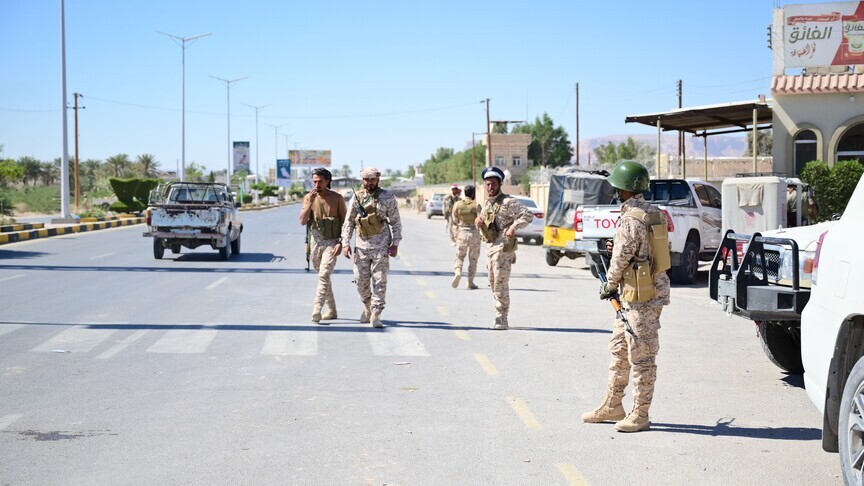
Al-Alimi stated that the government forces are confronting the Houthis in Taiz, Marib, Lahij, Al-Jawf, Hajjah, Al-Bayda and Al-Dhalea provinces.
He rejected turning “any temporary battlefield gain into a fait accompli or a platform for threatening waterways.”
The state had previously regained the temporary capital Aden and more than 70% of Yemeni territory, al-Alimi said.
He described the current developments as a “new phase” in efforts to restore state institutions and secure Yemen’s territory, coastline and territorial waters.
Al-Alimi also expressed appreciation for the French ambassador’s efforts to strengthen bilateral relations and for France’s position opposing the arming and financing of the Houthis and supporting the protection of freedom of international navigation.
His remarks come amid an exchange of military escalation between the Houthis and Saudi Arabia in recent days, alongside intensifying clashes between the Houthis and Yemeni government forces on several fronts.
Yemen’s territorial control has recently witnessed shifts, with the Houthis advancing along the western coast and taking control of strategic areas in Hudaydah and Taiz provinces, including the city of Mokha, as well as Red Sea islands including Mayyun Island in the Bab el-Mandeb Strait.
Government forces, meanwhile, have advanced in Al-Jawf province toward its capital Al-Hazm, while clashes continue on the Marib, Al-Dhalea and Al-Bayda fronts alongside airstrikes targeting Houthi positions and movements in several areas.
The developments are part of a military escalation that began in early July 2026, the most extensive after years of relative calm following the April 2022 truce, before fighting intensified further in September, particularly along the western coast and around the Bab el-Mandeb Strait.
Yemen has been gripped by war since the Houthis seized the capital Sanaa and several provinces in September 2014, prompting a Saudi-led Arab coalition to intervene in March 2015 in support of the internationally recognized Yemeni government.