Klaus Jurgens is the director of Economyfirst Limited London.
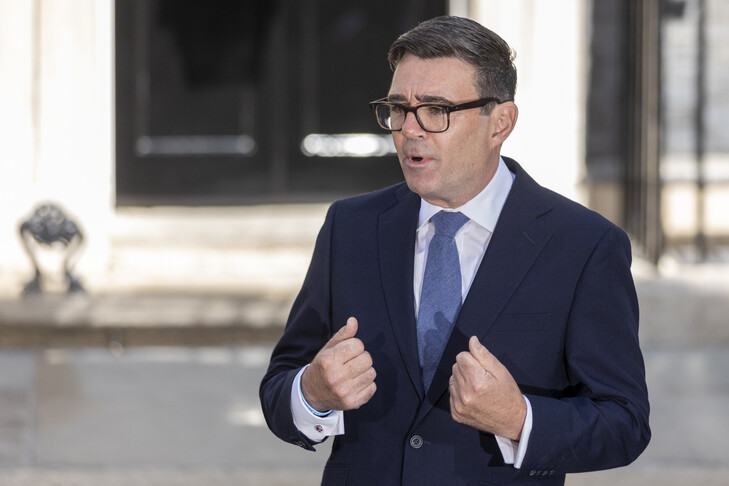
With new UK Prime Minister Andy Burnham announcing his new team as "the cost of living" Cabinet, which is a clear signal that tackling the severe economic pressures and soaring everyday expenses squeezing ordinary households will be his administration's top priority, Britain has a new prime minister whom some pundits refer to as the self-styled King of the North. This comes as no surprise, as he plans to set up a "Number 10 North," spending one day a week in Manchester to bridge the North-South divide. But is a successful former Greater Manchester mayor automatically a successful prime minister?
Where is Britain headed with Burnham as new prime minister?
Trapped between a rock and a hard place, can he and his greatly reshuffled Cabinet redefine Labour’s historic hallmark policies—best summed up as democratic socialism—or will he all too quickly give in to Reform UK and its far-right ideology to regain the lead in the polls? Granted, he positively transformed Greater Manchester, promoted workers’ rights, and stated that the North needs a stronger voice. Now his success depends on his charisma to keep his own Cabinet under control and whether the public buys into his proposed policies.
New Labour?
It has already been announced that from October onwards, for at least six months, VAT on private households' (and some smaller companies') electricity bills will be scrapped. While this results in a meagre annual saving of £45 ($60) per household, it is a start. Furthermore, Burnham declared a reduction in net migration as another goal, though how he plans to achieve it remains hazy.
Further change is indeed in the air, as the Department for Science, Innovation and Technology will be merged with the Department for Business. Does this imply that traditional government support for research, development, and academia is off the table, while a more business-friendly agenda is prioritized? Then there is the topic of social care: who should finance it, and should it be completely free, like many National Health Service (NHS) provisions?
On the one hand, he is at least delaying former Prime Minister Keir Starmer’s Digital ID plans, which will generate savings to the tune of £1.8 billion. On the other hand, in an even more ambitious move, Burnham wants to spend 3% of annual GDP on defense by 2030.
New Cabinet, old foes, or all new friends?
Perhaps the greatest surprise is the comeback of John Healey, who, as former defense secretary, was certainly a key figure in toppling Starmer, and has now been promoted to the post of chancellor of the Exchequer (treasurer). Appointing Wes Streeting as the new defense secretary is also a clever move, as he was seen as one of the major contenders in the race for premier.
Another eye-opener was the demotion of Yvette Cooper from her position as foreign secretary to the important, but certainly less glamorous, job of health and social care secretary. Burnham decided to hand over her former role to Ed Miliband.
One more return to front-line Cabinet work is Angela Rayner, who previously had to leave her post due to a private housing finance scandal. Meanwhile, two big names are out: Rachel Reeves and David Lammy.
Reform UK – a short-lived phenomenon?
Let us now take a look at Reform UK, which has surged through Labour’s heartlands in many instances. What policies do they promote? Tax cuts, scrapping Net Zero policies, freeing businesses from excessive red tape, keeping the NHS free at the point of use, abolishing the House of Lords, changing the voting system from “first past the post” to proportional representation, and leaving the European Court of Human Rights (ECHR). Fair and square, one might say, these are not all mainstream ideas, but they are nevertheless part of a democratic UK political debate.
However, similar to Germany’s Alternative for Germany (AfD) and Austria’s Freedom Party of Austria, their real intentions are often camouflaged, with the Muslim Council of Britain stating that Reform UK uses minority groups as political scapegoats.
Burnham will undoubtedly be reading the polls as well. A few days before Starmer resigned, a survation.com poll said that Reform UK and Labour would score 24% each, the Conservatives 21%, and both the Lib Dems and the Green Party 11%. Will Burnham adopt some of the aforementioned “mainstream” suggestions, or will he swing towards the far-right approach of Reform UK in preparation for the 2029 general elections?
Did Cameron fragment British society via Brexit?
Is the current instability in the political arena really just the result of then-Prime Minister David Cameron's June 2016 Brexit referendum? The answer is a clear and resounding no. Polarization among the British public was always there; consider the historical division between the upper and lower classes without any sizable middle class. Hence, we have always had fragmentation, Brexit only reinforced it. However, today, according to IPSOS UK, 52% of the public want to rejoin the EU, while only 23% want to stay out. Brexit did not work out for Britain at all.
Britain's political system transforming itself
Can we attest that the British political system as such is broken? Regarding this topic, we can observe that, not unlike other European political systems—albeit much delayed—Britain has become a multi-party country.
The British political system is, therefore, not broken, it has simply transformed from a bipolar system into a multipolar one. However, stability is still lacking, which explains the revolving door at Number 10. Progressing from a two-party to a multi-party system takes time. Once fully established, the revolving doors should not be used as frequently; power will only shift every five years when the pendulum swings through democratic elections, rather than through egocentric political party infighting.
*Opinions expressed in this article are the author's own and do not necessarily reflect the editorial policy of Anadolu.