ANKARA
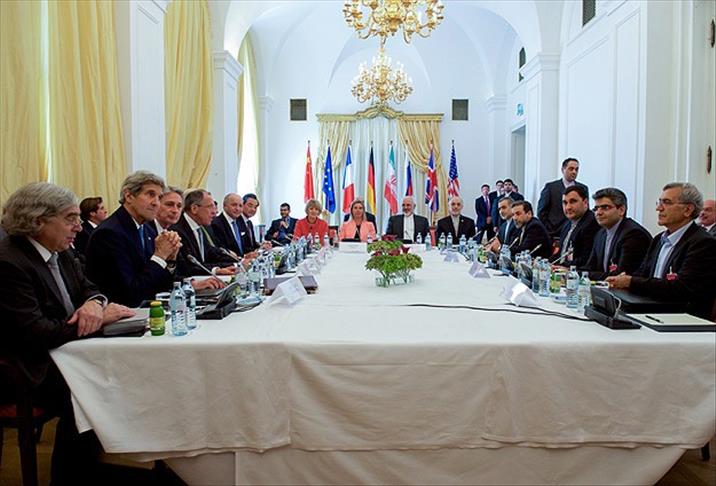
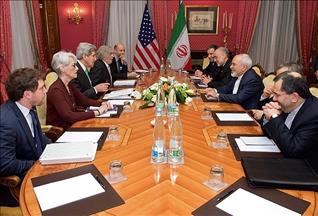
Iran and the world powers group, P5+1, have reached a milestone agreement over the nuclear issue in the Austrian capital of Vienna.
EU High Representative Federica Mogherini and Iranian Foreign Minister Javad Zarif both read out a joint statement at a press conference in Vienna Tuesday to announce that they agreed to the “Joint Comprehensive Plan of Action”.
“The Joint Comprehensive Plan of Action includes Iran’s own long-term plan with agreed limitations on Iran’s nuclear program, and will produce the comprehensive lifting of all UN Security Council sanctions as well as multilateral and national sanctions related to Iran’s nuclear program, including steps on access in areas of trade, technology, finance, and energy,” the statement said.
The plan of action leaked online to several news outlets and a Russian government website is 159 pages long "complex, detailed and technical" document, which reflects a step-by-step approach, and the reciprocal commitments to be endorsed by the UN Security Council.
Some of the key points in the Joint Comprehensive Plan of Action include:
1. Iran reaffirms that “under no circumstances will Iran ever seek, develop or acquire any nuclear weapons”.
2. If the plan of action is implemented successfully, it “will enable Iran to fully enjoy its right to nuclear energy for peaceful purposes under the relevant articles of the nuclear Non-Proliferation Treaty”.
3. This plan “will produce the comprehensive lifting of all UN Security Council sanctions as well as multilateral and national sanctions related to Iran’s nuclear program, including steps on access in areas of trade, technology, finance and energy”.
4. The International Atomic Energy Agency will be requested to monitor and verify the nuclear-related measures.
5. Iran's long term plan includes “certain agreed limitations on all uranium enrichment and uranium enrichment-related activities, including certain limitations on specific research and development (R&D) activities for the first eight years, to be followed by gradual evolution, at a reasonable pace, to the next stage of its enrichment activities for exclusively peaceful purposes”.
6. Iran will “begin phasing out its IR-1 centrifuges in 10 years. During this period, Iran will keep its enrichment capacity at Natanz at up to a total installed uranium enrichment capacity of 5060 IR-1 centrifuges”.
7. Iran will continue to conduct enrichment R&D in a manner that does not accumulate enriched uranium. “Iran's enrichment R&D with uranium for 10 years will only include IR-4, IR-5, IR-6 and IR-8 centrifuges, and Iran will not engage in other isotope separation technologies for enrichment of uranium. Iran will continue testing IR-6 and IR-8 centrifuges, and will commence testing of up to 30 IR-6 and IR-8 centrifuges after eight and a half years.”
8. Based on its long-term plan, “for 15 years, Iran will carry out its uranium enrichment-related activities, including safeguarded R&D exclusively in the Natanz Enrichment facility, keep its level of uranium enrichment at up to 3.67%, and, at Fordow, refrain from any uranium enrichment and uranium enrichment R&D and from keeping any nuclear material”.
9. Iran will convert its Fordow facility into a nuclear, physics and technology center.
10. During the 15 year period and as Iran gradually moves to meet international qualification standards for nuclear fuel produced in Iran, “it will keep its uranium stockpile under 300 kilograms of up to 3.67% enriched uranium hexafluoride (UF6) or the equivalent in other chemical forms”.
11. Iran will redesign and rebuild a modernized heavy water research reactor in Arak. However, there will be no additional heavy water reactors or accumulation of heavy water in Iran for 15 years.
12. A resolution will be implemented at the UN Security Council within 90 days that will terminate all provisions of previous UN resolutions on the Iranian nuclear issue, including 1696 (2006), 1737 (2006), 1747 (2007), 1803 (2008), 1835 (2008), 1929 (2010) and 2224 (2015).
13. The EU will also terminate all provisions of the EU regulation, implementing all nuclear-related economic and financial sanctions.
Earlier on Tuesday, Yukiya Amano, director-general of the International Atomic Energy Agency, and Ali Akbar Salehi, Iranian vice-president and president of the Atomic Energy Organization of Iran, signed the “Road-map for the Clarification of Past and Present Outstanding Issues regarding Iran's Nuclear Program."
The IAEA made a separate agreement with Iran over the country's Parchin military site. According to Iran’s news agency IRNA, Salehi said that the agreement was within the red lines specified by Iran.
Iran’s agreement is with the P5+1 countries which include U.K, China, France, Germany, Russia and the U.S.