By Ali Abo-Rezeg
ISTANBUL
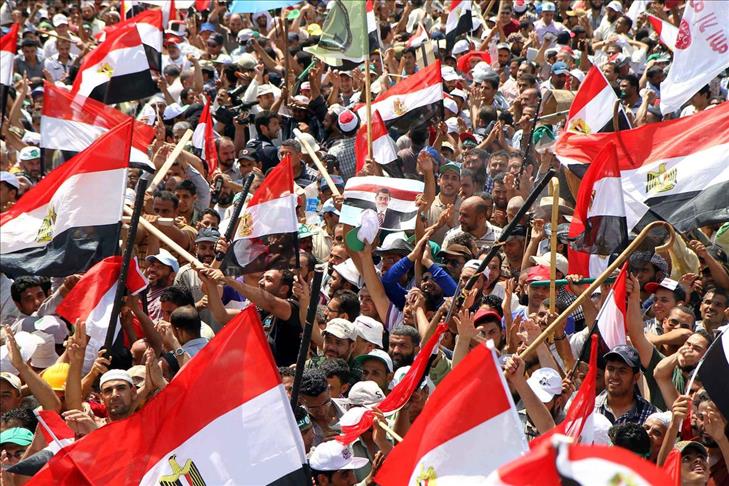
Ashraf Abdel Ghaffar, a senior Muslim Brotherhood leader, said that if time were to rewind, his group would still take the decision to stage a sit-in against the military coup that overthrew Egypt’s first democratically-elected civilian president, Mohamed Morsi.
"Sit-ins are one of the most prestigious forms of democratic protest across the world. The demonstrators wanted the democratically-elected president, Morsi, to continue his four-year term of office, a right guaranteed by the Egyptian constitution," Abdul Ghaffar said in an exclusive interview with Anadolu Agency.
"No one imagined that the peaceful sit-in would end the way it did. The sit-in was broadcast live, if there were non-peaceful preparations it would have been seen by everybody. Furthermore, European Union and African Union delegations visited the sit-in and found no weapons with the demonstrators as propagated by the state media," he said.
Abdul Ghaffar continued: "What happened on Aug. 14, 2013 was not an ordinary dispersal of a peaceful sit-in, but genocide by forces that did not consider national or religious brotherhood."
Responding to the allegation that Brotherhood leaders knew the specific time when regime forces planned to disperse the sit-in, Abdul Ghaffar said: "I was responsible for al-Nahda sit-in and I never knew about the time. If we knew, we would have at least taken the women and children out."
"What really happened on Aug. 14, 2013, after morning prayers, was that there were many demonstrators who noticed abnormal movements by armored vehicles and bulldozers close to the bridge next to the University of Cairo," he said.
Hundreds of pro-Morsi demonstrators were killed when security forces violently dispersed their protest camps in Cairo's Rabaa al-Adawiya Square and Giza's al-Nahda Square on Aug 14, 2013, only weeks after the military ousted Morsi from office.
According to the National Human Rights Council, the dispersal of both protest camps that day left 632 people, including eight policemen, dead.
In a report based on a year-long investigation, Human Rights Watch said last year that at least 817 demonstrators were killed in Rabaa and 87 in Nahda, in what HRW executive director Kenneth Roth called "one of the world’s largest killings of demonstrators in a single day in recent history."
"What took place was that the international community conspired with the coup leaders against democracy in Egypt in order to keep the Islamists out of power," Abdul Ghaffar said.
Abdul Ghaffar continued: "The West’s attitude toward the coup in Egypt lies in stark contrast from their attitude toward what happened in Ukraine, for example.”
"The Ukrainians staged a sit-in to topple the president while raising arms against the state. As soon as 46 protesters were killed, the world turned upside down and Europe and the U.S. intervened and supported the protesters. In Egypt, however, hundreds of protestors were killed and these same actors stood with the murderer and supported him," he said.
Abdul Ghaffar admitted that there were differences of opinion among Brotherhood leaders in Egypt and called on them to uphold the public interest before anything else.
Since May, considerable differences have appeared within the ranks of the Muslim Brotherhood leadership over how to confront the military regime in Egypt.
"Several leaders and I are seeking to bridge the gap between the different views," he said. "The Muslim Brotherhood is an idea before being a huge organization that exists in more than 80 countries. I call on the Muslim Brotherhood leaders to come back to their senses, realize the real danger, and responsibly reach a compromise that can satisfy all the different actors."