11 April 2016•Update: 19 April 2016
By Max Constant
BANGKOK
The leader of the political party most closely affiliated with Thailand's junta has slammed a draft charter written by a military-appointed committee of legal experts.
Democrat party leader Abhisit Vejjajiva says his party will reject an effort to grant military-appointed senators the right to have a role in the selection of the prime minister.
“The draft distorts democratic will and weakens people’s power compared with state authority,” Vejjajiva told The Nation on Monday.
“People’s rights have been progressive in previous charters, but those in the new draft go backward from the most recent 2007 constitution."
Despite emphasizing what he called the “many flaws” of the draft charter, Vejjajiva -- who led the country from 2008 to 2011 -- said his party has still not decided how it will vote at an Aug. 7 popular referendum to which the text will be subjected.
“It is still hard to say if we will vote for it or against it. Some people rejected it before it is complete [and] some people support it no matter what," he said.
"[Often] because they don’t like the people who reject it."
He added that the Democrat Party -- along with the Puea Thai party, one of the country's two major parties -- saw a "yes" vote to an accompanying question on whether 250 military-appointed senators be granted the power to choose a prime minister as having the potential to escalate political conflicts.
“This way of selecting the prime minister will be against the people’s will,” he said.
Vejjajiva’s position strongly echoes that of Yingluck Shinawatra, the leader of Puea Thai whose elected government was overthrown in the May 2014 coup that brought the current junta to power.
The Shinawatras -- Yingluck and her brother, fellow ex-premier Thaksin -- have long been in direct opposition to the Democrats.
“I urge people to consider whether this constitution is beneficial for the people as a whole,” Yingluck wrote on her twitter account April 1.
“I urge the people to consider whether our freedom and basic rights have been lessened compared to past constitutions."
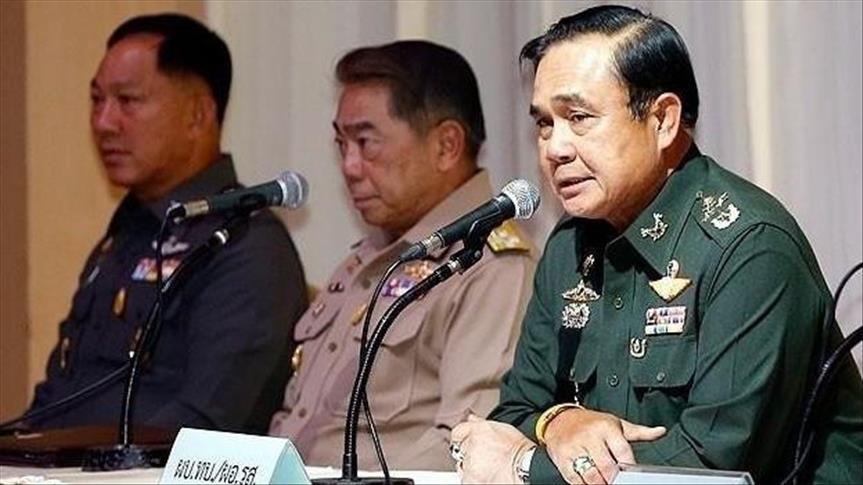
Junta chief-cum-prime minister Gen. Prayuth Chan-ocha has reacted angrily to criticism of the draft and of the additional questions.
“Politicians dare to criticize the National Council for Peace and Order [NCPO, the official name of the junta] and our reform efforts because if we succeed, people will never turn to them again,” he said Sunday.
“Politicians hardly solve any problems, but in fact they are part of the problem," he underlined.
The two most contentious issues in the draft charter are the appointment by the junta of the 250-member senate and that a non-elected outsider could be chosen as premier.
The additional question to be submitted at the referendum would allow the senate to vote jointly with the 5000-member lower house for the choice of a prime minister. It gives a de facto veto power to the senate.
In 1991, a military-sponsored constitution allowed a non-elected outsider to become prime minister.
Gen. Suchinda Kraprayoon, who seized power that year, became premier April 1992 through a joint vote by the two Houses.
It provoked massive demonstrations, which ended in bloodshed in May 1992. The crisis ended when King Bhumibol Adulyadej intervened to ask Kraprayoon to quit.
On Monday, Boonlert Visetpricha -- a sociologist at Bangkok's prestigious Thammasat university-- related the present situation to the past in an opinion piece in the Bangkok Post.
“If we learn from the Suchinda case, we will find it necessary to reject the draft charter, which in many ways fails to uphold democratic principle,” he wrote.